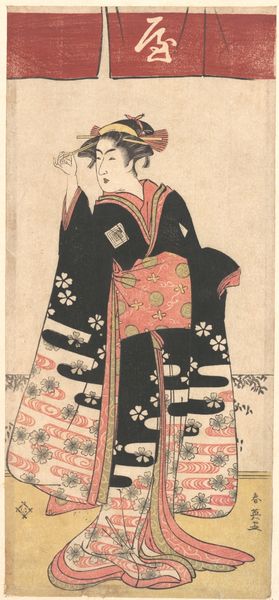
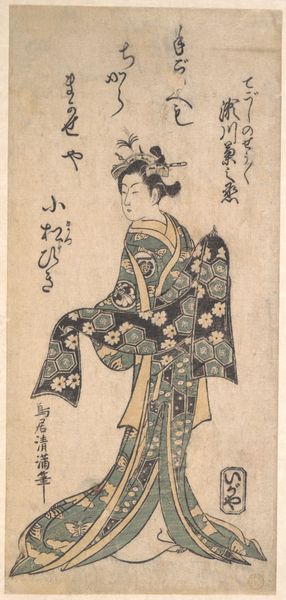
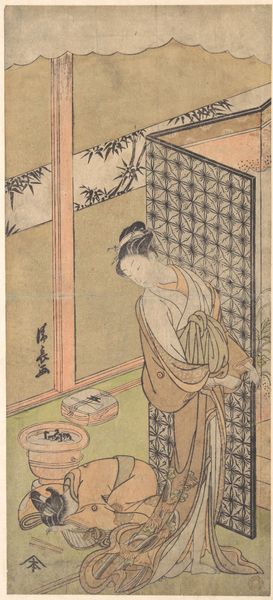
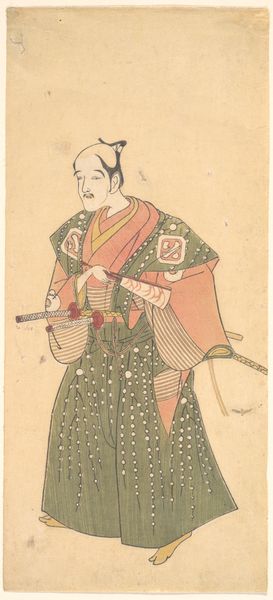
The Actor Osagawa Tsuneyo II, Possibly as Misao Gozen, in the Play Chiyo no Hajime Ondo no Seto (Beginnings of Eternity: The Ondo Straits in the Seto Inland Sea) (?), Performed at the Kiri Theater from the Twenty-seventh Day of the Seventh Month, 1785 c. 1785
0:00
0:00


#
portrait
# print
#
caricature
#
asian-art
#
caricature
#
ukiyo-e
Dimensions: 32 × 14.2 cm (12 1/2 × 5 5/8 in.)
Copyright: Public Domain
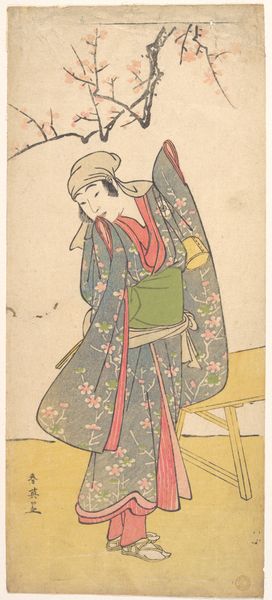
Editor: Here we have Katsukawa Shunko's woodblock print from 1785, titled "The Actor Osagawa Tsuneyo II, Possibly as Misao Gozen." The muted colors give it a calm, almost melancholic feel, even though it's portraying an actor in a theatrical role. What social commentary, if any, can we gather from such an artwork? Curator: That melancholic feel is precisely where the work finds its strength, placing the *on'nagata*, male actors who perform female roles, in conversation with broader themes of identity. Here we see not just a portrait but a complex negotiation of gender and performance. These prints gained popularity during a time when the Tokugawa shogunate was enforcing strict sumptuary laws aimed at regulating social behavior and appearance. Editor: So the prints become a form of…resistance? Curator: Exactly! By depicting actors, who were already liminal figures within society, artists like Shunko offered a subversive commentary on those very restrictions. Consider the role of Misao Gozen. Often portrayed as virtuous and self-sacrificing. To see a male actor in that role, captured in a print, is to question the rigidity of societal expectations about gender. This is also happening during a rise in mercantile economy and, subsequently, an elevation of Kabuki alongside. Does the placement within a theater impact how you read the figure? Editor: I see! It makes the print not just an image but a form of social commentary on performance. What a powerful message! Curator: Precisely, thinking about performative representation, and how it questions fixed societal positions lets us rethink what "the traditional" truly means!
Comments
No comments
Be the first to comment and join the conversation on the ultimate creative platform.
 Collect
 React
React Comment
More like this