Copyright: NAMIDA AG, Glarus (displayed with the permission of Hundertwasser Non-Profit Foundation) The displayed work of art is protected under the copyright law. In particular, it is not permitted to reproduce, to alter, to print or to publish these works of art. Violations will be prosecuted according to civil and criminal law.
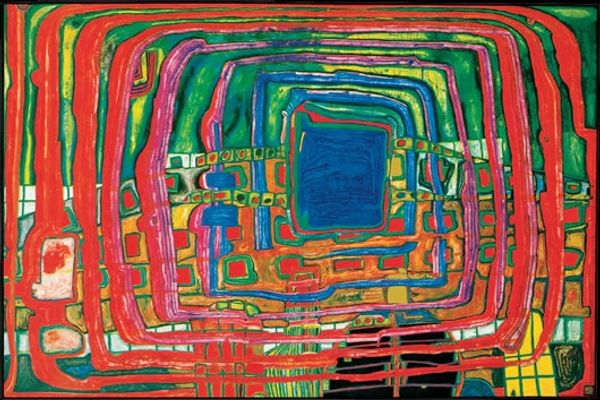
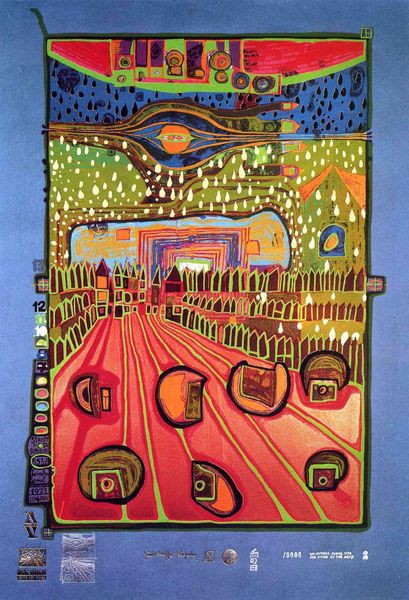
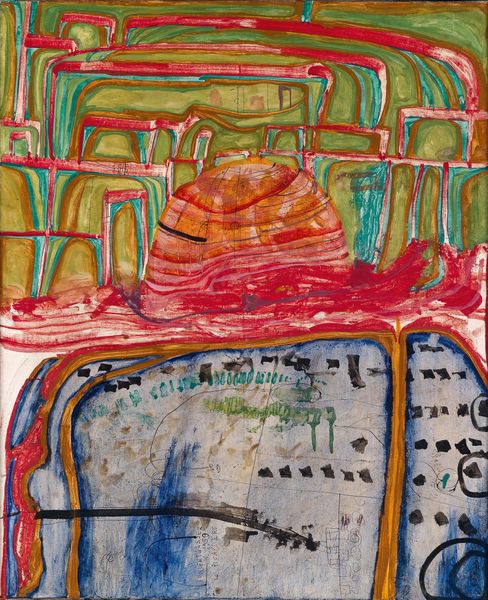
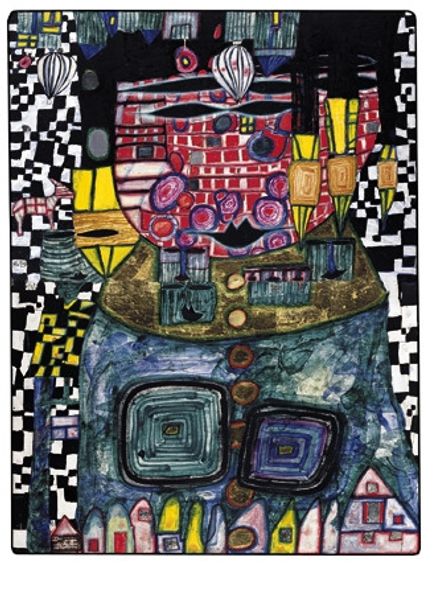
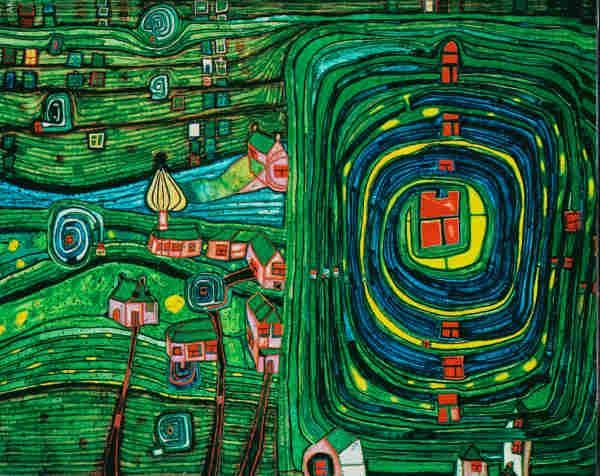
Curator: We're standing before Friedensreich Hundertwasser’s "460 Hommage au Tachisme," a mixed-media painting from 1961. Editor: My initial impression is chaos. Yet a compelling, structured chaos. There’s a strong vertical pull, disrupted by those vibrant, concentric layers of red and green. Curator: Hundertwasser was deeply engaged with abstract expressionism, as indicated by the painting's title, and this piece reflects that. Note the organic forms, the rejection of clean lines in favor of an almost frenetic application of paint. Editor: Absolutely. The spiral motif appears repeatedly, doesn’t it? I read spirals as universal symbols of life, growth, and cosmic energy. There's almost a sense of ritualistic, maybe even shamanistic, symbolism here. Curator: That’s a fascinating point. The painting certainly deviates from pure formalism, in that it evokes meaning beyond pure surface and texture. There’s that very geometric, golden block at the bottom, offering some kind of…foundation. The structural incongruity there is arresting. Editor: That gilded block, it strikes me as representing a city, perhaps. Its rigid form contrasts sharply with the natural chaos above, suggesting the uneasy relationship between humanity and the environment. Look at the way the reds and greens dominate. Nature reclaiming space. Curator: Indeed, Hundertwasser's later architectural work advocated for designs more aligned with the natural world. The repetition of color creates visual harmony despite the textural differences. There is an interplay of flatness and implied depth using line, form, and layering that reveals incredible complexity in what, at first glance, seems quite unstructured. Editor: I appreciate your point about the structural unity achieved despite the chaotic appearance. Perhaps what struck me as chaos is, in fact, a representation of the beautiful, imperfect patterns of nature, echoed in these striking colors and lines. Curator: The title positions it within the "Tachisme" movement— a European form of abstract expressionism, distinct from its American counterpart. Perhaps we could simply appreciate it, then, for the beautiful dialogue that it represents, however unresolved, between structure and expression. Editor: Yes. An unresolved dialogue perhaps, but definitely a vital and deeply engaging visual statement.
Comments
No comments
Be the first to comment and join the conversation on the ultimate creative platform.
 Collect
 React
React Comment
More like this