drawing, painting, watercolor
drawing
water colours
painting
landscape
watercolor
academic-art
watercolor
Dimensions: overall: 35.5 x 24.5 cm (14 x 9 5/8 in.) Original IAD Object: 1"-1'
Copyright: National Gallery of Art: CC0 1.0
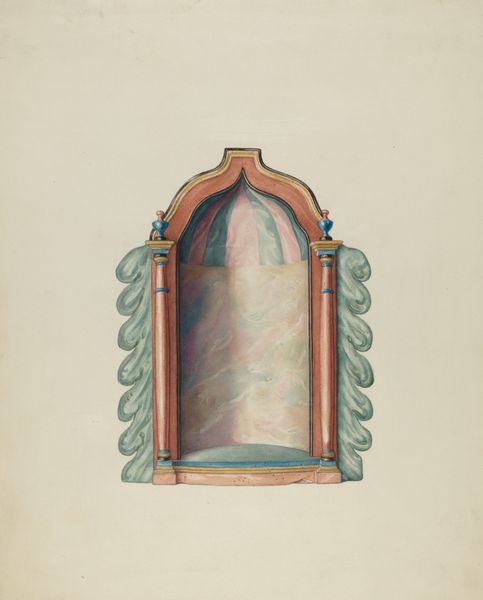
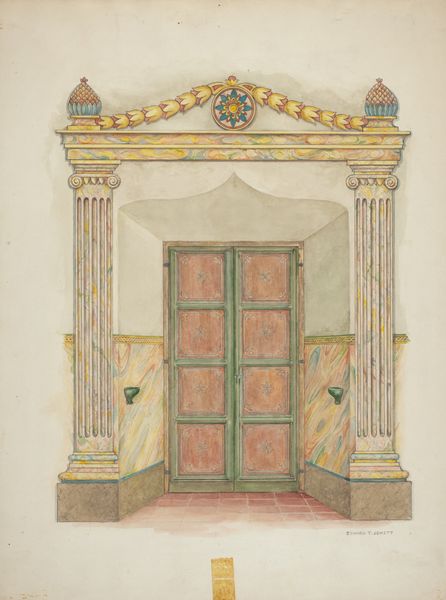
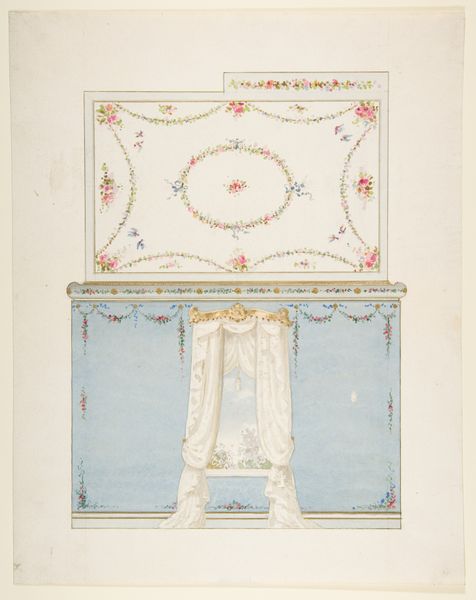
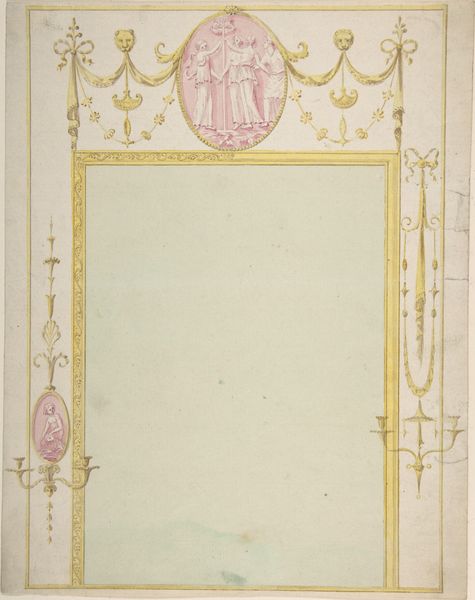
Curator: This is "Wall Painting," a watercolor and drawing piece by Edward Jewett, dating back to around 1940. It presents an arched opening. Editor: There’s a certain serenity to this image. The muted colors create an atmosphere of calm, like peering into a tranquil space, or an unadorned alcove in an antique interior. Curator: Exactly. And it’s also hinting at a decorative style with deep roots. See the floral swag arching above the opening? It brings to mind classical friezes—a visual vocabulary of idealized beauty. And of course, that tiny, centralized cherub symbol represents purity and, quite literally, angelic presence. Editor: Yes, that central cherub certainly establishes the axial symmetry, doesn’t it? From a formal perspective, the use of watercolor provides a translucence, creating a layered effect which softens the geometry. Note the framing which uses shades of grey to set back the primary architectural feature in white. Curator: That layering is key, both formally and symbolically. Think about what a wall signifies—a boundary, a division, but also support and structure. The act of painting *on* it infuses meaning, transforming the mundane into the sacred or memorable. Editor: Absolutely. The eye is directed into the interior of the simulated wall, in which the opening awaits for something to fill its emptiness. You can notice that the inner space seems boundless given how the gradient and shadow play of the wall directs your eyes without obstruction, beyond. Curator: What does this symbolic interplay mean in the context of the 1940s? There are hints that perhaps a spiritual space is necessary in times of adversity or that there is an interior need for architectural design that draws on the spiritual meaning-making of the classical world? Editor: That interplay suggests it's a study in classical formal techniques, rendered softly, like memory or even longing. There’s a sense of incompleteness but the very restraint becomes its defining element. Curator: Perhaps by pairing back, this rendering suggests a universal yearning for harmony that has been transmitted down the generations. Editor: Agreed, Edward Jewett really captured an enduring architectural design with simple colors and balanced, effective compositional design.
Comments
No comments
Be the first to comment and join the conversation on the ultimate creative platform.
 Collect
 React
React Comment
More like this