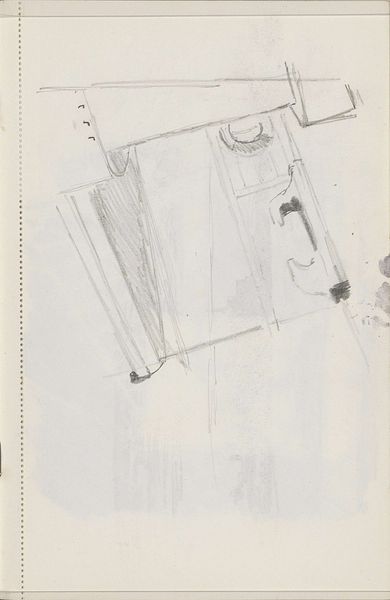
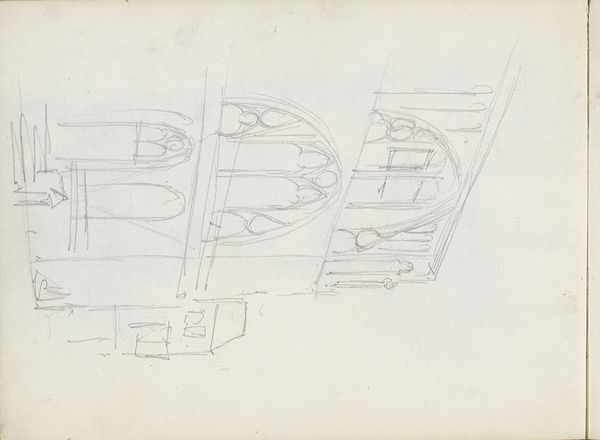
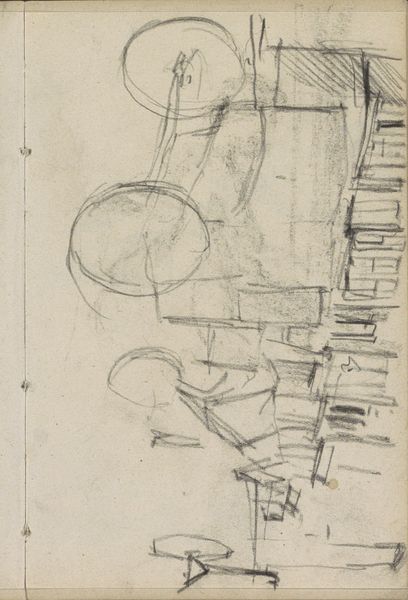
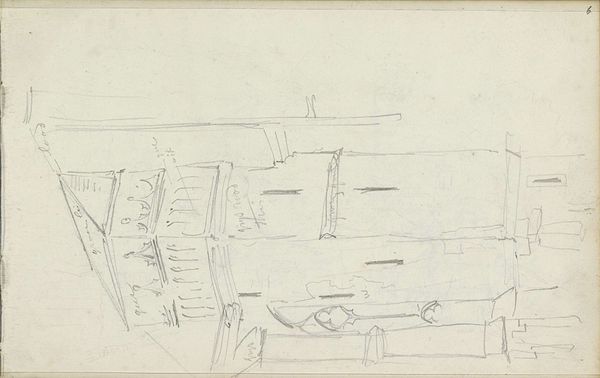
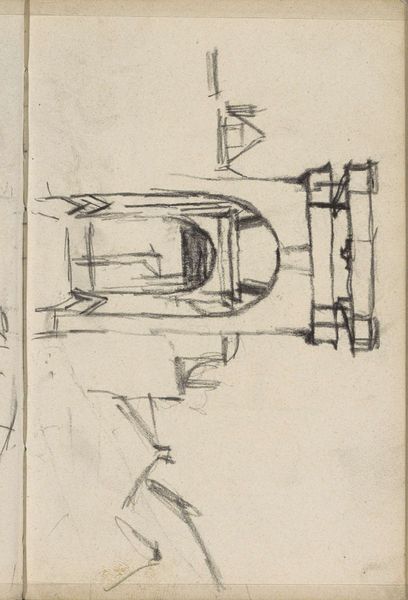
Vooraanzicht van het midden- en zijschip van een kerk c. 1900
0:00
0:00

careladolphlioncachet
Rijksmuseum
drawing, pencil, architecture
#
drawing
#
amateur sketch
#
thin stroke sketch
#
quirky sketch
#
hand drawn type
#
landscape
#
form
#
personal sketchbook
#
idea generation sketch
#
sketchwork
#
geometric
#
pencil
#
line
#
sketchbook drawing
#
sketchbook art
#
architecture
#
initial sketch
Copyright: Rijks Museum: Open Domain
Curator: We're looking at a work by Carel Adolph Lion Cachet, entitled "Vooraanzicht van het midden- en zijschip van een kerk," or "Front View of the Central and Side Aisles of a Church" from around 1900. It's a pencil drawing currently held in the Rijksmuseum. Editor: It's a really sparse, almost hesitant sketch. The lines are faint, as if the artist was testing out ideas, not making a finished statement. The architectural structure seems almost ethereal, barely there. Curator: That speaks to its likely function. This seems less like a formal presentation and more like a preparatory sketch, perhaps from a sketchbook. We can see the architecture serving a broader societal purpose through this sketch, revealing how quickly such imagery moves from personal use to public meaning. Editor: Right, it gives a window into the artist’s creative process. It would be interesting to understand how Cachet’s own religious or spiritual beliefs may have been implicated. Curator: Absolutely. Remember, this was a period of intense social change, with increasing secularization. Cachet, working in the decorative arts and graphic design, certainly was affected by socio-political shifts. Editor: How do you think his approach reflects the cultural discourse of his time? Are there political layers in what appears to be a simple architectural rendering? Is it a commentary on institutionalized religion? Curator: It's difficult to say definitively without more context. Cachet worked within established artistic and commercial frameworks, designing for prominent companies and exhibitions. We need to consider his audience, for example. Editor: True, but perhaps there is the inherent commentary through form and negative space? Curator: Perhaps. This type of art piece opens up so many discussions, though. Editor: Definitely. These quick lines suggest a tension between observation and the interpretation within Cachet’s inner world. It brings us to see his potential doubt towards tradition that is communicated in his use of minimalistic lines.
Comments
No comments
Be the first to comment and join the conversation on the ultimate creative platform.
 Collect
 React
React Comment
More like this