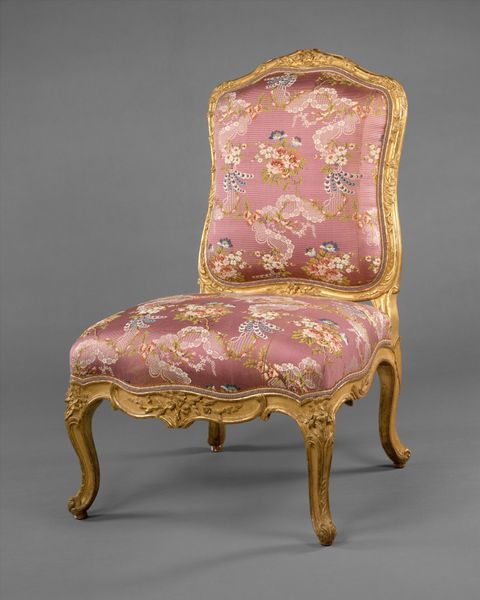
Dimensions: 34 x 18-1/2 x 18 in. (86.4 x 47.0 x 45.7 cm)
Copyright: Public Domain
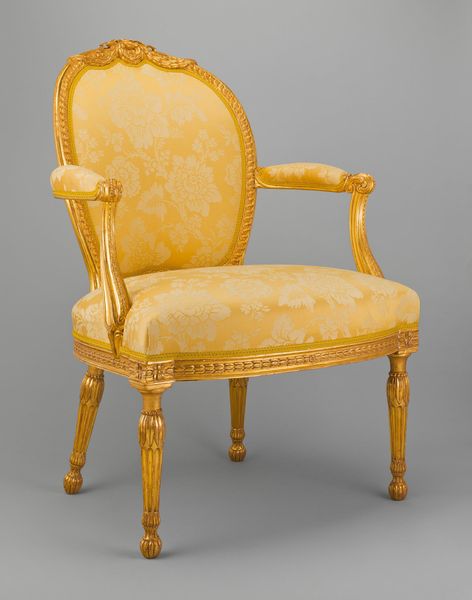
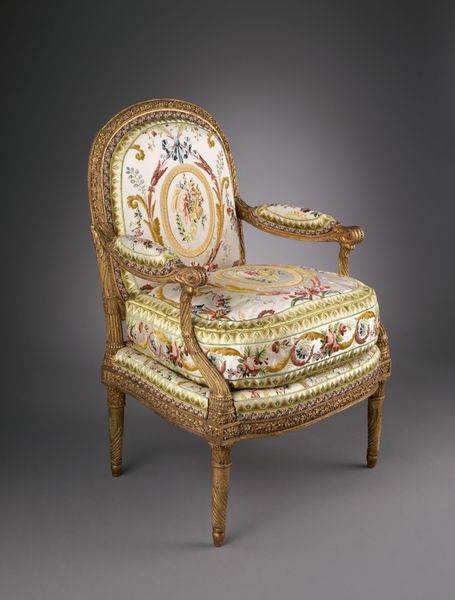
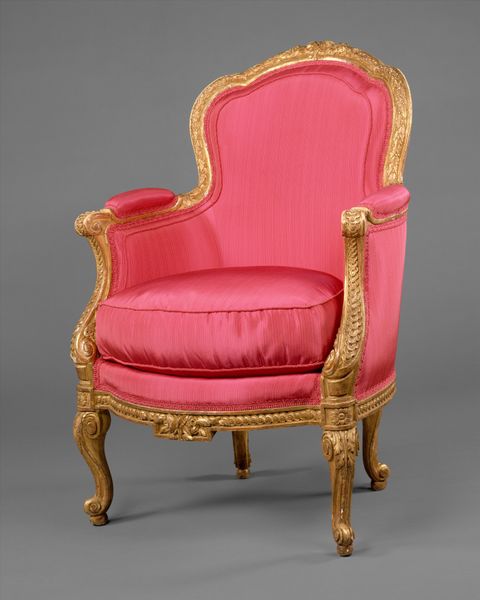
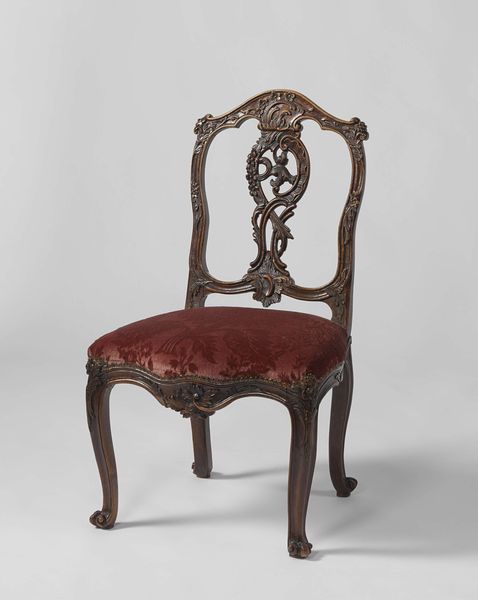
Editor: So, here we have a side chair, or *chaise à la reine*, crafted in 1784 by Georges Jacob. It's a wooden sculpture, really, and part of the decorative arts. I am immediately struck by how the delicate pink fabric contrasts with the gilded, almost aggressively textured wood. It’s beautiful, but I wonder how to interpret its mix of restraint and excess. What do you make of it? Curator: This chair speaks volumes about its time. Think of the Rococo period; its essence is all about visual symbols. The chair isn’t merely furniture; it's a coded message. The gilded wood symbolizes wealth, power, divine right even, recalling classical motifs intended to communicate permanence. Consider the owner of the chair – perhaps Marie Antoinette herself. How might this inform its cultural memory? Editor: So, the materials speak to the power structures of the time? Is the pink also symbolic? Curator: Precisely. The pink softens the impact of the gold. Think of the colour pink: often associated with youth, beauty, femininity and love – which would be particularly resonant within a courtly setting, communicating not just about wealth, but refined taste and gentle power. Why do you think these choices were intentional, given the political context of the time? Editor: I suppose it shows the distance between the monarchy and the people, and perhaps even an obliviousness to the rumblings of revolution, with its inherent tension between excess and frivolity. Curator: An excellent insight. We are constantly reminded that even seemingly benign imagery reinforces ideologies and power structures. Do you see now how charged objects become with meaning and purpose? Editor: Yes, absolutely! This really makes me think about how the meanings of objects evolve across time. Thanks for shedding light on its complexities.
Comments
No comments
Be the first to comment and join the conversation on the ultimate creative platform.
 Collect
 React
React Comment
More like this