fluxus
Copyright: Nam June Paik,Fair Use
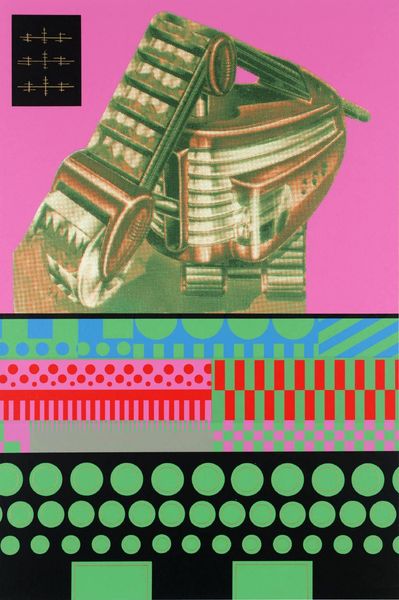
Editor: This is Nam June Paik’s "Evolution, Revolution, Resolution" from 1989. It's a mixed-media collage combining prints, electronics, and what looks like an installation piece on a vibrant green background. There’s a playful, almost whimsical quality to it, with the TV sets arranged to resemble a figure. What do you see in this piece, particularly regarding its commentary on technology and culture? Curator: Paik’s work, particularly this piece, is a fascinating intersection of technology, identity, and global politics. The use of obsolete TV sets forming a humanoid figure brings forth questions about how technology shapes and mediates our human experience, our very evolution. How does the incorporation of Eastern calligraphy in contrast with the electronic circuitry complicate your reading of the piece? Editor: The calligraphy feels like a grounding element, perhaps representing a cultural anchor amidst rapid technological advancement. But does that also exoticize Eastern culture in relation to Western tech? Curator: Precisely. Paik, as a Korean artist working in the West, occupied a unique position. He critiques both the utopian promises of technology and the potential for cultural homogenization. Consider the title— "Evolution, Revolution, Resolution"— is Paik suggesting a cyclical pattern of technological and societal change? How do you think this cycle impacts different cultures differently? Editor: It makes me wonder if “resolution” is ever truly achieved, or if it's just a temporary state before the next wave of change. Curator: Indeed. Paik’s genius lies in posing these complex questions rather than offering simple answers. The layers of media encourage us to actively consider our relationship with technology and its influence on cultural identity. Editor: I never considered how technology is culturally situated. This has broadened my understanding significantly. Curator: And I'm left considering if Paik was prescient. His work suggests an inherent tension within postmodern society struggling to reconcile tech progress, its meaning, and its potential to displace people's relationship to identity and culture.
Comments
No comments
Be the first to comment and join the conversation on the ultimate creative platform.
 React
React Comment