print, paper, engraving
#
neoclacissism
# print
#
paper
#
text
#
engraving
Dimensions: height 510 mm, width 330 mm
Copyright: Rijks Museum: Open Domain
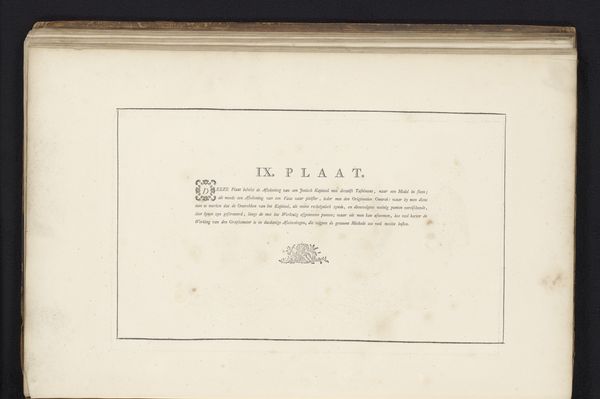
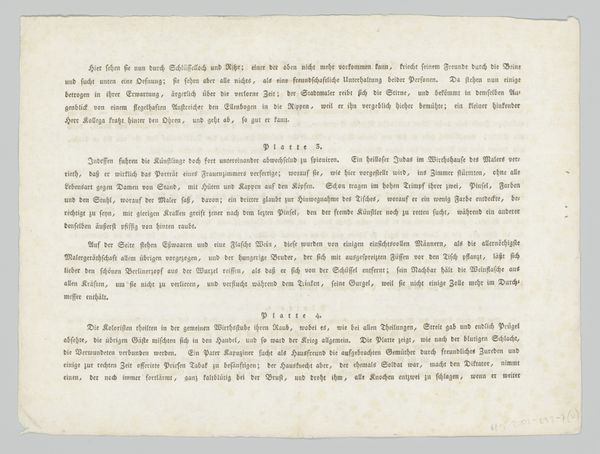
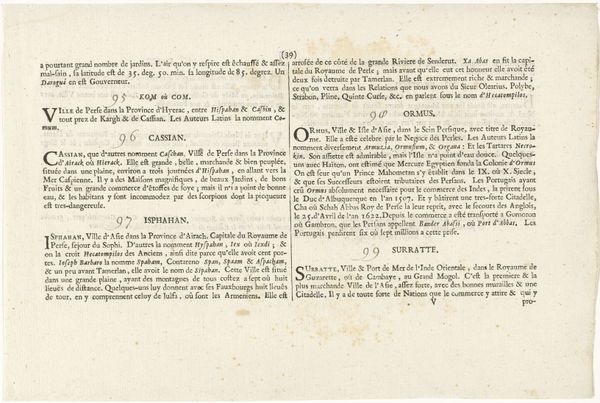
Curator: Let’s turn our attention to "Toelichting bij een anatomisch beeld en een Griekse Venus," which roughly translates to "Explanation of an anatomical image and a Greek Venus". Antoine George Eckhardt created this engraving on paper sometime between 1777 and 1778. Editor: My initial response is dominated by the stark formality of the composition. It looks like a page torn from an old book, with a densely packed text block taking center stage. There is an air of detachment and academia to it, like I’m stumbling across scientific lecture notes or something. Curator: Well, in its time, it spoke volumes about societal frameworks! You see, this print reflects the rise of Neoclassicism, a movement consciously revisiting and idealizing aesthetics from ancient Greece and Rome. Simultaneously, the inclusion of anatomical imagery speaks to burgeoning scientific rationalism of the era. Eckhardt uses these contrasting symbols to reveal intellectual shifts within Western thought and politics. Editor: Right, the juxtaposition is crucial here, placing idealized beauty alongside clinical analysis. Was the "Greek Venus" itself a point of political and cultural contestation at that time? Whose ideals of beauty were being centered, and at what cost to other conceptions of the body? Curator: Exactly! Art historical narratives and archeology, alongside anatomy, were instruments through which power dynamics were established. We must consider the audiences for whom such prints were intended: those privileged enough to afford education or claim knowledge concerning anatomy, and what message this imagery conveys regarding gendered or racialised bodies. The cool, academic presentation perhaps shields unsettling sociopolitical undercurrents. Editor: The rigid presentation style certainly downplays the complexities at play, and it makes you wonder about how Enlightenment ideas, apparently progressive, were really upholding established social hierarchies. It really underlines how crucial historical analysis is, for contextualizing our aesthetic perceptions. Curator: Yes, and questioning those. To look past aesthetics, towards how artwork echoes not only sociopolitical tensions but their repercussions that ripple through society still. Editor: So true. Hopefully we provided some means for thinking past the surface and grappling honestly.
Comments
No comments
Be the first to comment and join the conversation on the ultimate creative platform.
 Collect
 React
React Comment
More like this