1891
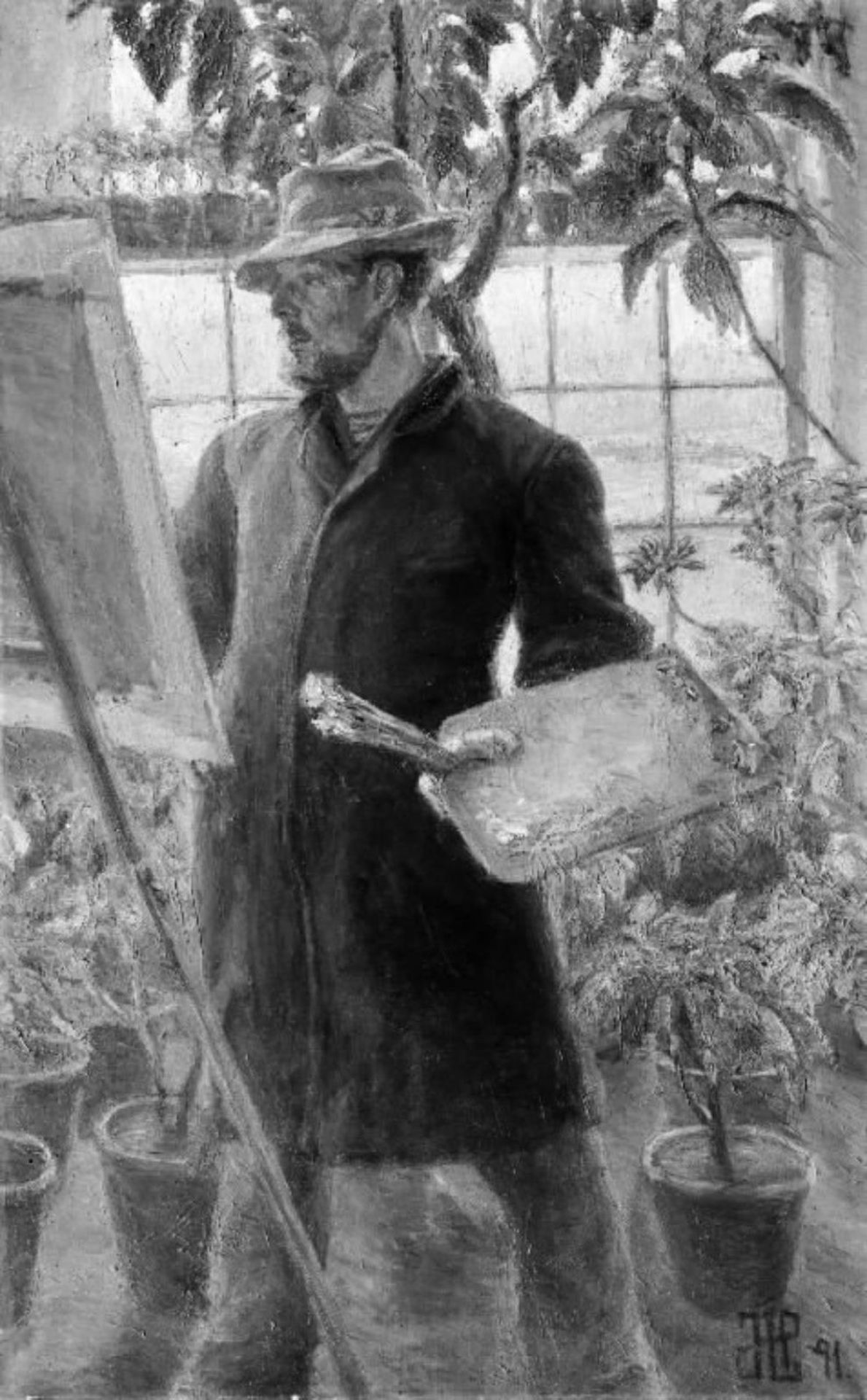
Maleren Harald Holm


Listen to curator's interpretation
Curatorial notes
Editor: We're looking at "Maleren Harald Holm," a painting from 1891 by Henry Lørup. It's monochrome, stark. The artist depicted stands amidst potted plants, palette in hand. What stands out for you? Curator: It’s tempting to view this portrait through the lens of artistic labor. We see the artist, brush in hand, ready to create. But how can we unpack this representation within the broader context of late 19th-century Danish art? Think about the prevailing social hierarchies of the time – the bourgeois versus the bohemian artist. How does Lørup, in his choice of monochrome and realist style, comment on this dynamic? Is this perhaps a deliberate rejection of the flamboyant romanticism often associated with artists of the era, aligning instead with a more grounded, perhaps even proletarian, sensibility? Editor: That’s a fascinating angle. The monochrome does lend itself to a sense of severity. Could it be seen as a commentary on the commodification of art and the artist's role within that system? Curator: Exactly! Consider how artists, even then, struggled to define their identities and resist being pigeonholed by societal expectations and the art market itself. By stripping away color and focusing on form and composition, is Lørup drawing attention to the fundamental labor and skill involved in creating art? Moreover, could the surrounding potted plants represent a deliberate construction of the artist's environment, carefully curated for a particular effect, reinforcing or perhaps subtly critiquing the artificiality inherent in artistic identity? Editor: It sounds like Lørup's choices point towards a kind of rebellion. Curator: Perhaps not a full-blown revolution, but a quiet act of resistance. This piece encourages us to see the act of portraiture not as a passive representation but as a site of complex negotiation. By understanding the socio-political landscape of the late 19th century, we gain a deeper appreciation for the ways in which artists like Lørup subtly challenged dominant ideologies through their work. What did you glean from our discussion? Editor: That historical context is critical to interpreting this artwork; thanks to that I now see the image as a complex social commentary.