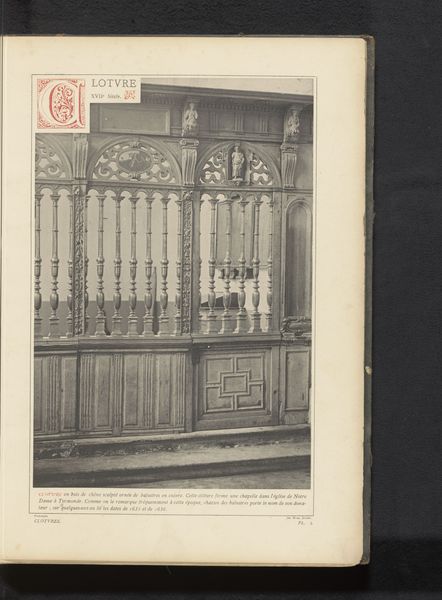
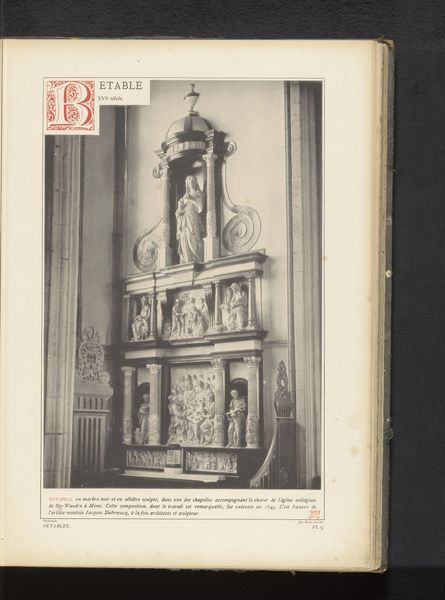
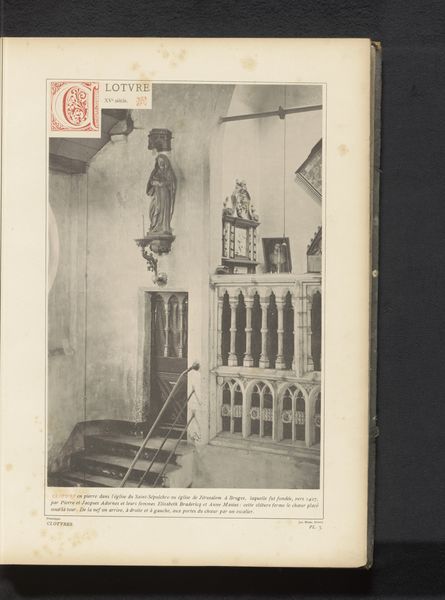
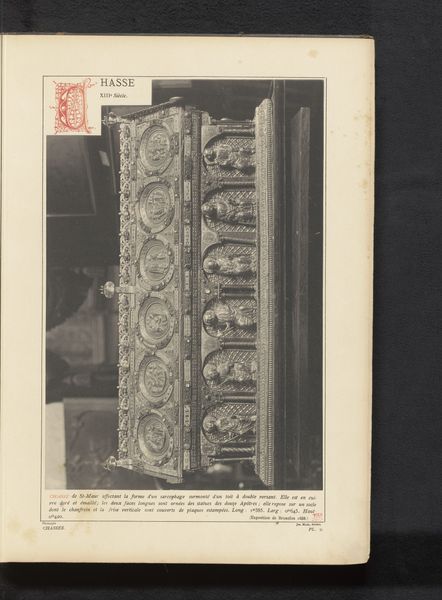
carving, print, photography, wood
#
medieval
#
carving
# print
#
photography
#
wood
Dimensions: height 341 mm, width 235 mm
Copyright: Rijks Museum: Open Domain
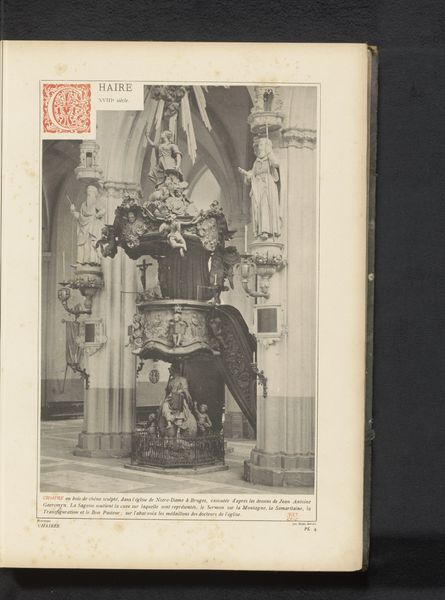
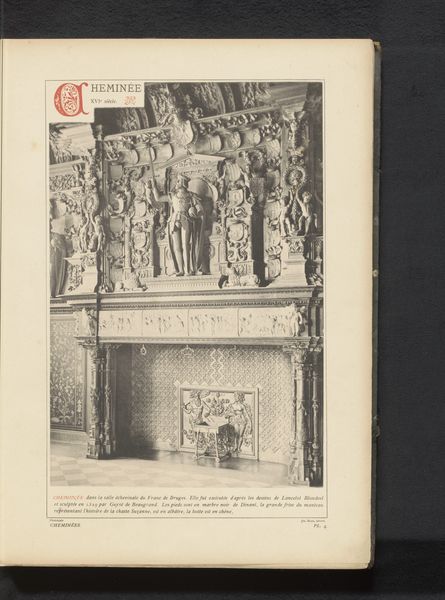
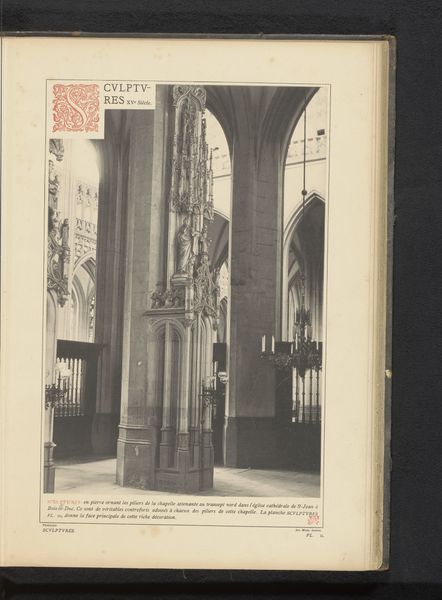
Editor: So, this is a photograph of a wooden pulpit, titled "Preekstoel in de Onze-Lieve-Vrouwekerk te Alsemberg," dated before 1889. It strikes me as incredibly ornate; what jumps out at you when you look at this image? Curator: Primarily, the articulation of form. Observe how the photographer captures the light as it plays across the complex, multi-leveled carvings. The chiaroscuro effect sculpts the surfaces and creates a dialogue between volume and void. How does this interplay inform your understanding of the work? Editor: It really highlights the depth and detail in the carving, making it feel almost theatrical. Does the composition’s verticality influence how you perceive its function and meaning? Curator: Indeed. The upward thrust of the pulpit’s form directs the gaze, literally and figuratively. One could interpret this verticality as a visual metaphor for the ascension of religious thought, and I suggest we look carefully at how the base differs from the structure itself and from the small figurines included. Editor: That’s fascinating. It’s made me see how every element, from the base to the sculptural details, contributes to the overall effect. Curator: Precisely. A careful consideration of these formal choices can illuminate a work’s meaning without the need for extraneous context. Editor: I definitely see the value in focusing on these compositional elements, thanks for explaining it to me. Curator: You are very welcome, examining artwork like this makes me glad to use semiotics.
Comments
No comments
Be the first to comment and join the conversation on the ultimate creative platform.
 Collect
 React
React Comment
More like this