

1817
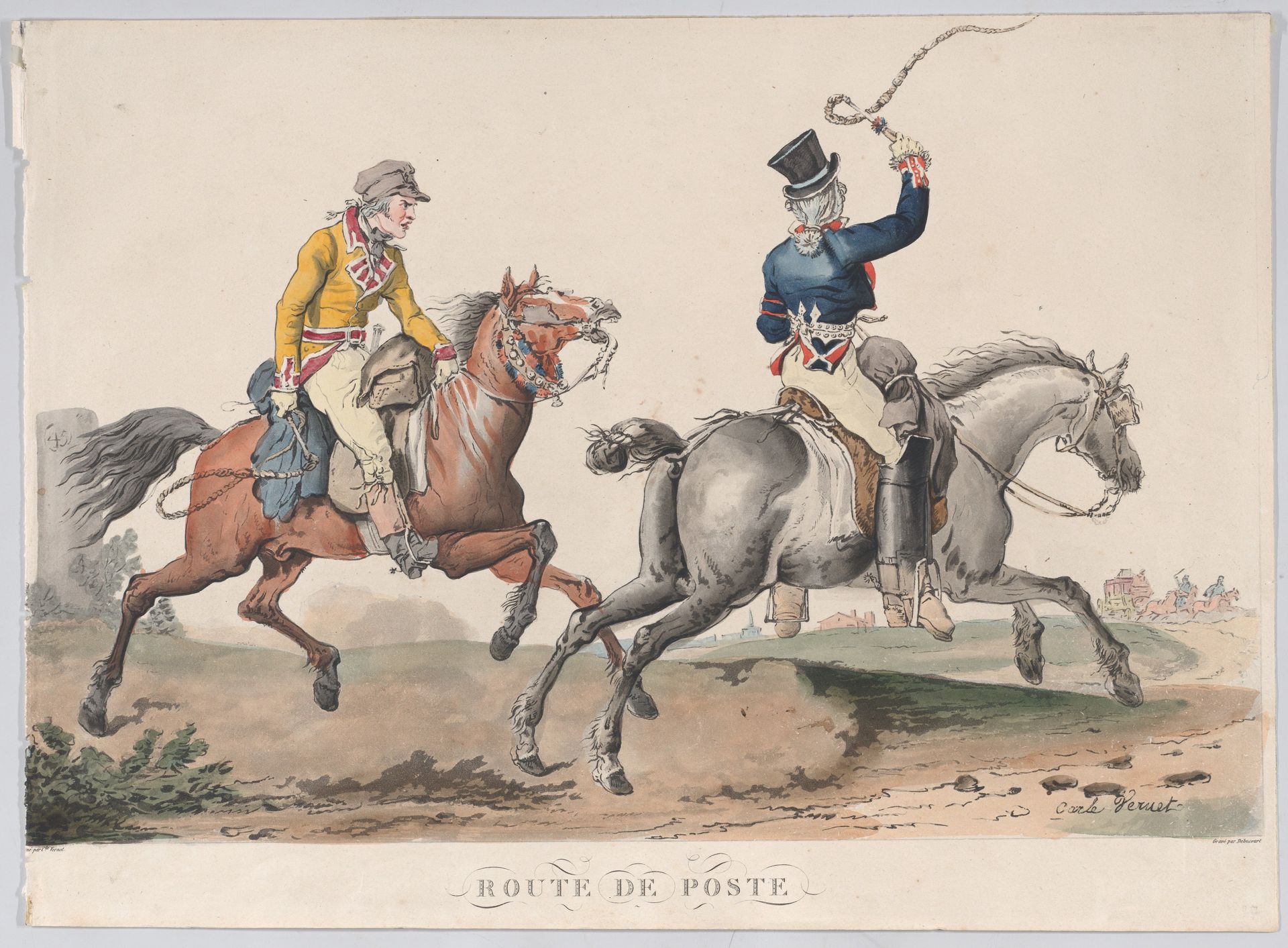
Route de Poste

Louis Philibert Debucourt
1755 - 1832The Metropolitan Museum of Art
Metropolitan Museum of Art, New York, NYListen to curator's interpretation
Curatorial notes
Louis Philibert Debucourt’s “Route de Poste” captures a scene of hurried transit, immediately drawing us to the raised whip of the rider in the background. In Debucourt’s time, this symbol spoke of urgency and authority. The raised whip echoes gestures found in ancient equestrian statues, where it signified command and control, but here, it is repurposed in the context of modern efficiency and movement. Think of Roman equestrian statues, where the rider often held a scepter or weapon, symbols of power and martial prowess. The raised whip taps into a primal connection between humans and animals, evoking a complex mix of domination and partnership. Its crack could elicit fear, obedience, and a visceral response, engaging viewers on a subconscious level. Ultimately, the raised whip in “Route de Poste” is not just about speed; it’s about the relentless march of time. This motif persists, evolving from a symbol of aristocratic dominance to one of modern efficiency, revealing the cyclical nature of power and control across history.