painting, oil-paint
#
portrait
#
painting
#
oil-paint
#
figuration
#
11_renaissance
#
history-painting
#
italian-renaissance
Dimensions: 118 x 93 cm
Copyright: Public domain
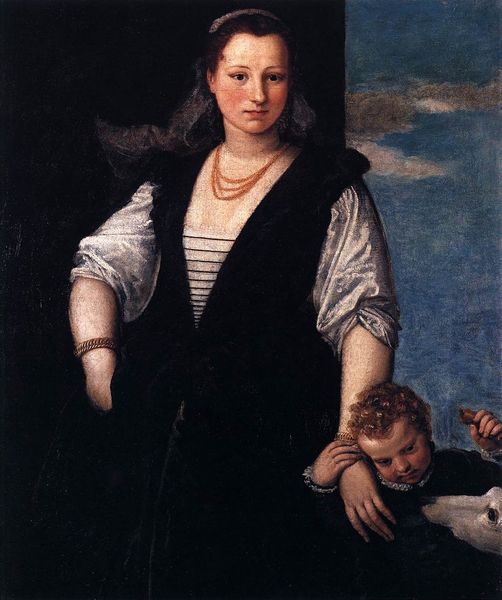
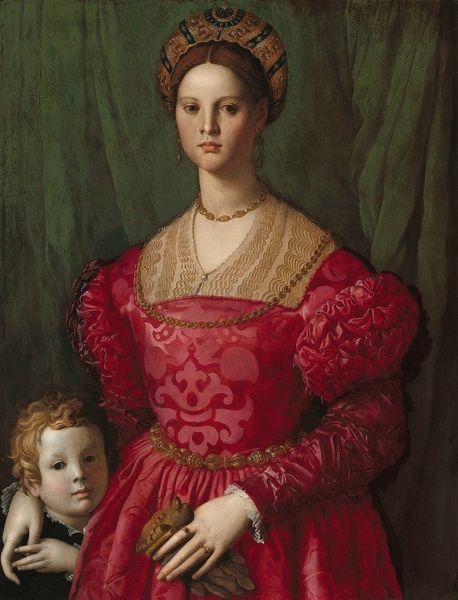
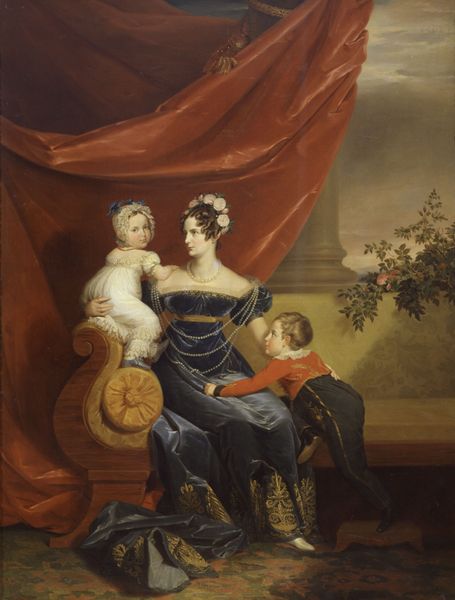
Curator: Here we see Titian's "Portrait of Laura de Dianti," an oil on canvas believed to have been completed around 1523, offering a window into Renaissance-era Italy. Editor: It’s immediately striking—the rich blue of her dress against that warm, almost somber background. And the child, a young boy in brilliantly striped clothing. The composition is… complicated. Curator: Complicated indeed. It’s thought that Laura de Dianti was the mistress, and later possibly the wife, of the Duke of Ferrara. Consider the power dynamics implicit in a portrait such as this during that era. It raises questions of gender, agency, and the representation of women within patriarchal structures. Editor: The layering of symbols seems deliberate. Her headdress, for instance— the jewel resembles a miniature portrait itself. I wonder, who is depicted in that tiny medallion? And the boy--his presence is intriguing. Note that golden earring— a single ornament. It appears to almost mirror her simple pearl drop. Curator: He certainly introduces complex issues of race, class, and representation. It's critical to analyze the historical context of his presence within the frame. Was he a servant? A symbol of wealth and power? This relationship bears consideration under contemporary postcolonial theory. Editor: I see that connection. But equally powerful to me is the long tradition of the child as symbolic accessory to the patron. Renaissance viewers would note that this child reflects the lady’s generosity and beneficence, indicating both the depth of her spirit and of her pocketbook. He seems integral, almost grafted to her being, so perfectly balanced and positioned. Curator: These nuances force us to ask questions about the construction of identity and status. Whose gaze are we occupying as we look at this painting, and what narratives are being reinforced? How does this artwork contribute to our understanding of women in the Italian Renaissance, beyond just their aesthetic value? Editor: The portrait captures a fascinating moment of cultural memory. Through objects and arrangements, it communicates very powerfully the lady's essence to a broader audience even centuries later. Curator: Exactly! This is why situating artwork within history gives so much more resonance and opens so many avenues for current social conversations and reflection. Editor: Yes, and looking at these elements through the lens of symbolism helps us retrieve and connect with stories of humanity and cultural change.
Comments
No comments
Be the first to comment and join the conversation on the ultimate creative platform.
 Collect
 React
React Comment
More like this