1567 - 1599
Melons


Listen to curator's interpretation
Curatorial notes
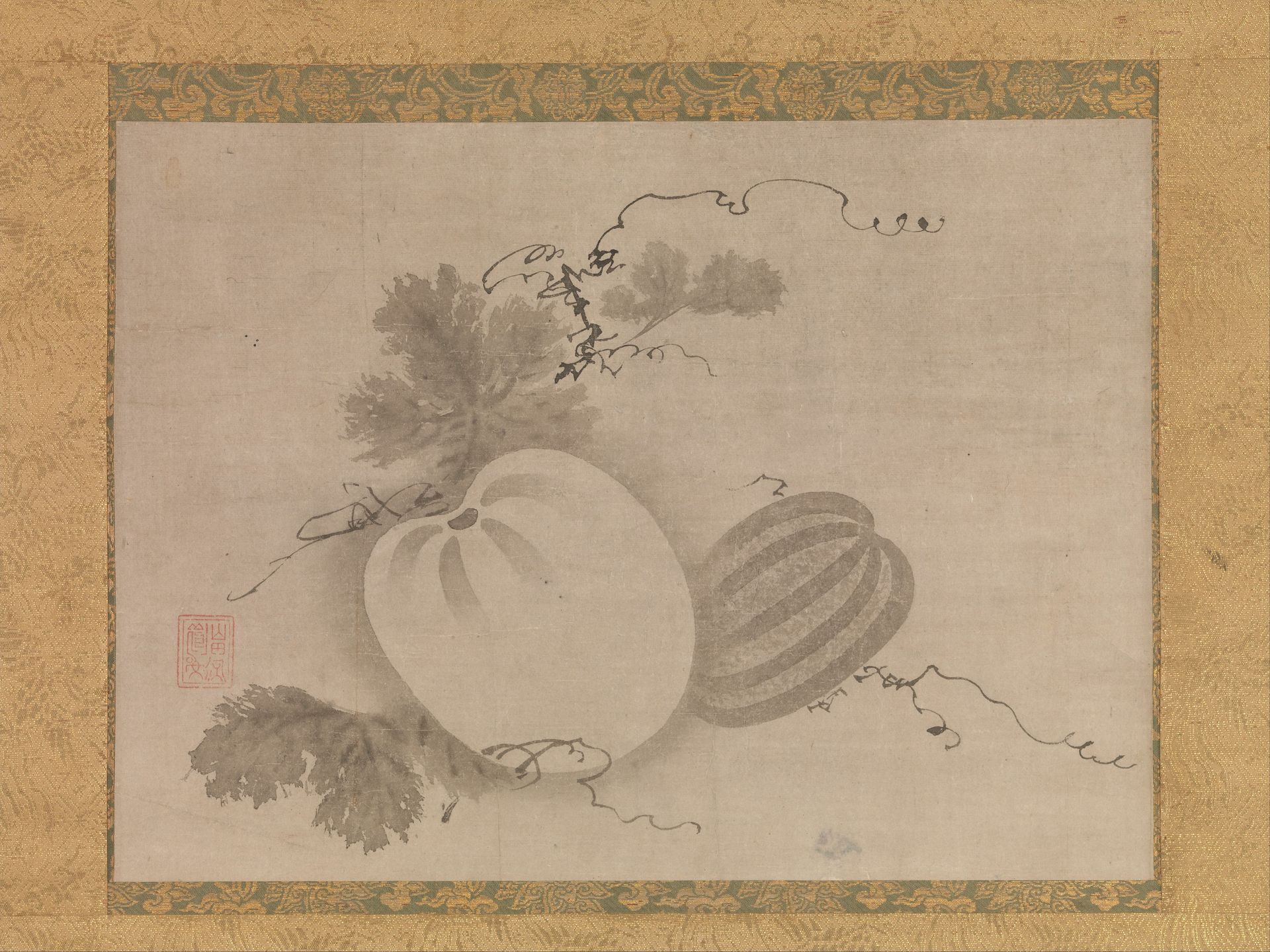
Curator: This watercolor drawing, known as "Melons," dates from between 1567 and 1599 and is attributed to Yamada Dōan. It resides here at the Metropolitan Museum of Art. Editor: You know, my first thought is how understated it is. Almost…unfinished? But in a really captivating way. It’s just two melons and some foliage rendered in such a simple, delicate style. Curator: Precisely. And the minimalism speaks volumes, doesn’t it? Within the context of the late 16th century, during Japan’s Azuchi-Momoyama period, such drawings were frequently made by artists linked to powerful political and military figures. This brings up interesting considerations surrounding patronage, status, and aesthetic expression. These sparse ukiyo-e drawings highlight a taste for understated beauty in Japanese aesthetics that still resonates today. Editor: Right, that *wabi-sabi* vibe. I get it. The imperfection, the transience… But honestly, when I first saw it, I wasn't thinking about all of that. I thought of my grandpa’s garden. He always grew the strangest-looking vegetables! It feels very personal. Curator: The association is telling; indeed, melons themselves can act as signifiers within particular visual languages. They can act as vanitas symbols suggesting a brief and fleeting pleasure because their succulent freshness is short lived. Furthermore, such renderings of nature can be imbued with symbolism around cycles of growth and harvest. Editor: Well, my grandfather would've loved that deep dive. For me, it's the wobbly lines that create the vines, those sketchy leaves, they feel alive, like they’re still reaching. Also the asymmetry really makes the eye travel through the artwork. Curator: The informality of the style stands in marked contrast to what one may expect from official or more academic art of the period. Perhaps this suggests that art during that era encompassed different visual and symbolic languages across artistic communities. Editor: You know, thinking about it now, there is a certain formality to its…informality! Like a perfectly messed-up hairstyle. Someone clearly thought a lot about what *not* to include. Curator: Exactly! Perhaps on closer viewing, these drawings force us to re-evaluate notions of authorship and what constitutes intention and artistry during a particular time. Editor: I’m now off to find my grandfather's zucchini recipe. That guy knew about fleeting pleasure. Thanks for the enlightenment! Curator: And I have gained fresh appreciation for vegetable gardens. It has been very insightful to delve deeper with you.