About this artwork
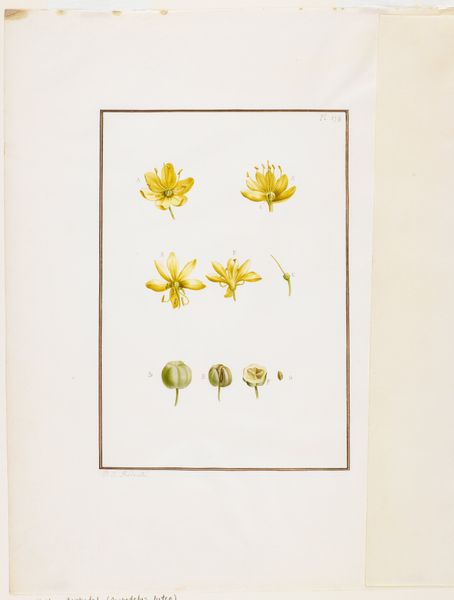
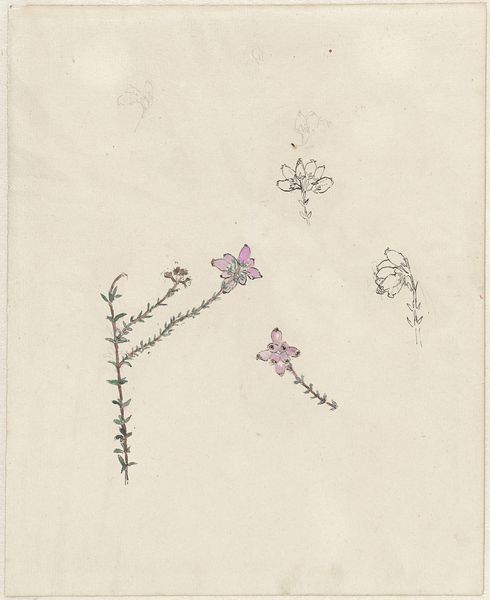
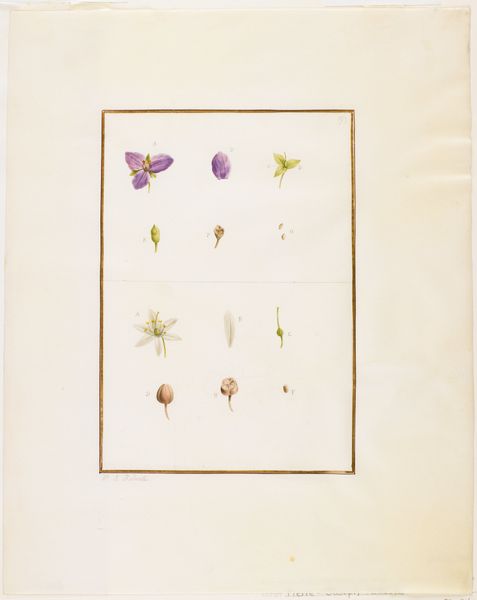
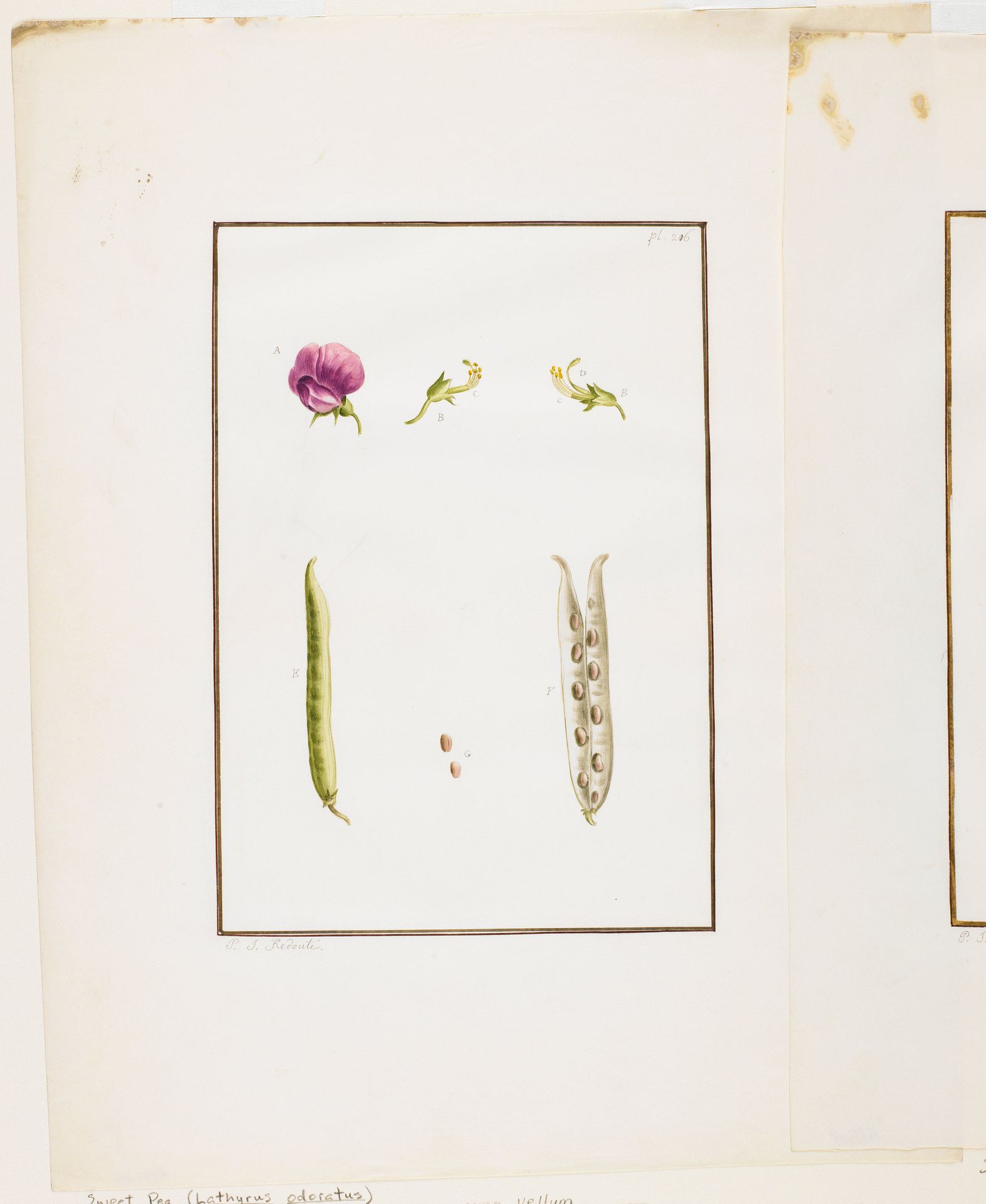
Curator: Welcome, everyone. Today, we’re looking at "Botanical Dissection- Sweet Pea (Lathyrus odoratus)," a watercolor drawing on paper created circa 1778-1790 by Pierre-Joseph Redouté. Editor: My immediate impression is of meticulous detail. The cool, clean tones of the paper enhance the jewel-like quality of each plant part. Curator: Precisely. Redouté's illustrations, rendered primarily in watercolor, were not just beautiful but served a crucial scientific purpose. Consider the context: The late 18th century witnessed a surge in botanical exploration. Redouté's detailed works aided botanists in identifying and classifying newly discovered plants from across the globe, contributing significantly to scientific knowledge. Editor: Absolutely, but the composition itself fascinates me. Notice how the artist arranged the dissected components. The vibrant pink of the flower contrasts against the delicate green of the seed pod. Semiotically, there’s a strong visual hierarchy, leading the eye through the stages of the plant’s life cycle. Curator: His patrons were often aristocrats, including Marie Antoinette. Therefore, access to botanists, conservatories, and rare specimens was certainly available, offering new narratives related to botany and imperialism that helped to frame societal relationships in a burgeoning Enlightenment Europe. It allows one to rethink narratives of colonialism as stories are being extracted to show new growth of knowledge. Editor: True, but stepping back, one can also appreciate the pure artistry. Observe how the artist captured the texture and form. Redouté understood the power of the line and watercolor. His scientific work, such as this botanical work, makes it difficult to determine if this should be thought of as simply illustration, decoration, science, or fine art. Curator: I concur with that sentiment. But the botanical illustrations often omit aspects that may challenge ideas of beauty and growth such as the signs of decay, and elements related to social or ecological concerns with plant life such as pollution. It gives insight into social power structures involved. Editor: I agree that it does serve to create an art historical and sociological impact within the field. On pure aesthetic terms, I think that Redouté has created a gorgeous formal interplay. It is quite beautiful, while creating an element of science that cannot be disputed. Curator: Exactly, there’s much here to unpack. Thank you for sharing in this conversation. Editor: Thank you. It was a delightful exploration.
Botanical Dissection- Sweet Pea (Lathyrus odoratus)
c. 1778 - 1790


Artwork details
- Medium
- drawing, paper, watercolor, pendant
- Dimensions
- 9 3/16 x 6 3/8 in. (23.34 x 16.19 cm) (image)15 1/16 x 11 3/4 in. (38.26 x 29.85 cm) (sheet)
- Location
- Minneapolis Institute of Art
- Copyright
- Public Domain
Tags
Comments
Share your thoughts
About this artwork
Curator: Welcome, everyone. Today, we’re looking at "Botanical Dissection- Sweet Pea (Lathyrus odoratus)," a watercolor drawing on paper created circa 1778-1790 by Pierre-Joseph Redouté. Editor: My immediate impression is of meticulous detail. The cool, clean tones of the paper enhance the jewel-like quality of each plant part. Curator: Precisely. Redouté's illustrations, rendered primarily in watercolor, were not just beautiful but served a crucial scientific purpose. Consider the context: The late 18th century witnessed a surge in botanical exploration. Redouté's detailed works aided botanists in identifying and classifying newly discovered plants from across the globe, contributing significantly to scientific knowledge. Editor: Absolutely, but the composition itself fascinates me. Notice how the artist arranged the dissected components. The vibrant pink of the flower contrasts against the delicate green of the seed pod. Semiotically, there’s a strong visual hierarchy, leading the eye through the stages of the plant’s life cycle. Curator: His patrons were often aristocrats, including Marie Antoinette. Therefore, access to botanists, conservatories, and rare specimens was certainly available, offering new narratives related to botany and imperialism that helped to frame societal relationships in a burgeoning Enlightenment Europe. It allows one to rethink narratives of colonialism as stories are being extracted to show new growth of knowledge. Editor: True, but stepping back, one can also appreciate the pure artistry. Observe how the artist captured the texture and form. Redouté understood the power of the line and watercolor. His scientific work, such as this botanical work, makes it difficult to determine if this should be thought of as simply illustration, decoration, science, or fine art. Curator: I concur with that sentiment. But the botanical illustrations often omit aspects that may challenge ideas of beauty and growth such as the signs of decay, and elements related to social or ecological concerns with plant life such as pollution. It gives insight into social power structures involved. Editor: I agree that it does serve to create an art historical and sociological impact within the field. On pure aesthetic terms, I think that Redouté has created a gorgeous formal interplay. It is quite beautiful, while creating an element of science that cannot be disputed. Curator: Exactly, there’s much here to unpack. Thank you for sharing in this conversation. Editor: Thank you. It was a delightful exploration.
Comments
Share your thoughts