About this artwork
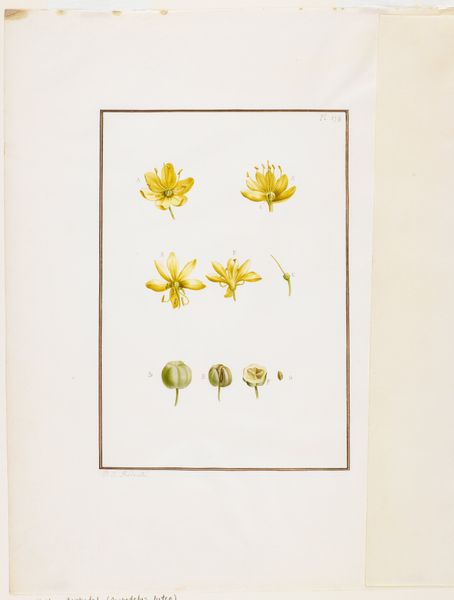
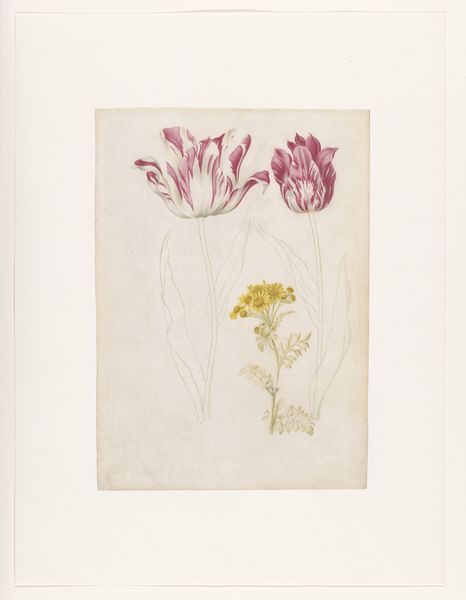
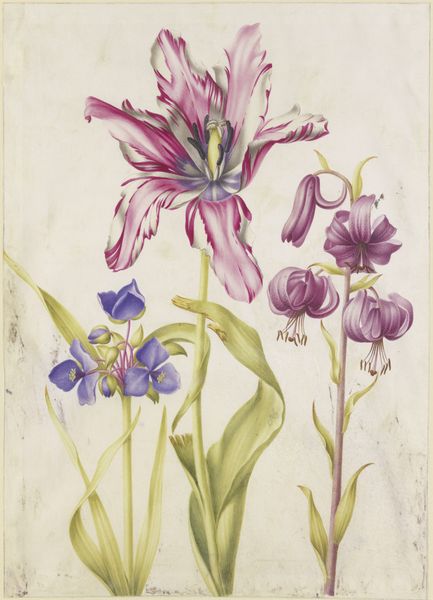
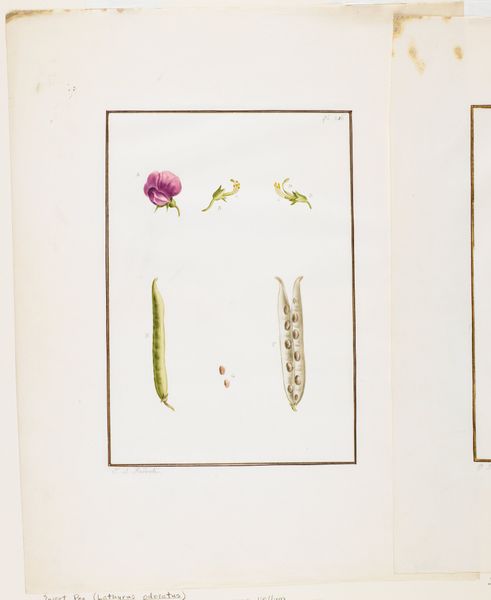
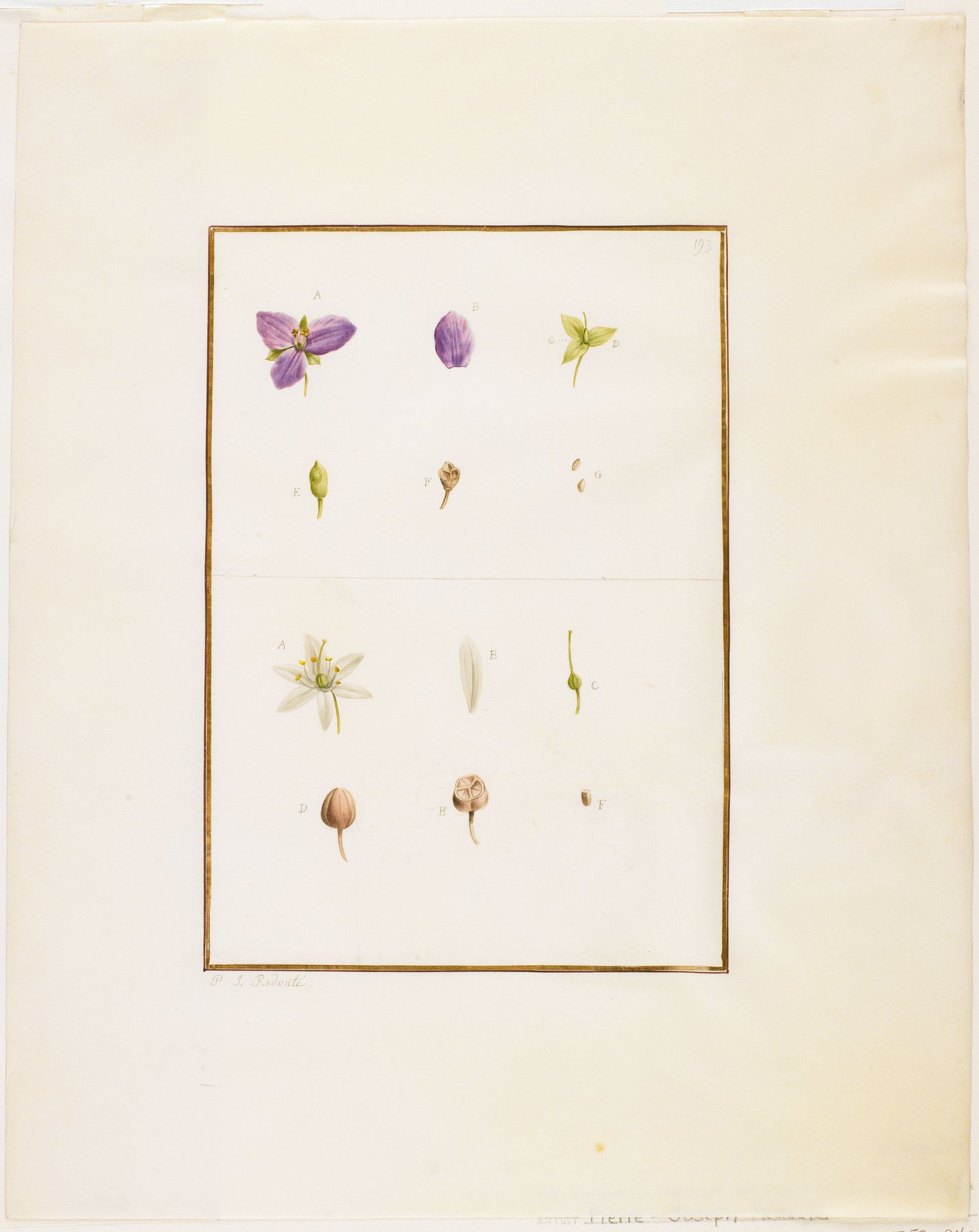
Curator: This botanical illustration, titled "Botanical Dissection - Spidorwort and Senna," comes to us from Pierre Joseph Redouté, dating circa 1778 to 1790. It employs watercolor on paper. Editor: It’s incredibly delicate. The meticulous detail is almost scientific in its precision, but rendered with a lightness of touch, especially considering it’s almost two and a half centuries old. Curator: Indeed, Redouté was appointed draughtsman to the court of Queen Marie Antoinette. Consider the socio-political context: botany was booming, entwined with colonial expansion and the exploitation of resources, including medicinal plants from colonized lands. Works such as these advanced "scientific" goals in tandem with imperial aims. Editor: I'm struck by the layout – the neat division into two registers, each presenting a kind of floral autopsy. The colors, soft lavenders and creams, give a tranquil feel, even as the subject is literally deconstructed. What's fascinating is how this ordered presentation guides your eye through each minute variation, each stem and petal. Curator: These botanical studies were also ways to codify and categorize the natural world. Linnaean taxonomy was emerging, aiming to structure and understand life through rigorous categorization, yet the presentation here echoes the aristocratic fascination with the natural world as spectacle and commodity. How do we read the seemingly neutral lens through which colonial botanists viewed the plants they documented? Editor: The starkness, though beautiful, becomes clinical through the deconstruction. The negative space of the white paper surrounding each carefully depicted component only accentuates this sense. I am really appreciating how each fragment becomes its own focused composition through shape, texture, and the almost ethereal wash of watercolor. Curator: Yes. And as the 'court painter of flowers,’ as he came to be known, his art implicitly served the interests of power, reflecting specific colonial relationships during his life, something we should not forget as we analyze such aesthetically pleasing specimens. Editor: That's insightful. By shifting my focus to composition and considering sociohistorical context, I begin to view this lovely botanical study in an entirely new light. Curator: It's always beneficial to situate these exquisite objects in time. Thanks.
Botanical Dissection- Spidorwort and Senna c. 1778 - 1790


Artwork details
- Medium
- drawing, paper, watercolor
- Dimensions
- 9 1/16 x 6 3/8 in. (23.02 x 16.19 cm) (image)14 9/16 x 11 3/4 in. (36.99 x 29.85 cm) (sheet)
- Location
- Minneapolis Institute of Art
- Copyright
- Public Domain
Tags
drawing
water colours
paper
watercolor
watercolour illustration
academic-art
botanical art
Comments
No comments
About this artwork
Curator: This botanical illustration, titled "Botanical Dissection - Spidorwort and Senna," comes to us from Pierre Joseph Redouté, dating circa 1778 to 1790. It employs watercolor on paper. Editor: It’s incredibly delicate. The meticulous detail is almost scientific in its precision, but rendered with a lightness of touch, especially considering it’s almost two and a half centuries old. Curator: Indeed, Redouté was appointed draughtsman to the court of Queen Marie Antoinette. Consider the socio-political context: botany was booming, entwined with colonial expansion and the exploitation of resources, including medicinal plants from colonized lands. Works such as these advanced "scientific" goals in tandem with imperial aims. Editor: I'm struck by the layout – the neat division into two registers, each presenting a kind of floral autopsy. The colors, soft lavenders and creams, give a tranquil feel, even as the subject is literally deconstructed. What's fascinating is how this ordered presentation guides your eye through each minute variation, each stem and petal. Curator: These botanical studies were also ways to codify and categorize the natural world. Linnaean taxonomy was emerging, aiming to structure and understand life through rigorous categorization, yet the presentation here echoes the aristocratic fascination with the natural world as spectacle and commodity. How do we read the seemingly neutral lens through which colonial botanists viewed the plants they documented? Editor: The starkness, though beautiful, becomes clinical through the deconstruction. The negative space of the white paper surrounding each carefully depicted component only accentuates this sense. I am really appreciating how each fragment becomes its own focused composition through shape, texture, and the almost ethereal wash of watercolor. Curator: Yes. And as the 'court painter of flowers,’ as he came to be known, his art implicitly served the interests of power, reflecting specific colonial relationships during his life, something we should not forget as we analyze such aesthetically pleasing specimens. Editor: That's insightful. By shifting my focus to composition and considering sociohistorical context, I begin to view this lovely botanical study in an entirely new light. Curator: It's always beneficial to situate these exquisite objects in time. Thanks.
Comments
No comments