painting, oil-paint
#
cubism
#
painting
#
oil-paint
#
figuration
#
geometric
#
modernism
Copyright: Public domain
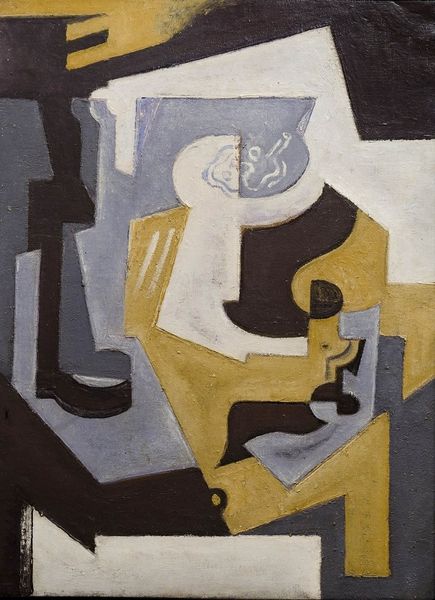
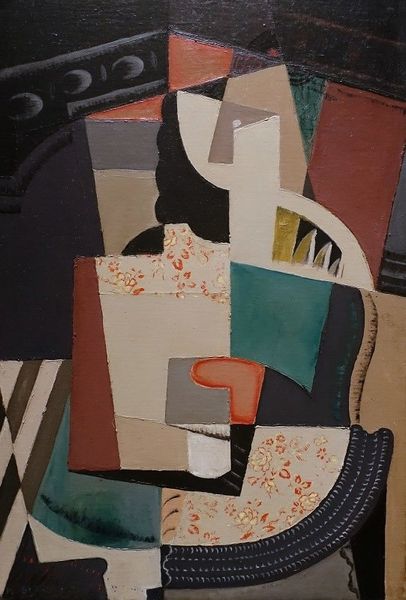
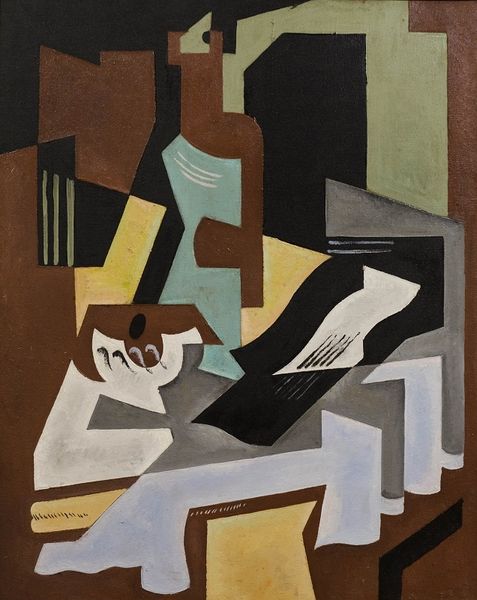
Curator: Right, let’s talk about María Blanchard’s “Juguetes,” or “Toys,” painted around 1920. Blanchard was such a powerhouse in the Cubist movement, and this work, rendered in oil, just hums with her signature style. What are your initial thoughts? Editor: Stark, almost melancholic. For a painting called "Toys," I’m surprised by how serious it feels. The color palette is muted, and even though there are whimsical objects, they appear frozen, trapped almost. It is almost sad. Curator: Precisely. There's this incredible tension, isn't there? On one level, it's a straightforward still life: a rocking horse, a drum, a toy trumpet. But Blanchard warps and simplifies these forms, pulling them into the Cubist orbit. And contextually, post World War One, the notion of “play” gets loaded, fraught with disillusionment. It speaks to a damaged, maybe impossible innocence. Editor: Absolutely, the socio-political aspect amplifies that stillness. These were times when joy felt difficult to come by, and this composition could almost stand as an indictment of a society that was unable to maintain its childhood—lost it in war and other conflicts. Even a toy trumpet looks… weaponized somehow. Curator: Beautifully put. I find that the geometric deconstruction both hides and reveals something profound, you know? It breaks the objects into simpler forms so they may be understood in new ways. The textures, though, they’re almost edible! That chalky, matte finish; the way she builds up layers of paint... You want to reach out and touch them. It almost feels tactile, despite its cerebral nature. Editor: Yes, that tension is striking. The muted colors serve a kind of quiet rebellion too. The painting lives within an important discussion about Cubism, and female agency within that space, during the Interwar. Curator: Right, because she inhabited, really *lived* through some profound art-historical moments. Looking at this still life, the shapes almost speak of her struggle: her searching, and that persistent hope. A visual haiku of loss, but rendered with, a quiet understanding. Editor: A haunting nursery rhyme you can never quite sing right. Curator: Exactly. What a poignant testament.
Comments
No comments
Be the first to comment and join the conversation on the ultimate creative platform.
 Collect
 React
React Comment
More like this