Dimensions: 235 × 210 mm (image); 259 × 237 mm (plate, approx.); 250 × 229-230 mm (primary support); 788 × 575 mm (secondary support, approx.)
Copyright: Public Domain
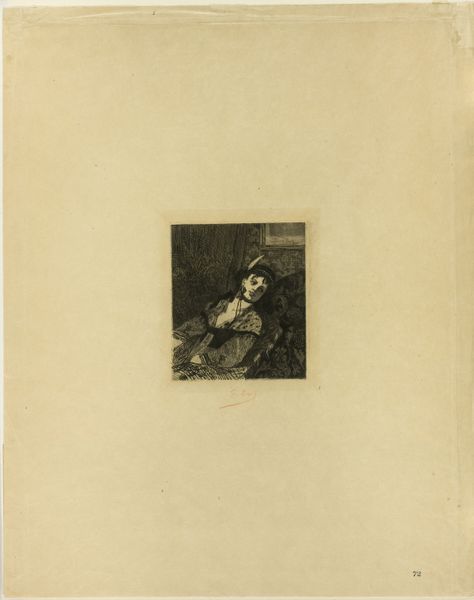
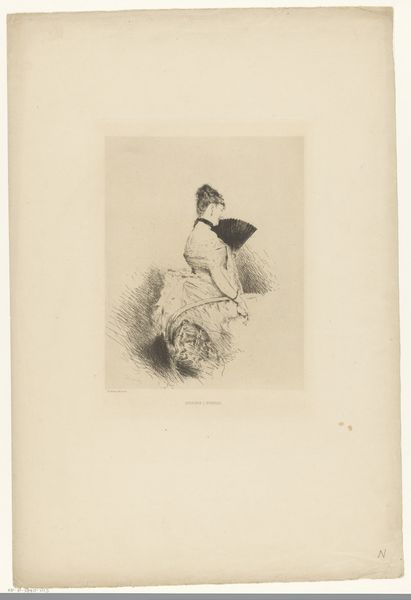
Curator: Let’s take a look at "Into the Gutter!", plate ten from A Life. Max Klinger created this etching and print in 1884. It’s currently held here at the Art Institute of Chicago. The print on toned paper depicts a scene with a woman in a state of distress, and she’s surrounded by dark, looming figures. Editor: The first thing that strikes me is the unsettling mood. The high contrast and cramped space create a palpable sense of claustrophobia and unease. Her vulnerability is highlighted against the starkness of her surroundings. Curator: Klinger’s series "A Life" critiques bourgeois society in Wilhelmine Germany. Each plate represents different stages and experiences. The positioning of the woman is very much a commentary on the social and moral decline that Klinger observed in the era. Editor: Right, and consider the title, "Into the Gutter!" It immediately reframes our understanding of the subject, placing her as a fallen woman or a social outcast, mirroring societal judgment and the harsh consequences for those who defy social norms of the time. Are we seeing how prevailing expectations trap her? Curator: I see this piece operating in a fascinating intersection of art and the societal institutions that framed art's creation and display. Think of how Klinger’s work challenged traditional art academies, his decision to work in printmaking was itself a commentary on democratizing art access. He directly confronted hypocrisies prevalent in institutions upholding traditional norms, wasn’t he? Editor: Definitely. There’s a clear engagement with gender and power dynamics here. I’m wondering if that is further amplified by looking at how women were represented in art historical canons, their marginalization in art institutions. I appreciate your thoughts about Klinger democratizing art, and wonder, by repeating the image, is it further normalizing cultural oppression by repeating her image of subjugation? Curator: It raises so many questions about visibility and representation. In Klinger’s time, art acted as a political battleground—challenging or reinforcing cultural norms and power. Considering it, I would contend his repetition serves more to challenge and to shine light on previously overlooked injustice. Editor: Seeing this, my own framework for how images are made and how they participate within larger structures and institutions, especially around women's roles, is strengthened. Curator: For me, considering Klinger’s “Into the Gutter!”, the complexities of the institutions it depicts become even more clear, more transparent in their artifice.
Comments
No comments
Be the first to comment and join the conversation on the ultimate creative platform.
 Collect
 React
React Comment
More like this