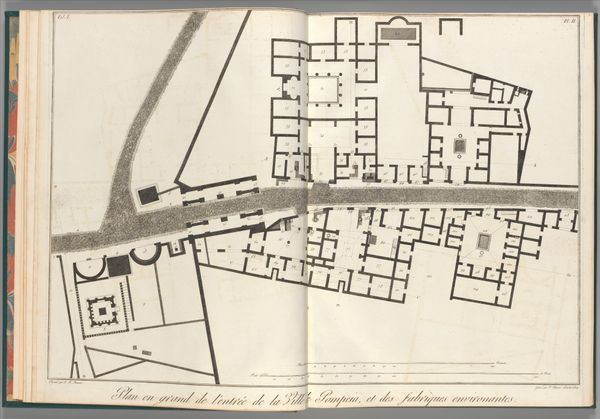
![Cross-sections, which show the different aspects of the buildings shown in the plan of Pompeii [the preceding plate], from "Antiquités de Pompeïa, tome premier, Antiquités de la Grande Grèce..." (Antiquities of Pompeii, volume one, Antiquities of Great Greece...), volume 1, plate 3 by Francesco Piranesi](https://d2w8kbdekdi1gv.cloudfront.net/eyJidWNrZXQiOiAiYXJ0ZXJhLWltYWdlcy1idWNrZXQiLCAia2V5IjogImFydHdvcmtzLzJlNWU5NTdjLThmYjktNDA1Ni04ODQ0LTFlZGQ1Y2JkNjFkYy8yZTVlOTU3Yy04ZmI5LTQwNTYtODg0NC0xZWRkNWNiZDYxZGNfZnVsbC5qcGciLCAiZWRpdHMiOiB7InJlc2l6ZSI6IHsid2lkdGgiOiAxOTIwLCAiaGVpZ2h0IjogMTkyMCwgImZpdCI6ICJpbnNpZGUifX19)
1804
Cross-sections, which show the different aspects of the buildings shown in the plan of Pompeii [the preceding plate], from "Antiquités de Pompeïa, tome premier, Antiquités de la Grande Grèce..." (Antiquities of Pompeii, volume one, Antiquities of Great Greece...), volume 1, plate 3


Listen to curator's interpretation
Curatorial notes
Editor: Here we have Francesco Piranesi's "Cross-sections, which show the different aspects of the buildings shown in the plan of Pompeii," created in 1804. It’s a detailed etching and engraving depicting cross-sections of Pompeii’s buildings. I’m immediately struck by how clinical it feels, almost like an architectural autopsy. What layers do you see here? Curator: Well, beyond the architectural record, this image becomes an active participant in shaping our understanding of history. It arrives at a time of immense social and political upheaval. Think of Neoclassicism rising as a cultural and political movement, the way societies then used the “ancient” as a tool. How do these geometric depictions intersect with contemporary power dynamics? Editor: So you're saying the "objective" nature of the drawing is itself a product of a particular cultural lens? Curator: Precisely. This image isn’t just a neutral record; it reflects the aspirations and ideologies of its time. Neoclassicism aimed to legitimize power through association with classical ideals. Notice how the cross-sections eliminate any sign of the people who once lived there, particularly women, people of color, enslaved populations...what purpose might that serve? Editor: It erases the messiness of everyday life, projecting an image of idealized, sanitized history. It’s presenting a vision of the past that validates the present, almost like visual propaganda. Curator: Exactly. By stripping Pompeii of its vibrant, complex social fabric, Piranesi inadvertently reveals the biases inherent in his own worldview and, more broadly, the worldview of Neoclassical Europe. Can we ever truly separate historical documentation from the socio-political contexts in which it was created? Editor: That’s really interesting. I was focused on the details of the architecture, but now I see the drawing itself as an argument, not just a depiction. Curator: Indeed. It encourages us to constantly question and actively resist simplistic narratives. Now, that’s a valuable skill.