1699
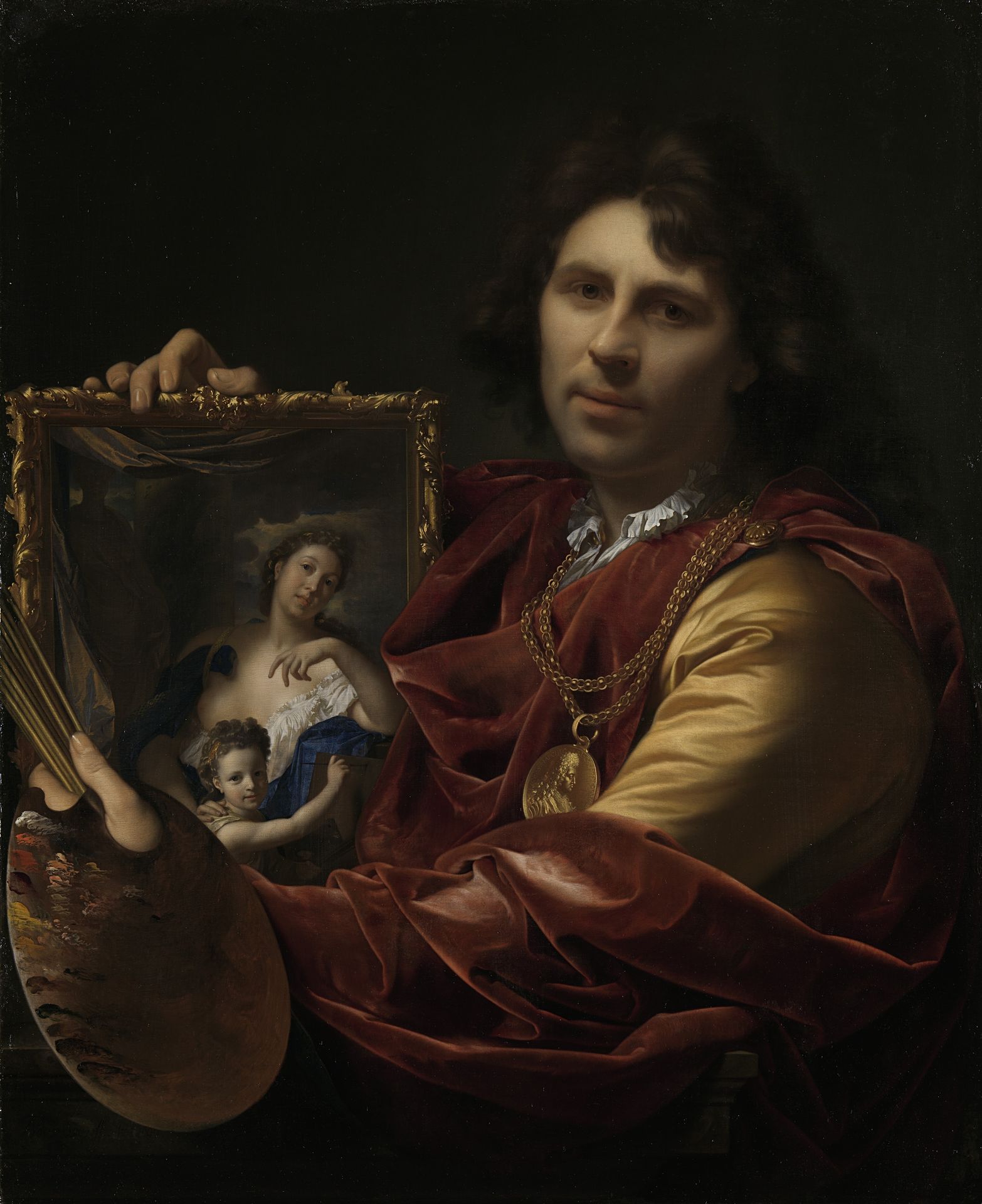
Self-portrait with the Portrait of his Wife, Margaretha van Rees, and their Daughter Maria

Adriaen van der Werff
1659 - 1722Location
RijksmuseumListen to curator's interpretation
Curatorial notes
Editor: Here we have Adriaen van der Werff's "Self-portrait with the Portrait of his Wife, Margaretha van Rees, and their Daughter Maria," painted in 1699 using oil paint. It feels like a very carefully constructed presentation. The artist almost seems to be showing off a curated version of himself and his family. What strikes you about this piece? Curator: Oh, a "curated self," that's beautifully put! For me, it’s that unsettling duality—van der Werff presents himself as a man of immense wealth and artistic skill, almost boastful with his gold chain and luxurious velvet, but there’s also this undeniable tenderness in how he includes his family, frozen in another painting within the painting. Do you see a contrast between the public image and a more intimate glimpse? Editor: Definitely. The portrait-within-a-portrait does soften the image. It’s like he’s saying, "Yes, I'm successful, but family is what truly matters." Curator: Exactly! And I wonder if it’s not also a little bit about legacy, immortality even. He’s capturing them within his own enduring creation, layering reality. A baroque matryoshka doll! What do you think his intention might have been in staging the subjects in the included portrait like that? Editor: Staging...hmm, you mean how they are posed like a Madonna and Child? That’s interesting, I had not noticed that direct connection. Maybe he’s idealizing them, placing them on a higher, almost sacred plane. Curator: Precisely! And isn't that idealization telling in itself? I see now in what way this Baroque master's work transcends the vanity of a self-portrait. Thanks for pointing that out. Editor: I hadn't considered that idealization and immortality were van der Werff's concerns, beyond a demonstration of artistic mastery and showing his wealth. Thank you!