print, engraving, architecture
#
baroque
# print
#
old engraving style
#
landscape
#
line
#
history-painting
#
engraving
#
architecture
Dimensions: height 240 mm, width 163 mm
Copyright: Rijks Museum: Open Domain
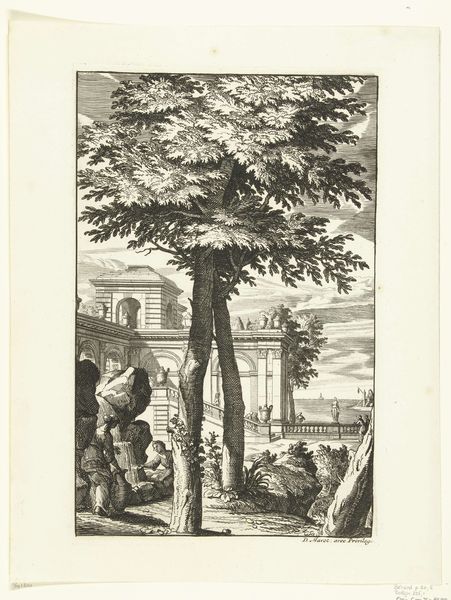
Curator: This is an engraving by Daniël Marot, dating roughly between 1673 and 1752, titled "Buitenplaats met waterval waarbij twee vrouwen," which translates to "Country house with waterfall with two women." It’s part of the Rijksmuseum collection. Editor: Immediately, I’m struck by the stark contrast and detail achieved with the engraving technique. The light plays wonderfully off the architectural elements and the cascading water. It’s almost theatrical. Curator: Marot was influential in introducing French Baroque design to the Netherlands and later England. Prints like these were critical for disseminating architectural and garden designs throughout Europe, influencing tastes and trends. Editor: The composition is really intriguing. That massive tree in the foreground almost bisects the scene. Its trunk guides your eye up toward the meticulously rendered buildings. Note how the intertwining of the trunks softens an otherwise rigid, orthogonal built environment. Curator: Exactly. Gardens became essential spaces for projecting power and taste during the Baroque era. The meticulously planned landscapes around grand houses showcased a patron's wealth, sophistication, and control over nature itself. We see this ideal here. Editor: Observe, too, the use of line. Varying densities create shadow and depth, particularly in the foliage. See the crisp delineation defining the figures – these visual components serve not just to depict a scene but also to construct an experience of idealized harmony. Curator: And what's fascinating is the context for that idealized harmony. Landowners projected an image of cultivated peace in these designed landscapes while simultaneously engaging in colonial exploitation. The wealth that sustained these estates was often directly tied to the suffering of others. Editor: While acknowledging that dark side, formally I still appreciate how the engraving utilizes negative space to imply movement in the waterfall. The white areas contrast powerfully with the dense linework defining the architecture. Curator: Yes, these landscapes represent a selective view of reality. The labor and resources required to maintain them are deliberately obscured from the scene. It's a calculated vision of serenity. Editor: Examining this artwork gives me a greater appreciation for the sheer skill of the artist. And for me, I realize I tend to prefer to reflect on its stylistic qualities, regardless of the history. Curator: It makes you wonder what wasn't depicted, doesn't it? A really captivating intersection of art and the structures that shape our world!
Comments
No comments
Be the first to comment and join the conversation on the ultimate creative platform.
 Collect
 React
React Comment
More like this