panel, painting, oil-paint
#
portrait
#
de-stijl
#
panel
#
painting
#
oil-paint
#
oil painting
#
geometric
#
modernism
Dimensions: 64.5 x 48 cm
Copyright: Public domain
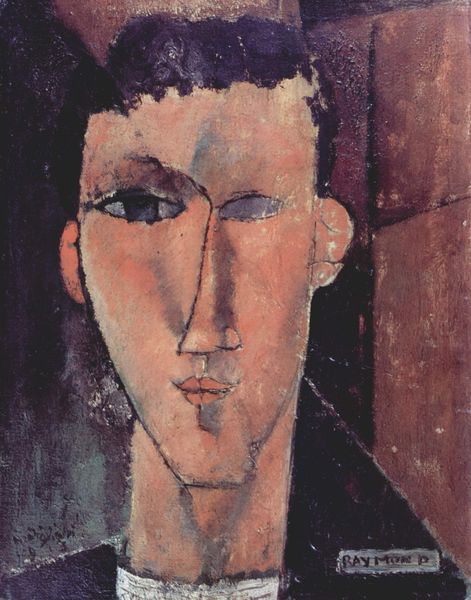
Editor: This is Theo van Doesburg's "Portrait of Pétro" from 1922, an oil painting on panel. The geometric shapes intersecting the profile create a disjointed, almost unsettling effect. What do you see in this piece? Curator: The unsettling effect is key. Consider the historical context: World War I had just ended, leaving a generation questioning traditional modes of representation, even the notion of unified identity. The De Stijl movement, to which van Doesburg belonged, sought a universal visual language, stripping away individual expression in favor of abstraction. Does this abstraction then "strip away" part of Petro's identity? Editor: That's fascinating. I hadn’t thought about the war's impact on representation itself. So, the geometric shapes aren’t just aesthetic; they represent a deliberate fragmentation? Curator: Precisely. And this fragmentation, particularly within a portrait, raises questions about how we perceive and construct identity. The clean lines and limited palette are not just about visual harmony; they are also about control, a kind of enforced order over a disrupted world. How might a feminist reading interpret this imposed geometry? Editor: Perhaps as a masculine imposition? A way of controlling and defining the female subject through abstraction? The hard lines feel very assertive, lacking the softness often associated with traditional portraiture of women. Curator: Exactly. This pushes us to consider how seemingly abstract aesthetic choices are deeply intertwined with power dynamics and the representation of gender. This seemingly simple portrait reveals complex tensions between abstraction, identity, and the social forces shaping artistic expression. Editor: I see it now! Thinking about the socio-political context and gender makes a huge difference. I'll never look at abstract art the same way. Curator: And hopefully, never look at the world the same way either. Art is always in conversation with the world around it.
Comments
No comments
Be the first to comment and join the conversation on the ultimate creative platform.
 Collect
 React
React Comment
More like this