1885
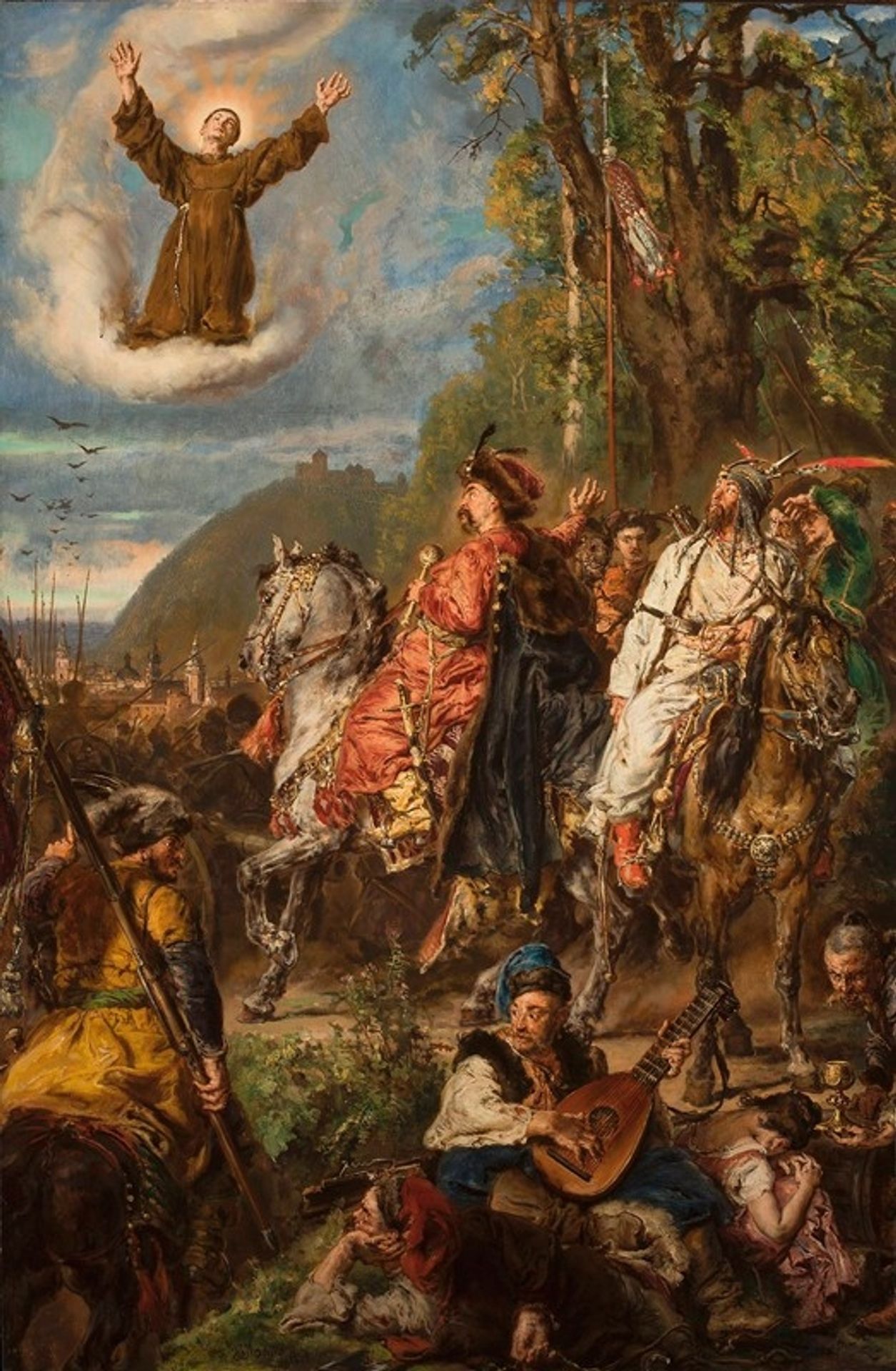
Bohdan Khmelnytsky with Tugay Bey at Lviv

Listen to curator's interpretation
Curatorial notes
Editor: This oil painting, "Bohdan Khmelnytsky with Tugay Bey at Lviv" by Jan Matejko, dating from 1885, feels epic and chaotic. There's so much happening, with a saintly figure floating above what appears to be an advancing army. How do you interpret this work? Curator: It's a rich tapestry of Polish and Ukrainian history, wouldn't you say? That floating figure isn’t necessarily a saint, but rather Jakub Strepa, the Patron Saint of Lviv, conjured as an omen for the city’s future. What do you notice about his position? Editor: He's raising his arms, as if blessing or maybe warning someone? It is interesting how Matejko positions him above this procession. Curator: Exactly. Matejko utilizes symbolism to convey deeper meanings. Look at Khmelnytsky and Tugay Bey: one figure in lavish color and one in pale, muted tones. This is the contrast Matejko establishes when portraying a historical record – as a call to the spirit, it resonates beyond the visible. What feelings arise when you contemplate these figures? Editor: There's definitely a sense of power, but also perhaps unease? Seeing them ride toward the city like this… Curator: Precisely. And consider the role of visual storytelling: historical figures can trigger different emotions that mirror our cultural heritage. The city looming on the hill, the saint looking down – each image is heavy with cultural memory, layered meaning. Editor: It’s fascinating how Matejko weaves so many cultural and psychological elements together. It almost feels like a prophecy more than a depiction of a past event. Curator: Yes! Through symbols, Matejko’s work embodies our humanity – history, faith and conflict all interwoven. It speaks of the human desire to find reason in the cultural continuity represented within our visual inheritance.