About this artwork
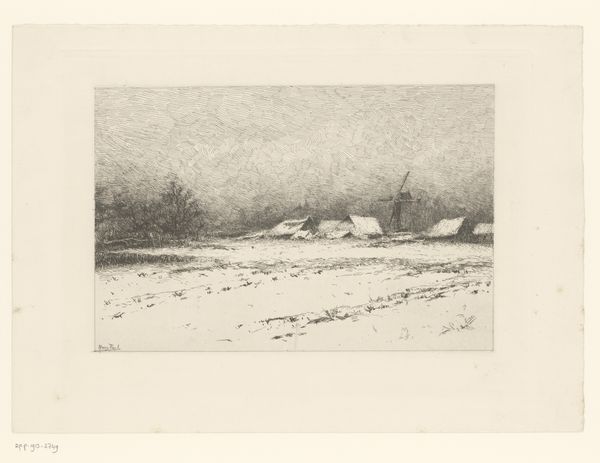
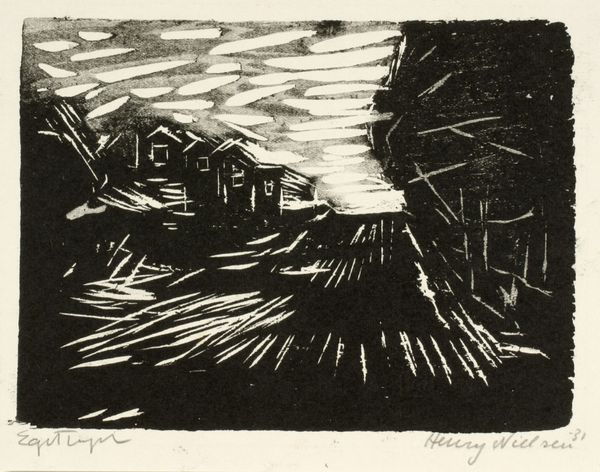
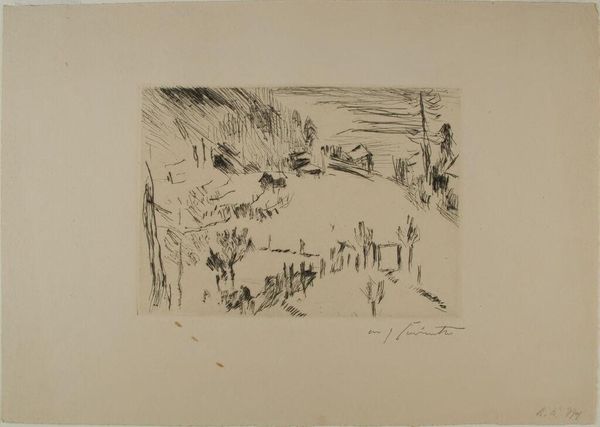
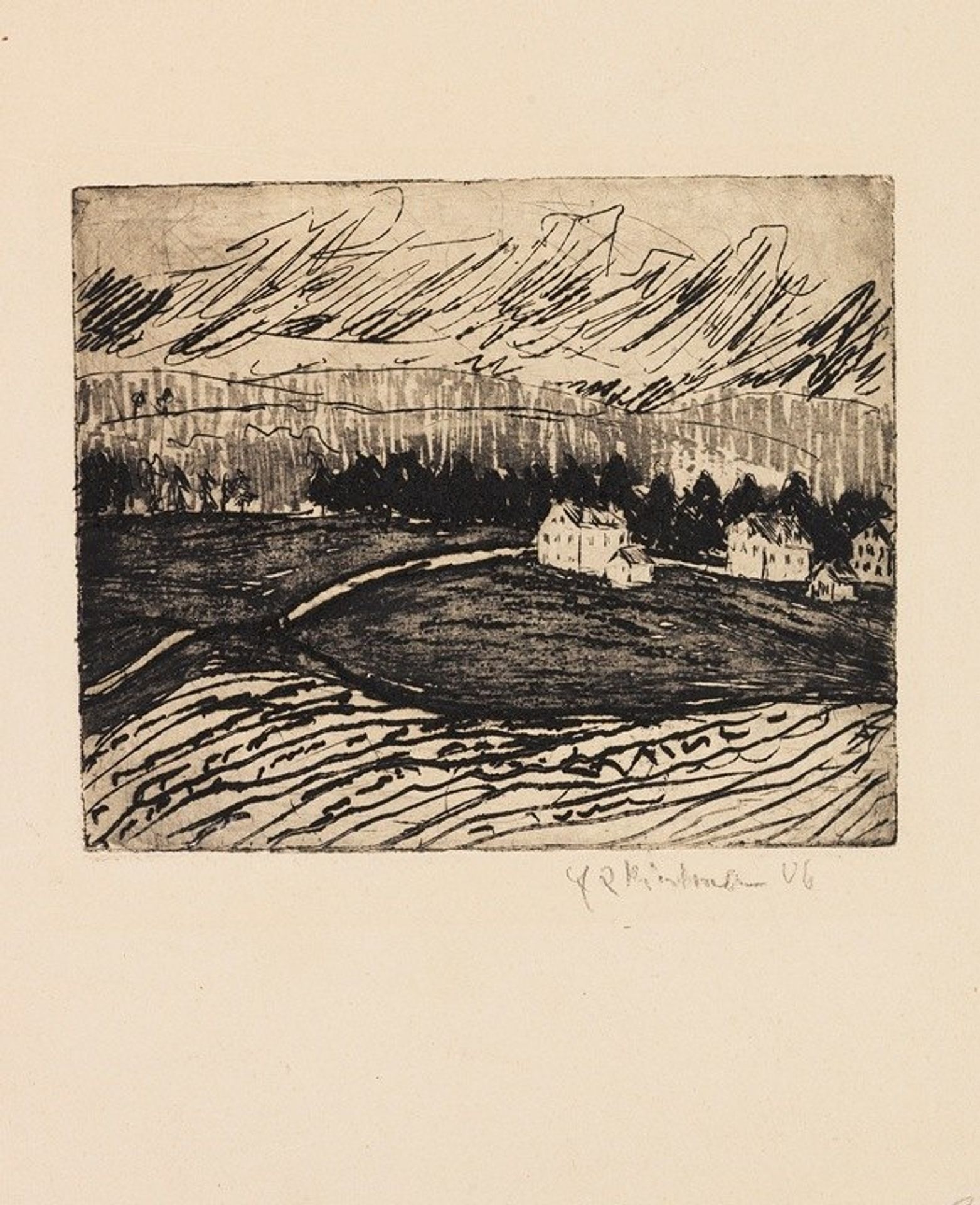
Curator: Welcome. Before us is Ernst Ludwig Kirchner’s etching, "Acker und Häuser im Erzgebirge," or "Fields and Houses in the Erzgebirge," completed in 1906. Editor: Immediately, I'm struck by its starkness. The high contrast between the black ink and the bare paper gives it a kind of rawness. Almost unfinished. Curator: Well, German Expressionism, as an artistic movement, aimed to present subjective emotion, particularly angst. The visible hatching and cross-hatching might intensify that unease. Editor: Precisely. It is less about accurate representation, wouldn't you agree, and more about conveying feeling? Look at those slashing lines that represent the sky – almost violent. It’s like a storm brewing, both literally and figuratively. Curator: Consider the setting itself, the Erzgebirge mountains. They have a long history of mining, and in the early 20th century they faced a loss of rural industry. Kirchner frequently reflected alienation through imagery, wouldn't it make sense for him to be critiquing industrial society? Editor: Perhaps, and that’s visually reinforced by the clustering of the houses. There are clear, bold delineations separating them, not a smooth harmony of forms blending into one another. This underscores the lack of integration or shared space, the visual depiction of alienation you referred to. Curator: There's also a psychological element to these sharply defined, closed spaces. The houses may represent insular, inaccessible psyches. Editor: Yes! In contrast to those sharp delineations, notice how the fields are rendered with more fluid, directional lines that converge. They direct the viewer toward the houses in the middle ground. Curator: Guiding us to where, ultimately, the problem lies? Editor: Precisely. So much more than just a quaint landscape, isn't it? It shows us not just the geography of a place but a state of mind. Curator: Absolutely. I now find I'm considering the continuity of emotional impact communicated through time thanks to symbolic structures like composition and line work.

Artwork details
- Medium
- drawing, print, etching
- Copyright
- Public Domain: Artvee
Tags
Comments
Share your thoughts
About this artwork
Curator: Welcome. Before us is Ernst Ludwig Kirchner’s etching, "Acker und Häuser im Erzgebirge," or "Fields and Houses in the Erzgebirge," completed in 1906. Editor: Immediately, I'm struck by its starkness. The high contrast between the black ink and the bare paper gives it a kind of rawness. Almost unfinished. Curator: Well, German Expressionism, as an artistic movement, aimed to present subjective emotion, particularly angst. The visible hatching and cross-hatching might intensify that unease. Editor: Precisely. It is less about accurate representation, wouldn't you agree, and more about conveying feeling? Look at those slashing lines that represent the sky – almost violent. It’s like a storm brewing, both literally and figuratively. Curator: Consider the setting itself, the Erzgebirge mountains. They have a long history of mining, and in the early 20th century they faced a loss of rural industry. Kirchner frequently reflected alienation through imagery, wouldn't it make sense for him to be critiquing industrial society? Editor: Perhaps, and that’s visually reinforced by the clustering of the houses. There are clear, bold delineations separating them, not a smooth harmony of forms blending into one another. This underscores the lack of integration or shared space, the visual depiction of alienation you referred to. Curator: There's also a psychological element to these sharply defined, closed spaces. The houses may represent insular, inaccessible psyches. Editor: Yes! In contrast to those sharp delineations, notice how the fields are rendered with more fluid, directional lines that converge. They direct the viewer toward the houses in the middle ground. Curator: Guiding us to where, ultimately, the problem lies? Editor: Precisely. So much more than just a quaint landscape, isn't it? It shows us not just the geography of a place but a state of mind. Curator: Absolutely. I now find I'm considering the continuity of emotional impact communicated through time thanks to symbolic structures like composition and line work.
Comments
Share your thoughts