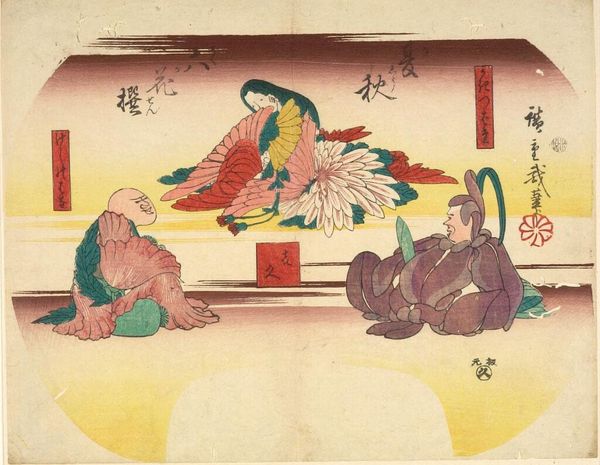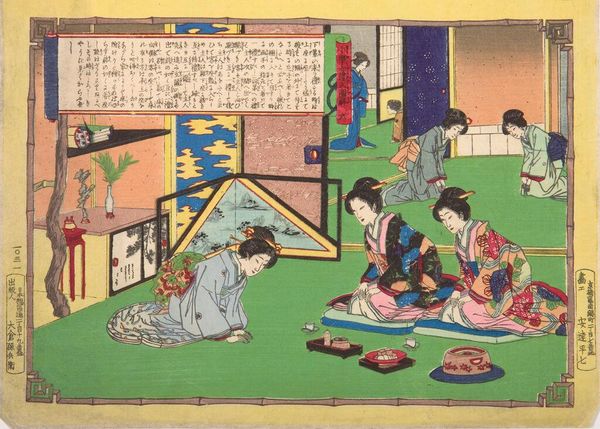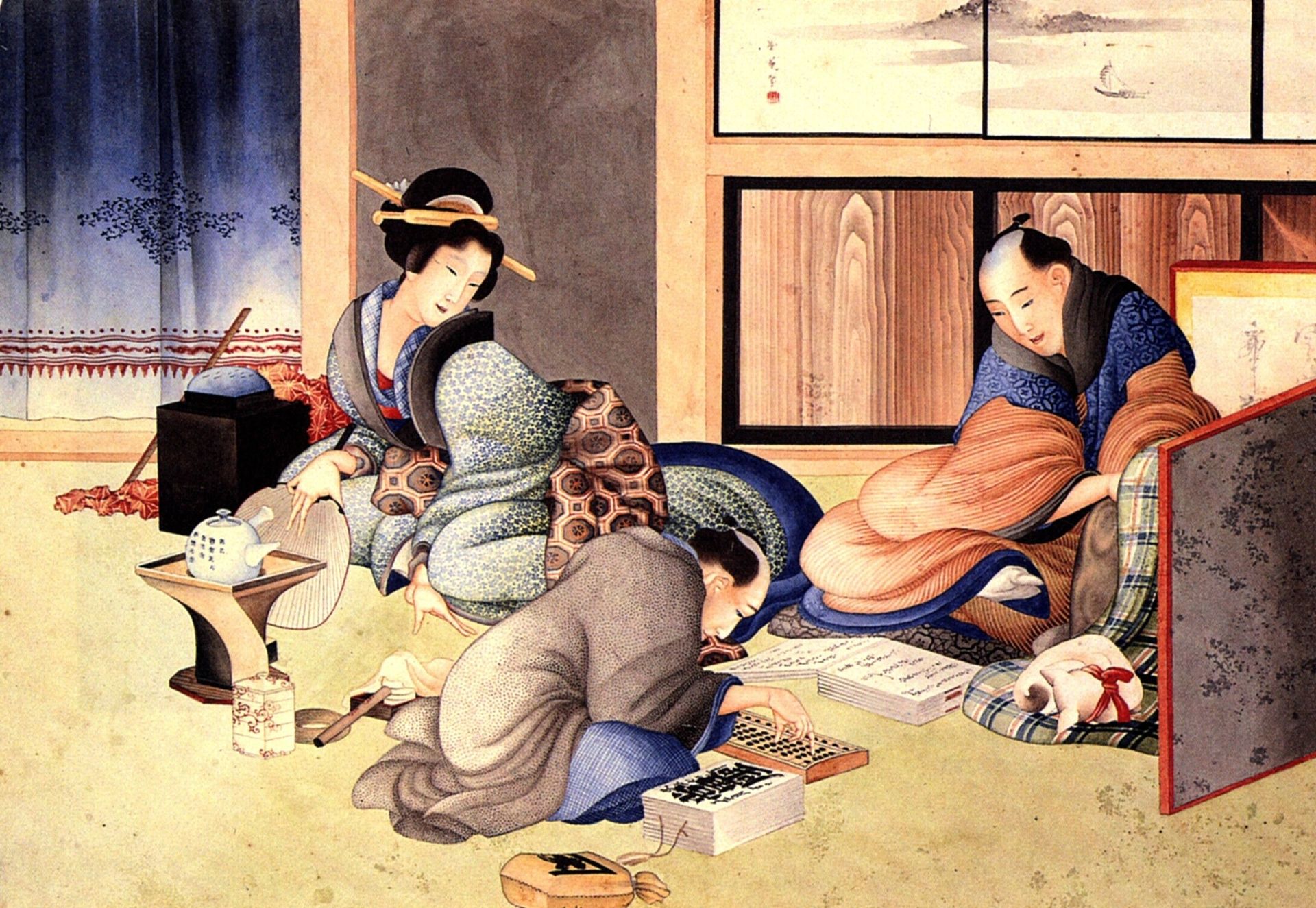
A merchant making up the account

Listen to curator's interpretation
Curatorial notes
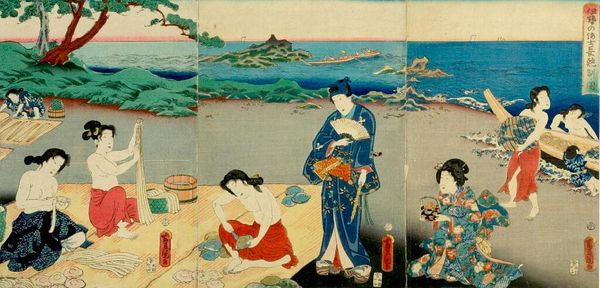
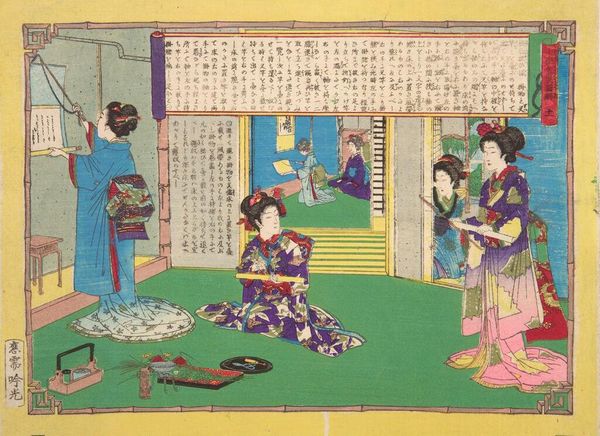
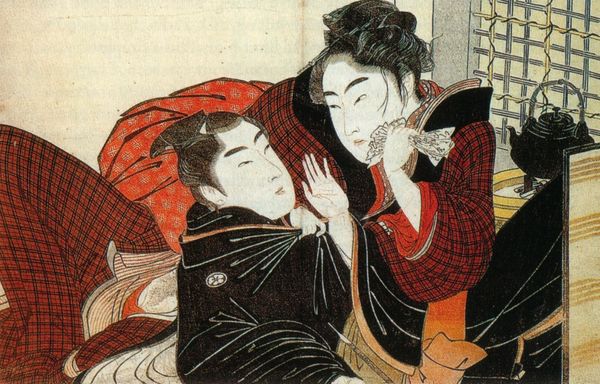
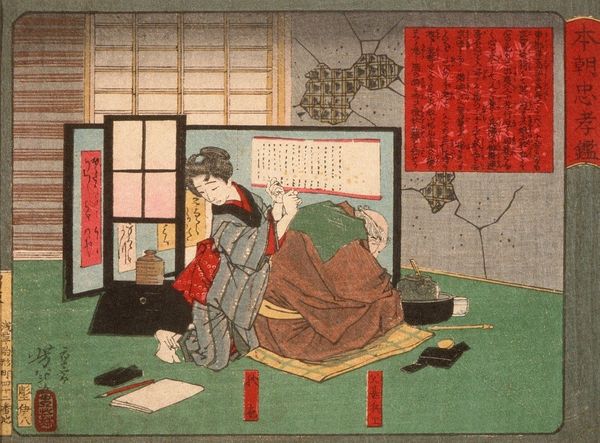
Curator: This work, attributed to Katsushika Hokusai, is titled "A Merchant Making Up the Account." It is a compelling example of ukiyo-e, likely a woodblock print. What's your immediate take on it? Editor: The scene feels quite intimate, almost voyeuristic. There's a definite focus on the objects—the abacus, the tea set—but there’s also an unmistakable focus on the clothing and materials; it all screams commerce, family life, even ritual. Curator: Exactly. It's fascinating to consider how Hokusai uses this genre scene to depict social class and gender roles. Note the seated figures. A woman—presumably the merchant's wife—attends to domestic tasks, a contrast to the men engaged in the business of trade and finance. How do those items and arrangements around them convey the materiality of life? Editor: The presence of those abaci, their physical design with those beads crafted to fulfill commercial purposes, places clear emphasis on the mechanisms of transaction, while the textile patterns on each kimono become social markers of affluence and status—all products of complex manufacturing processes, too. Curator: It also reveals a perspective on the gendered division of labor, one supported by political and economic conditions specific to this period in Japan. Do the woman's tools and stance demonstrate an active engagement with commerce, or is it merely representative of a lifestyle afforded through commerce? Editor: Considering this as an example of genre painting, I’d want to look at the societal implications of creating these images. Were these circulated for a commercial consumer base? And how does depicting them become part of manufacturing consent to the social hierarchies it is portraying? It shows how art and culture played a crucial part in shaping a cultural imagination and justifying a material order. Curator: Food for thought indeed, from these everyday artifacts rendered carefully in a scene, all through labor-intensive printmaking. Each element suggests its broader context; not simply illustrating objects, but illustrating class, culture, gender, and labor systems, too. Editor: It reveals art's power, though; as it simultaneously reflects a particular time while it also can invite a reflection upon the time itself.