drawing, painting, watercolor
drawing
baroque
painting
landscape
watercolor
watercolour illustration
watercolor
Dimensions: height 140 mm, width 209 mm
Copyright: Rijks Museum: Open Domain
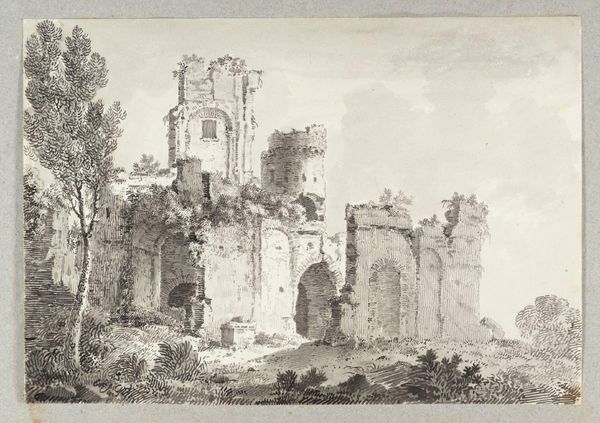
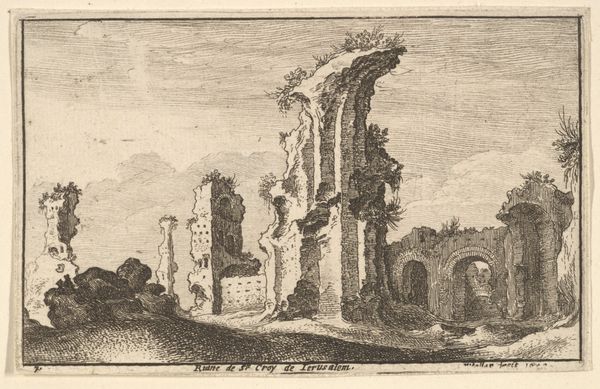
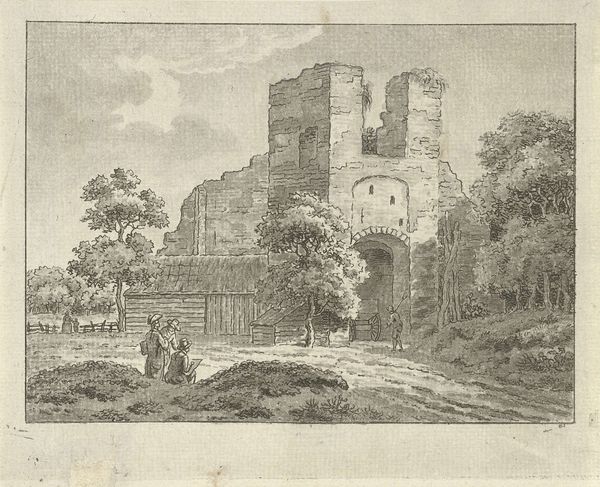
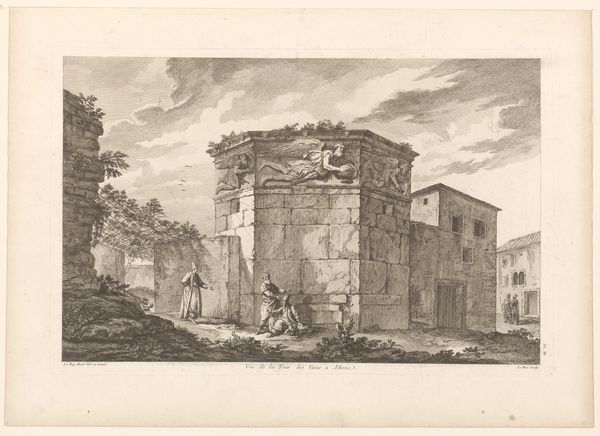
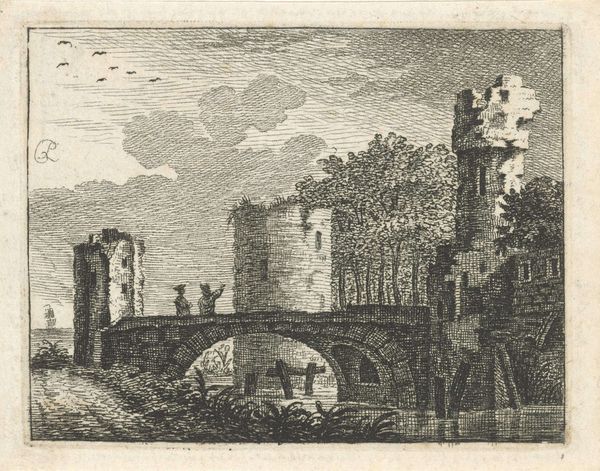
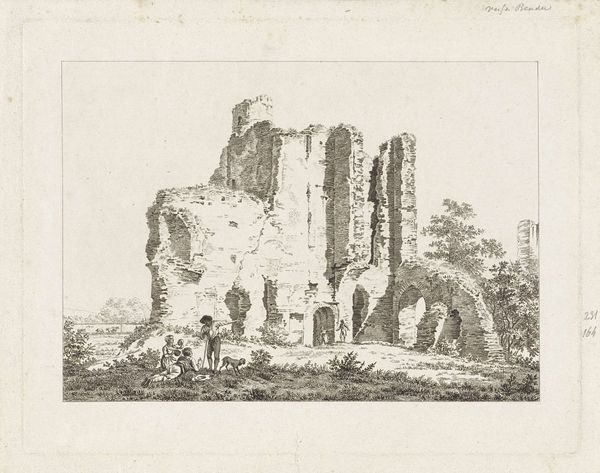
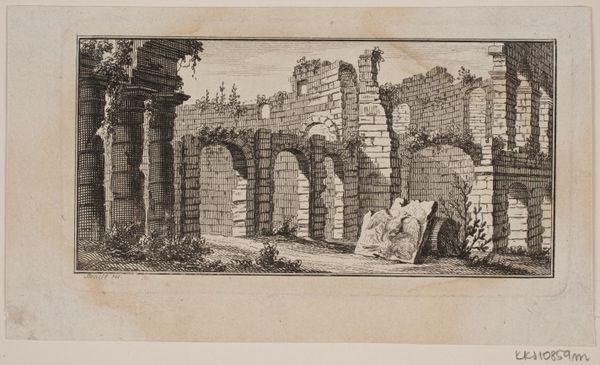
Curator: This is Jacob van der Ulft’s “Oude muur te Rome,” or “Old Wall in Rome,” created in 1674. It’s a watercolor and ink drawing depicting a weathered section of Roman wall. Editor: Immediately I'm struck by the monochrome palette, sepia tones rendering a sort of elegant decay. You can almost feel the sunbaked stones. The figure standing there, a little dwarfed by the architecture, brings an almost melancholic feel to the image, don’t you think? Curator: The use of watercolor here is quite skillful, especially given the date. Look how he achieves tonal variation using diluted washes. You see that the paper itself becomes an active part of the image’s texture. He makes very clever use of what would’ve been a relatively new industrial pigment, lending a sense of timelessness. The support here, in addition to the pigment available at the time, would indicate the work’s possible social purpose, how was it to be consumed? Editor: Precisely, and speaking to consumption, that wall itself has a fascinating history of power and neglect. Van der Ulft, though Dutch, paints a symbol laden with Roman imperial might, now softened with age, worn by the very city that constructed it. He subtly points at history's capacity to render even the most imposing structures into picturesque ruins. The artist’s market would be an interesting subject to explore for further historicization, wouldn’t you say? Curator: Absolutely. And consider, too, the labor involved. Grinding the pigment, preparing the sizing for the paper, the embodied effort in controlling the fluidity of watercolor in an era before standardized tools… These aspects underscore the materiality informing his overall effect. Editor: And thinking about it from a cultural history standpoint, this wasn't just any ruin—it was Roman. To a 17th-century European audience, images of Roman ruins served as constant reminders of civilization's rise and fall, laden with a didactic symbolism ripe for consideration in any analysis. How did that then play into politics? Curator: A potent mix, and his technical decisions absolutely enhance this historical narrative, lending the image gravitas despite its modest size and material simplicity. It makes the decay feel that much more substantial and considered. Editor: This certainly sheds new light on our understanding of how the socio-political climate influenced artistic production. This watercolor serves as a powerful link between materials, art and the historical narrative it portrays.
Comments
No comments
Be the first to comment and join the conversation on the ultimate creative platform.
 React
React Comment