About this artwork
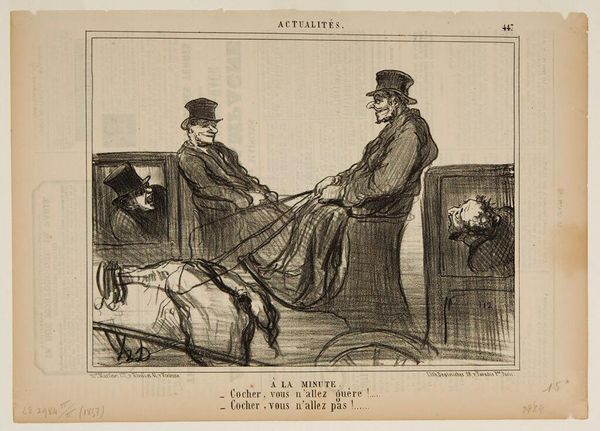
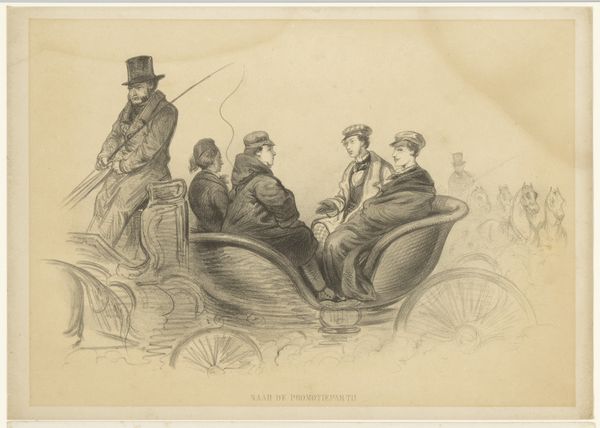
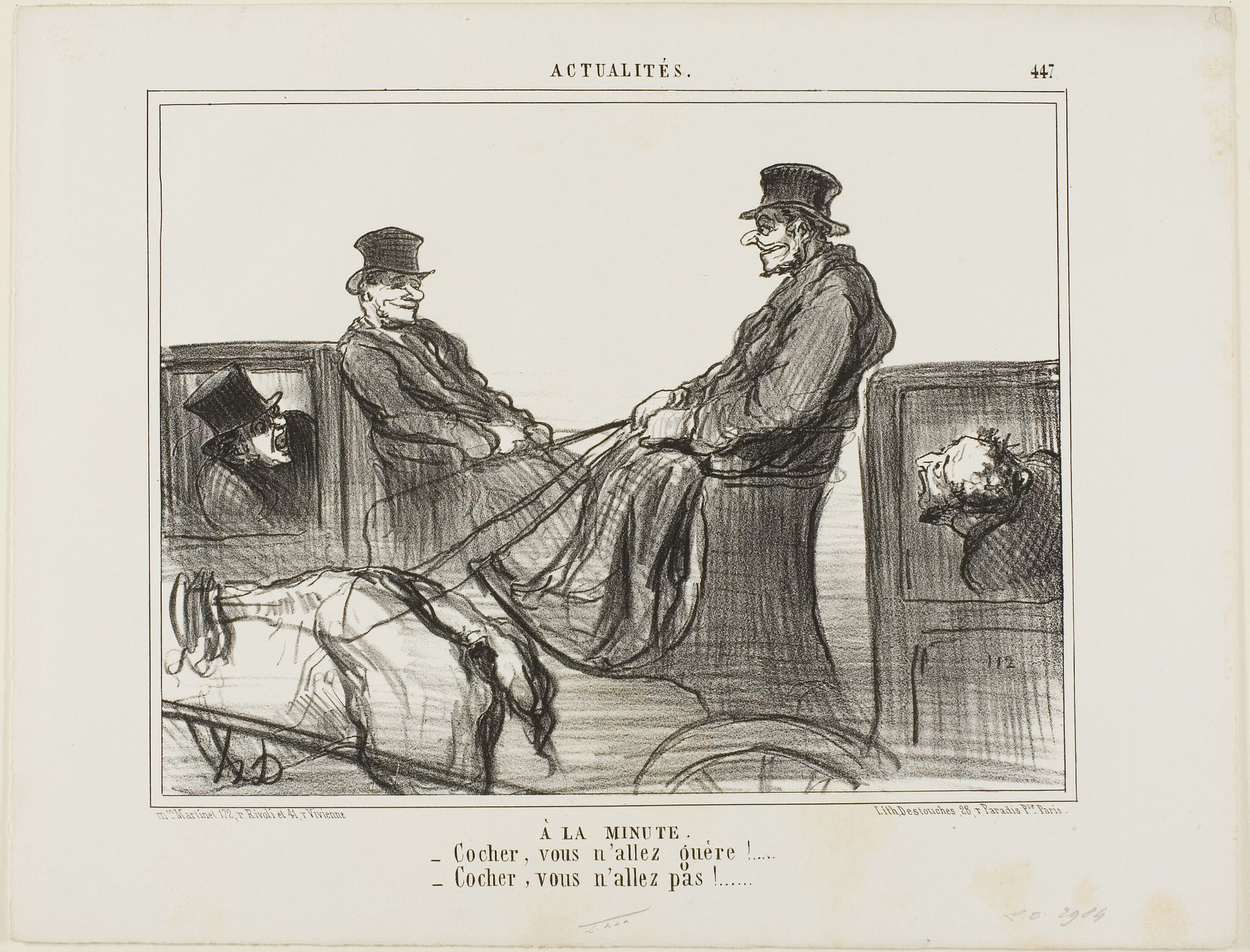
Honoré Daumier created this lithograph, Paid By the Minute, as plate 447 for his series Actualités. Daumier lived through considerable political upheaval in 19th-century France, and his work often critiques the bourgeoisie and their obsession with money. Here, we see a caricature of a horse-drawn carriage with two passengers berating the driver for their lack of speed. The title, "Paid by the Minute," encapsulates the anxiety of a rising capitalist class fixated on the relentless march of time as it correlates to money. The emotional depth comes from Daumier's ability to capture the impatience and the absurdity of a society consumed by financial gain. Daumier challenges conventional representations by highlighting the tensions between different social classes, and he uses satire to expose their flaws. This print serves as a sharp commentary on the human condition, where economic pressures distort our interactions and values.
Paid By the Minute. “- Driver, you are hardly moving! - Driver, you are not moving at all!,” plate 447 from Actualités
1857


Artwork details
- Dimensions
- 208 × 271 mm (image); 276 × 359 mm (sheet)
- Location
- The Art Institute of Chicago
- Copyright
- Public Domain
Comments
Share your thoughts
About this artwork
Honoré Daumier created this lithograph, Paid By the Minute, as plate 447 for his series Actualités. Daumier lived through considerable political upheaval in 19th-century France, and his work often critiques the bourgeoisie and their obsession with money. Here, we see a caricature of a horse-drawn carriage with two passengers berating the driver for their lack of speed. The title, "Paid by the Minute," encapsulates the anxiety of a rising capitalist class fixated on the relentless march of time as it correlates to money. The emotional depth comes from Daumier's ability to capture the impatience and the absurdity of a society consumed by financial gain. Daumier challenges conventional representations by highlighting the tensions between different social classes, and he uses satire to expose their flaws. This print serves as a sharp commentary on the human condition, where economic pressures distort our interactions and values.
Comments
Share your thoughts