drawing, lithograph, print, paper
#
drawing
#
lithograph
# print
#
landscape
#
paper
#
romanticism
Dimensions: 208 × 279 mm (image); 372 × 529 mm (sheet)
Copyright: Public Domain
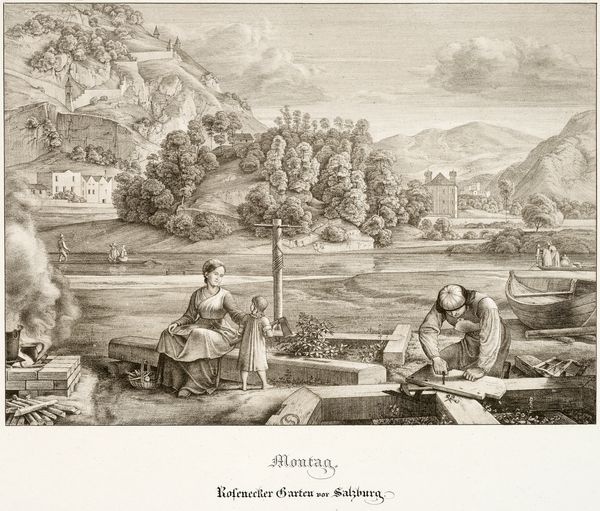
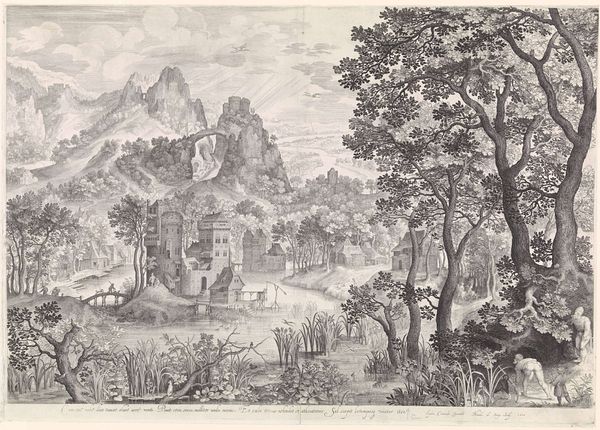
Curator: What a marvelously serene composition. The crisp lines and detailed rendering of this landscape invite a feeling of tranquil observation. Editor: It’s interesting that you find it serene. My initial impression is something closer to wistful, even a touch melancholy. There’s something about the muted tones, almost a sense of faded memory, especially in the rendering of the figures. Curator: Let me orient you. This lithograph, made in 1823, is titled "Thursday: Berchtesgaden and the Watzmann." Ferdinand Olivier, a prominent figure in the Romantic movement, crafted this scene. It is a work on paper, and you can see it at the Art Institute of Chicago. Editor: Knowing it's Romantic makes perfect sense. Look at how the sheer scale of the mountains dwarfs the people – this emphasizes a familiar Romantic theme, doesn’t it? Humanity’s smallness against the grandeur of nature. Also, note that "Thursday" is specified in the title. How might we interpret the weekday as significant? Curator: Intriguing. Within a symbolic reading, Thursdays, associated with the Norse god Thor, god of strength, lightning, storms and oak trees, points toward potent masculine principles set against softer, domestic imagery in the foreground: The planting and nurturing actions, and the figures of mother and child. This visual counterpoise invites interpretations on gender roles and natural forces at work. Editor: That adds a really interesting layer. Olivier was working in a period of great socio-political upheaval. So could this scene reflect the social mood of the era, perhaps yearning for simpler times? I mean, is he perhaps juxtaposing the mythic "masculine" ideals with the intimate lives of women and their offspring. I wonder, for his intended audience, if the setting's suggestion of ideal community values perhaps overshadowed the specific mythology you referenced. Curator: Precisely. Consider, too, the tradition of landscape art as a tool for national identity construction. Olivier, through careful depiction of recognizable landmarks, potentially evokes Bavarian cultural memory, the Watzmann, the famous and formidable mountain becomes an emblem of strength and belonging. Editor: Absolutely, so it isn't just about aesthetic appreciation or sublime terror; the location plays a role in cultivating patriotic feeling among people within a political landscape! A powerful work—at first glance it appears peaceful. Now I can discern a deeper meditation on culture, power, and place. Curator: It’s remarkable how a single image can hold so much. The artist uses cultural and mythic symbolism to prompt personal introspection. Editor: Agreed. And Olivier uses an engagement with place as an instrument in socio-political participation.
Comments
No comments
Be the first to comment and join the conversation on the ultimate creative platform.
 Collect
 React
React Comment
More like this