About this artwork
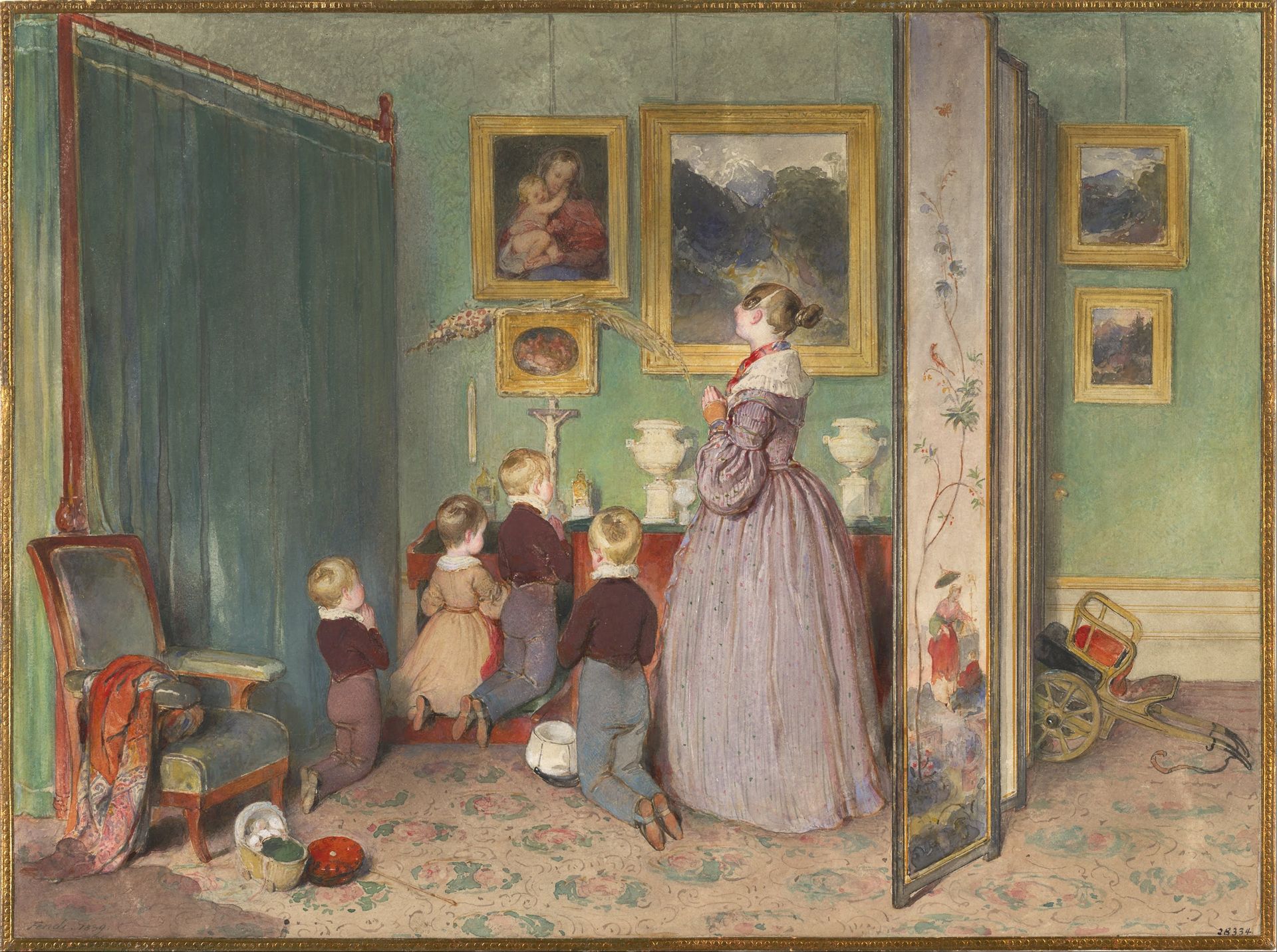
Peter Fendi created 'The Evening Prayer' using watercolour. At first glance, the gentle hues of the watercolour create a serene, domestic scene. Observe how the composition is neatly divided, on the left, domestic objects arranged, balanced by the family to the right. The scene’s emotional weight is carefully structured through spatial relationships, inviting a reading into the values it represents. Fendi uses the semiotic system to communicate cultural codes. For example, the composition subtly elevates the mother, positioning her at the center. Note how the children's figures are rendered with less detail, emphasizing their obedience within the family hierarchy. The paintings on the wall serve as additional layers of meaning, reinforcing the sanctity and tradition of domestic life. The artist challenges fixed meanings by presenting an idealized version of family and devotion. It is a careful blend of social commentary embedded in the formal qualities of the artwork. This challenges us to reflect on both our own cultural values.


Artwork details
- Medium
- painting, watercolor
- Location
- Albertina, Vienna, Austria
- Copyright
- Public domain
Tags
portrait
water colours
narrative-art
painting
figuration
handmade artwork painting
watercolor
underpainting
romanticism
watercolour illustration
genre-painting
watercolor
Comments
No comments
About this artwork
Peter Fendi created 'The Evening Prayer' using watercolour. At first glance, the gentle hues of the watercolour create a serene, domestic scene. Observe how the composition is neatly divided, on the left, domestic objects arranged, balanced by the family to the right. The scene’s emotional weight is carefully structured through spatial relationships, inviting a reading into the values it represents. Fendi uses the semiotic system to communicate cultural codes. For example, the composition subtly elevates the mother, positioning her at the center. Note how the children's figures are rendered with less detail, emphasizing their obedience within the family hierarchy. The paintings on the wall serve as additional layers of meaning, reinforcing the sanctity and tradition of domestic life. The artist challenges fixed meanings by presenting an idealized version of family and devotion. It is a careful blend of social commentary embedded in the formal qualities of the artwork. This challenges us to reflect on both our own cultural values.
Comments
No comments