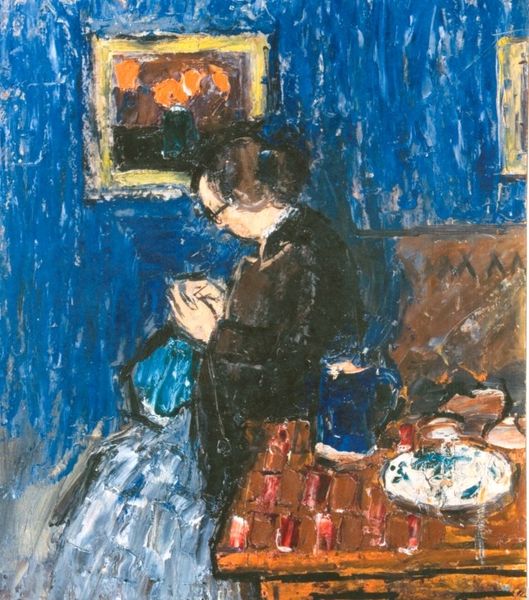
oil-paint, impasto
#
portrait
#
oil-paint
#
painted
#
possibly oil pastel
#
oil painting
#
impasto
#
intimism
#
genre-painting
Dimensions: 61.21 x 119.38 cm
Copyright: Public domain
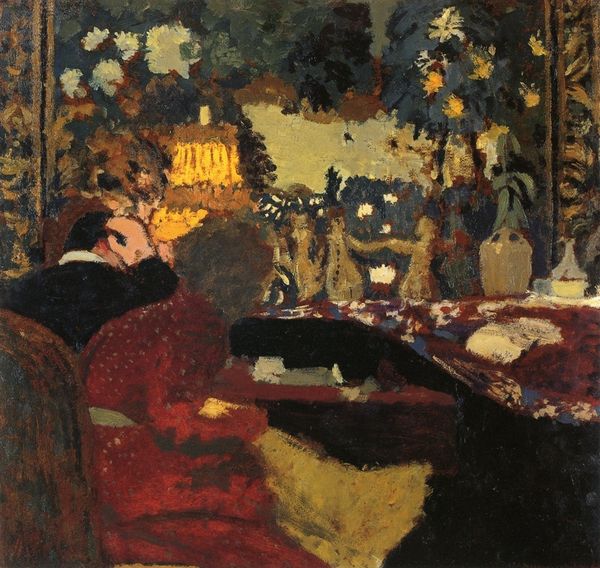
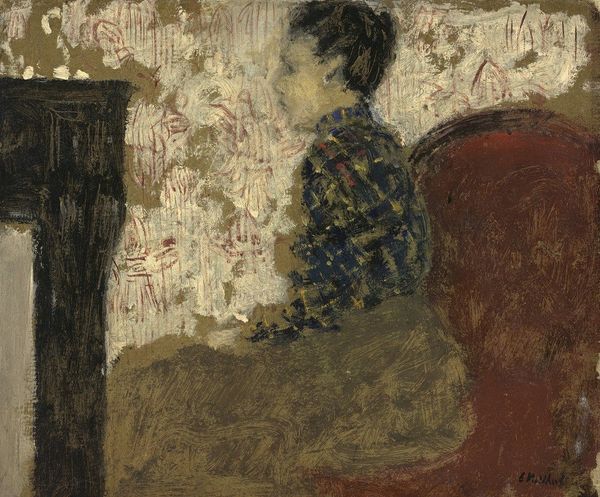
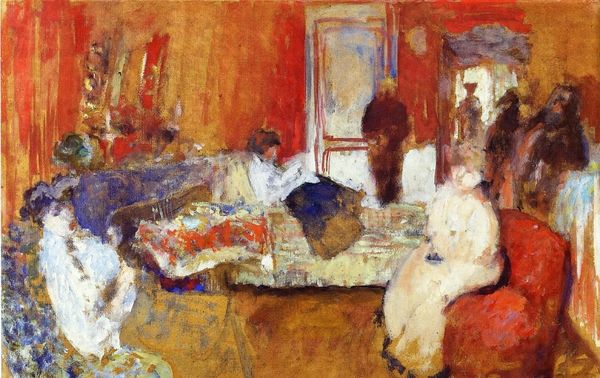
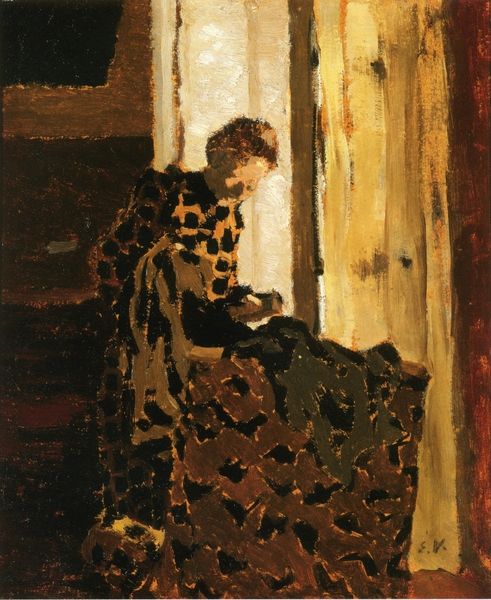
Editor: This is Édouard Vuillard's "The Dining Room," painted around 1900 using oil. The texture looks so thick and almost creamy. I am struck by how the figures seem to blend right into the background. How do you read the composition of this piece? Curator: I see it as a deliberate collapsing of space. Notice how Vuillard uses a restricted palette, predominantly earth tones, to flatten the image. There's a subtle play with the picture plane, where the figures and the background almost become one. Observe the impasto technique – the thick application of paint. Does this build a surface or break one? Editor: I see what you mean about the flattened space. At first glance it seems a bit chaotic, but the colors are actually very controlled. The impasto both creates texture, but in some way obscures detail as well. Curator: Exactly. He’s less interested in representation, more concerned with how the very materiality of paint can create a mood and construct visual relationships. Semiotically, how do the various chairs structure the viewing experience? How does our perspective change based on this implied composition? Editor: Now that you mention the chairs, I notice how their vertical lines punctuate the scene, providing some structure to the amorphous forms. Is Vuillard attempting to show something new? Curator: Yes, indeed. Vuillard pushes the boundaries between interior and exterior, figure and ground, representation and abstraction. Through his emphasis on surface texture and colour relationships, he transforms the ordinary domestic scene into a visually complex and ambiguous space. Editor: This way of examining the composition through its visual elements makes the image become even more of a tangible item! Curator: And through the image, our tangible world opens further too.
Comments
No comments
Be the first to comment and join the conversation on the ultimate creative platform.
 Collect
 React
React Comment
More like this