drawing, graphic-art, paper, typography, ink
#
drawing
#
graphic-art
#
art-nouveau
#
paper
#
typography
#
ink
#
decorative-art
Dimensions: height 148 mm, width 139 mm
Copyright: Rijks Museum: Open Domain
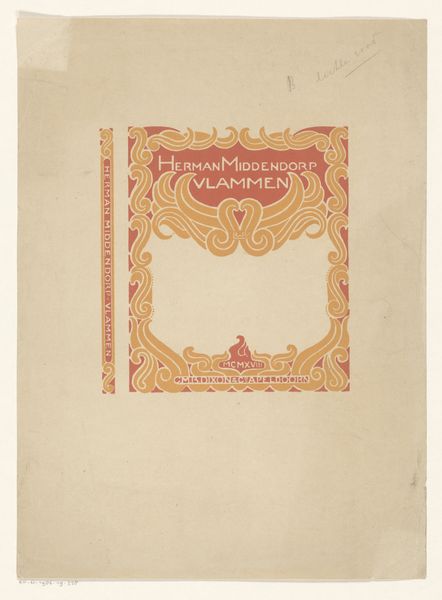
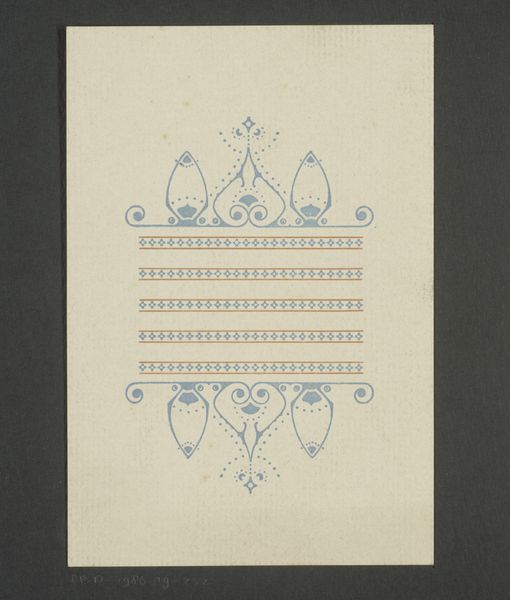
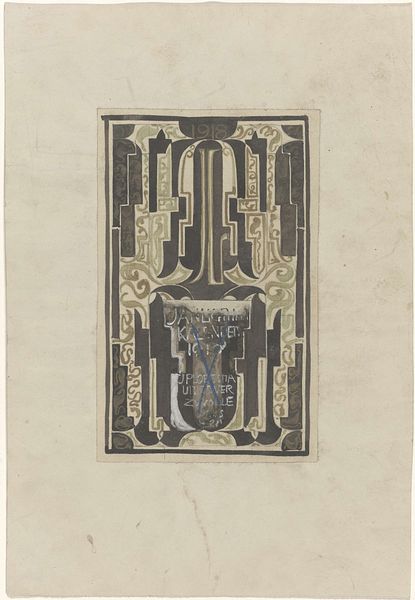
Editor: Here we have Reinier Willem Petrus de Vries's 1908 book cover design, "Bandontwerp voor: P. de Vledder. Bouwsteenen." It combines ink and typography on paper, and what strikes me most is the figure integrated into the "B" – almost like she’s supporting the title. What do you make of this combination of text and figure? Curator: It’s fascinating how the Art Nouveau style intertwines the human form with the letter. This piece speaks to the early 20th-century exploration of symbolism and its role in visual communication. The woman, seemingly part of the architecture of the word itself, can be viewed through a feminist lens. Consider how women were often idealized as both supporting structures and decorative elements within patriarchal societies. Do you think that representation holds true here? Editor: I hadn't considered that angle, but now that you mention it, the woman *is* literally supporting the title. It does seem to reflect a specific, perhaps limiting, role. Curator: Exactly. And note the title, "Bouwsteenen," meaning "Building Blocks." This design makes a powerful statement about women being foundational to cultural or societal structures, even if confined to that supporting position. It prompts us to consider power dynamics inherent in seemingly decorative art. How does that knowledge change your initial impression of the artwork? Editor: It certainly adds a layer of complexity. What I initially saw as simply beautiful now has a sharper, more critical edge. It feels less like innocent decoration and more like a loaded commentary. Curator: Precisely! By recognizing the social and historical context, we begin to see how art acts as a mirror, reflecting—and sometimes reinforcing—prevailing societal norms. Editor: It's amazing how much more there is to discover beyond just the surface aesthetics. Thanks!
Comments
No comments
Be the first to comment and join the conversation on the ultimate creative platform.
 Collect
 React
React Comment
More like this