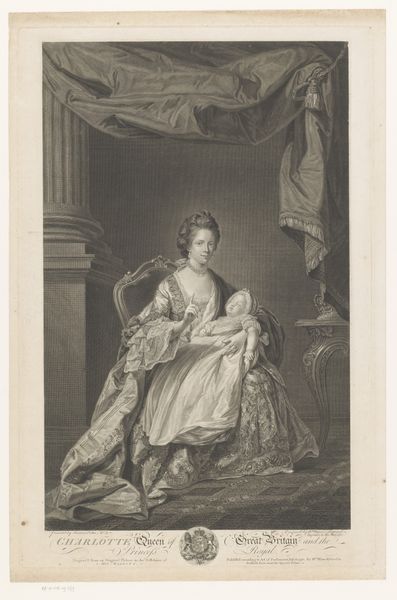
print, engraving
#
portrait
#
neoclacissism
# print
#
history-painting
#
engraving
Dimensions: height 744 mm, width 500 mm
Copyright: Rijks Museum: Open Domain
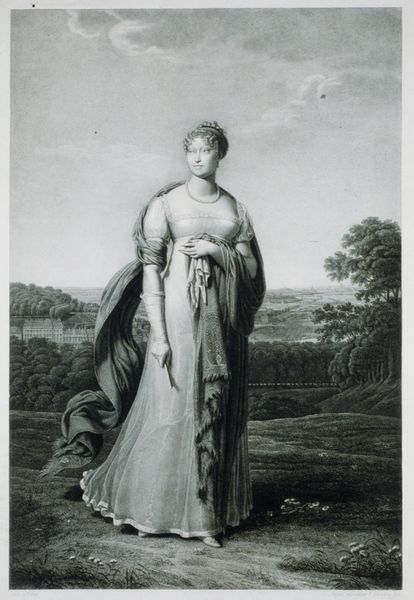
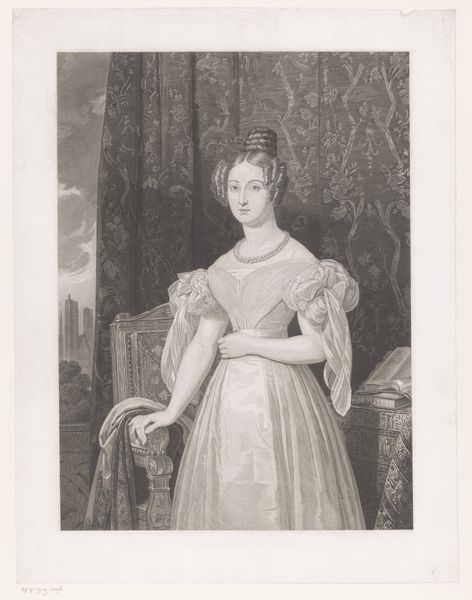
Editor: Here we have Jean Godefroy's "Portrait of Marie Louise of Austria, Empress of the French," an engraving from 1810. She looks rather melancholy, standing there in a grand, yet almost empty, landscape. What catches your eye about this piece? Curator: You know, she *does* seem a bit lost in thought, doesn't she? It’s a powerful portrait, steeped in the visual language of Neoclassicism, all clean lines and an almost sculpturesque feel. But for me, it's the *context* that really sings. Here's Marie Louise, barely 18, traded off in marriage to Napoleon – talk about pressure! This portrait isn't just about likeness; it's about projecting an image of imperial stability. See how that grand estate looms in the distance? It's a statement! But does it truly capture her inner world, do you think? Editor: I hadn't considered it as carefully staged like that, as a conscious construction of an image. It feels more genuine initially, but now… So much for love, huh? Curator: Indeed! Courtly portraits are usually calculated like this. One wonders if Godefroy might have captured a trace of her unease, don't you think? Her expression, poised yet perhaps hinting at a flicker of sadness behind those eyes? What's so fascinating to me is thinking of all of these competing elements at play - power, duty, propaganda and subtle emotions of the individual depicted. It's a rich brew. Editor: I will never look at these portraits the same way, it's a lesson on context. So interesting how you teased that bit of possible sadness out of it too. Curator: Exactly. It's about looking beyond the surface, questioning what the artist and the commissioner want us to see... and finding the untold stories humming underneath!
Comments
No comments
Be the first to comment and join the conversation on the ultimate creative platform.
 Collect
 React
React Comment
More like this