drawing, print, paper, engraving
#
portrait
#
drawing
#
baroque
#
portrait image
#
dutch-golden-age
# print
#
figuration
#
paper
#
form
#
portrait reference
#
framed image
#
portrait drawing
#
engraving
Dimensions: 220 × 161 mm (image); 242 × 166 mm (sheet, trimmed within lower platemark)
Copyright: Public Domain
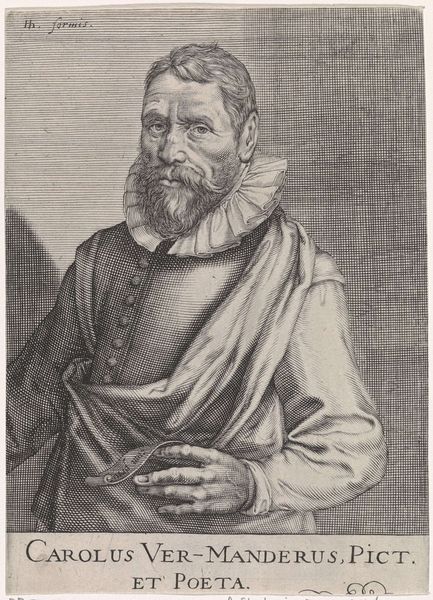
Editor: This engraving, "Sebastiaan Vrancx," made between 1630 and 1645 by Schelte Adamsz. Bolswert, strikes me as a study in power. The subject's gaze, the way he holds that sword... What do you see in this piece? Curator: It's more than just power, I think. Consider the historical context: Vrancx was a painter of battles. This portrait, created in the Dutch Golden Age, presents a specific type of masculinity – one tied to civic duty and military prowess but also artistry. Bolswert's choice to depict Vrancx with such detail also highlights the sitter’s identity, positioning him within a nexus of artistic, social and political concerns. Who held the power to commission portraits like this? Editor: So it speaks to a hierarchy of status. Does his stern expression suggest something beyond confidence, maybe a burden? Curator: Absolutely. Think about the Netherlands at this time, constantly navigating political and religious turmoil. Vrancx, as a painter of battles, visualised these struggles, maybe even participated in them. This image then becomes a reflection on the costs of conflict and leadership. We should ask: who benefits from this representation of power, and whose stories are left untold? Editor: That’s a great point. I was focusing solely on the individual, but placing it within that wider societal conflict and hierarchy changes my understanding. Thanks! Curator: Precisely. Examining these works necessitates an intersectional lens, enabling us to comprehend the intertwined aspects of identity formation.
Comments
No comments
Be the first to comment and join the conversation on the ultimate creative platform.
 Collect
 React
React Comment
More like this