print, engraving
#
portrait
# print
#
old engraving style
#
figuration
#
romanticism
#
line
#
genre-painting
#
engraving
#
realism
Dimensions: height 344 mm, width 278 mm
Copyright: Rijks Museum: Open Domain
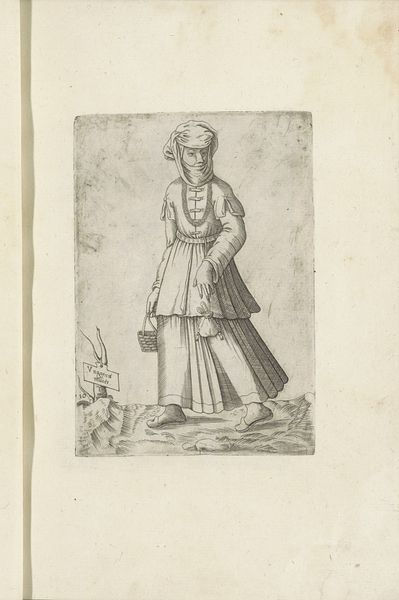
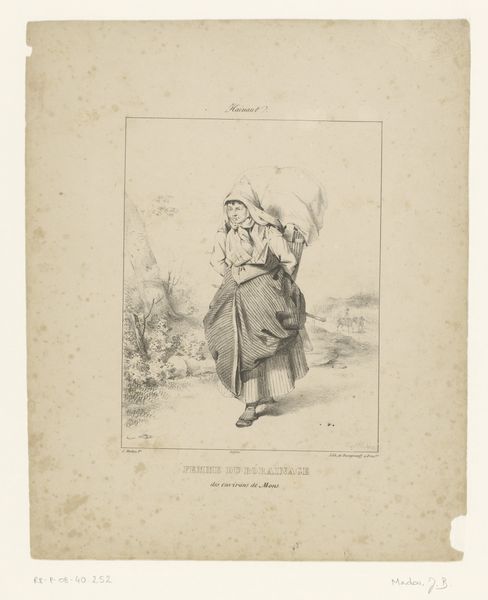
Editor: This print, "Visverkoopster te Scheveningen," or "Fish Seller in Scheveningen," created in 1825 by Guillaume Philidor Van den Burggraaff, portrays a woman carrying baskets. It's delicate, yet feels…stark. What can you tell me about this work, especially considering its production? Curator: Given that it’s an engraving, we need to consider the labor involved. Look at the lines, the detail – that's all painstaking work with a burin. The choice of printmaking as a medium is crucial here. It’s about reproduction, dissemination. How does that relate to the social context of the time, and to the subject matter—a working-class woman? Editor: So, the fact that it’s a print makes it more accessible, and therefore perhaps speaks to a broader audience than, say, a painting might? Curator: Precisely. Who would be buying and collecting these prints? And what does it mean to portray the labor of a fish seller through a process that itself is labor-intensive? The artist is depicting a particular kind of work, through another kind of work, and making that accessible as an object for a collection, or study. What's your read on the romanticism? Editor: Good point! Romanticism glorified the common person. Was this print meant to ennoble her labor? Curator: Maybe, but ennobling for whom? The romanticism interacts with this industrial mode of art production to change the act of meaning. Editor: I see. It's not just about the image itself, but about the system of production and consumption around it, and its reflection on a broader population’s work! Curator: Exactly! Thinking about the material conditions of art production – the how and the why – can radically change how we understand art history. Editor: I’ve definitely learned to consider not just what is depicted but how it came to be and where it circulates!
Comments
No comments
Be the first to comment and join the conversation on the ultimate creative platform.
 Collect
 React
React Comment
More like this