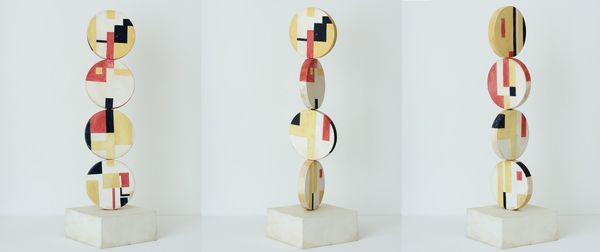
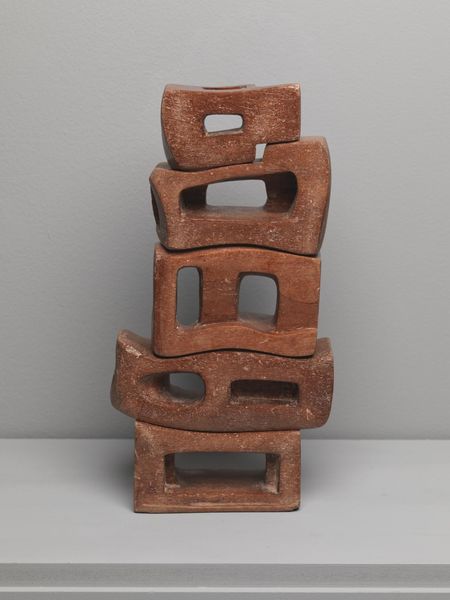
Dimensions: object: 1492 x 1099 x 213 mm
Copyright: © William Tucker | CC-BY-NC-ND 4.0 DEED, Photo: Tate
Editor: Here we have William Tucker's "Anabasis I" at the Tate, a striking sculpture with rounded forms in white and yellow. It almost feels like a playful object, yet there's a strange tension in how the shapes are balanced. What do you make of it? Curator: Oh, this piece hums with unspoken stories! It's like a visual poem. I find myself wondering about the journey implied by the title - a climb, a return. Do you see how the yellow form almost yearns upwards, yet is tethered? Editor: It’s true. It does feel held back. Why do you think the artist chose such simple shapes? Curator: Perhaps, stripping down to essentials allowed Tucker to explore fundamental ideas: support, resistance, and maybe even a touch of longing. It’s a visual haiku, isn't it? Editor: A haiku! I like that. It's definitely given me a new perspective on how much can be conveyed with so little. Curator: It makes me think of how we're all just trying to find our balance, really. Anabasis, indeed.
Comments


Join the conversation
Join millions of artists and users on Artera today and experience the ultimate creative platform.

Anabasis I was included in the 1965 New Generation sculpture exhibition at the Whitechapel Art Gallery that heralded a new approach, using playful abstract shapes, bright colour and made from new materials such as fibreglass and Perspex, freed from the need for a plinth. Such sculpture was physically part of the contemporary world but also self-contained and non-associative. Anabasis I shows the successive mutation of an interlocking simple cruciform shape: an edged yet curvilinear cross volume interlocks with a rounded version of the same form and finally with a transparent Perspex sheet cut to a plan of the previous form. Gallery label, September 2016