print, engraving
#
portrait
#
pencil drawn
#
neoclacissism
#
light pencil work
# print
#
pencil sketch
#
pencil drawing
#
pencil work
#
history-painting
#
engraving
Dimensions: height 203 mm, width 161 mm
Copyright: Rijks Museum: Open Domain
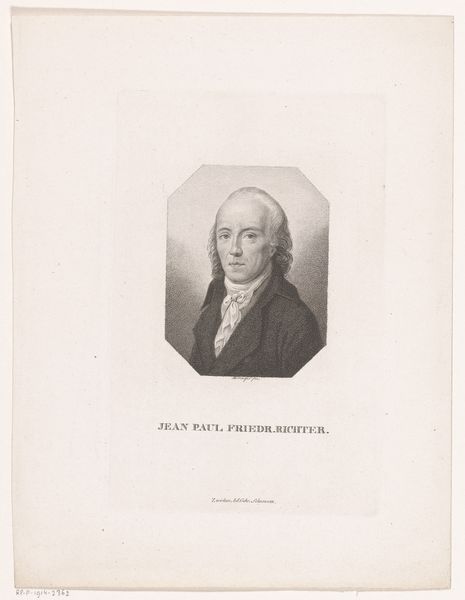
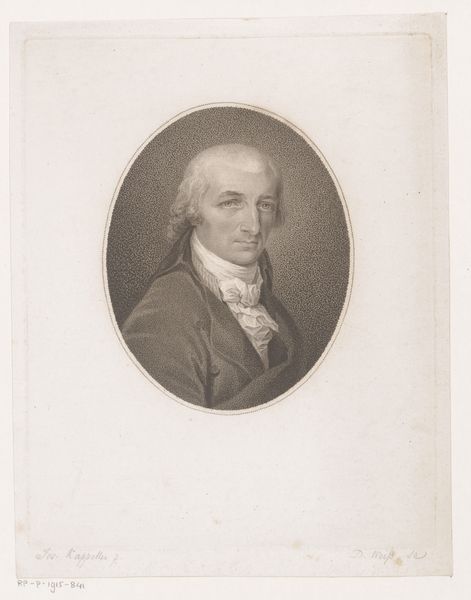
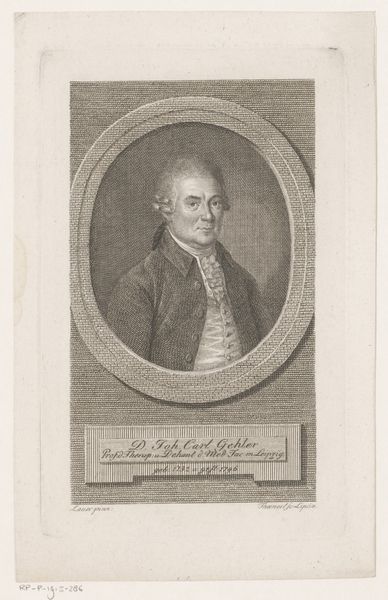
Curator: This is a print portraying Louis XVIII, King of France. It’s attributed to Johann Friedrich Bolt and was made sometime between 1814 and 1836. What's your immediate take? Editor: Stark! The rendering emphasizes a particular stoicism... Or perhaps, resignation? It’s powerful how much weight a simple engraving can convey. Curator: Indeed. Looking at the composition itself, it's interesting how Bolt chose engraving for this portrait, given the socio-political context of the time. Engraving, with its capacity for mass production, suggests a deliberate attempt to disseminate the image of the restored monarch widely. It democratizes the image, making it accessible beyond the elite circles who could afford painted portraits. Editor: Fascinating point! I immediately focus on those medals pinned to his chest. They seem almost… weighty, visually. Medals often act as visible symbols of power, honor, and legitimacy, yet here they almost drag him down. Perhaps representing the burdens of leadership? Curator: Good observation. Consider the actual production: the paper itself, likely a readily available stock, and the ink, economical for reproducing this image en masse. Bolt's choices suggest an understanding of printmaking not just as art, but as a tool of political messaging. It's a far cry from the luxurious court portraiture of the Ancien Régime, isn’t it? Editor: Definitely. Thinking of the image, the octagonal frame seems quite deliberate. It sets him apart while maintaining an artificial boundary… the symbolic boundary of the monarchy, perhaps? Or, is there a historical precedent for that shape in royal portraiture that I'm missing? Curator: A fair question! One can imagine the labor involved: the engraver meticulously translating an original image—perhaps a painting—onto a plate, and the printers pulling impression after impression. The relatively simple technique belies an efficient, almost industrial, mode of production meant to bolster royal image, not reflect it. Editor: Yes. And seeing that cross on his coat repeated evokes power, maybe even tradition... But there is something rigid, almost defensive about his stance. It certainly gives pause to consider its deeper significance! Curator: Studying the tangible materials gives valuable clues, don't they? I’m interested in what other meanings can be excavated with a more profound visual consideration! Editor: Absolutely, the layers of interpretation run deep.
Comments
No comments
Be the first to comment and join the conversation on the ultimate creative platform.
 Collect
 React
React Comment
More like this