About this artwork
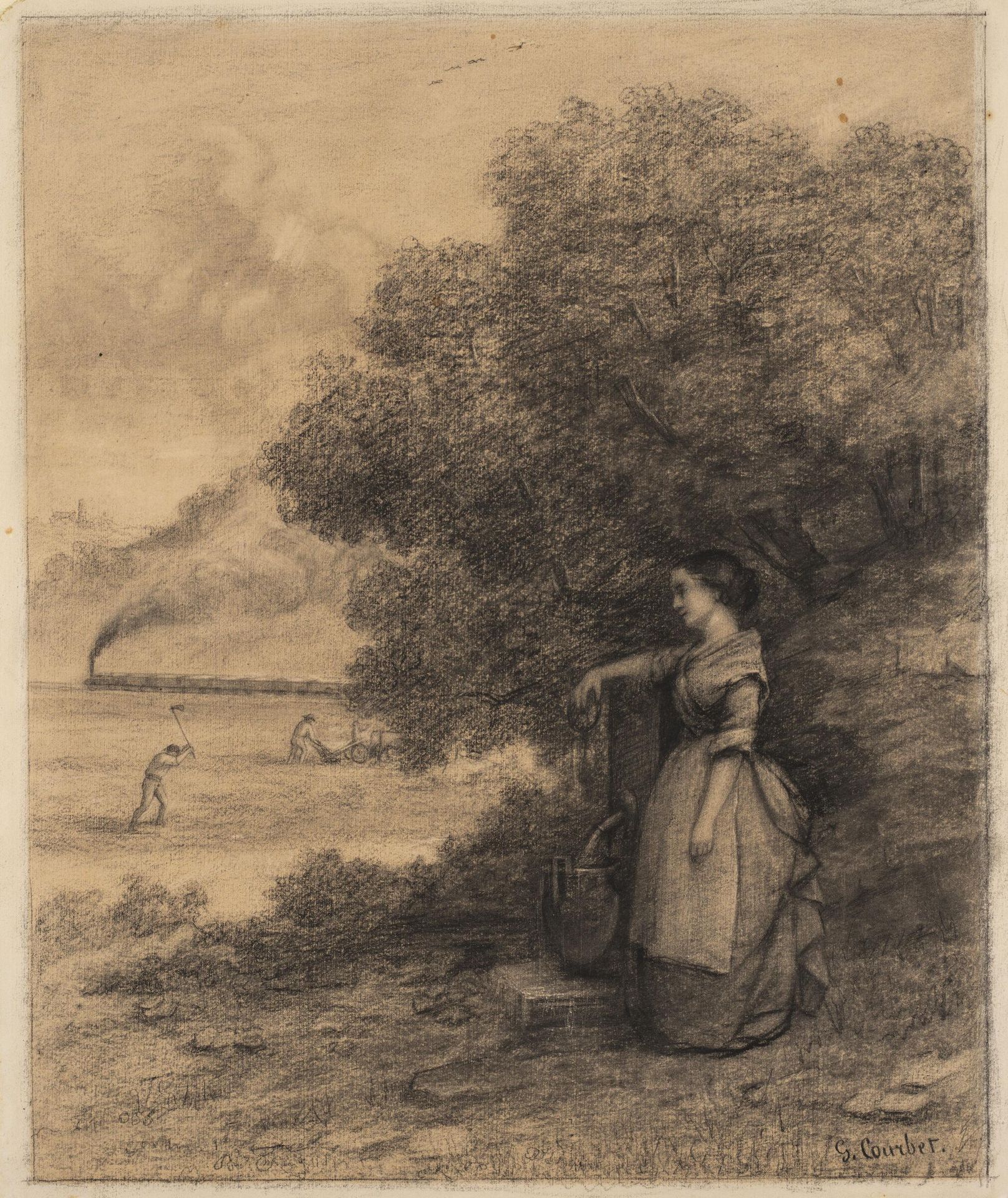
Curator: This is Gustave Courbet's "Peasant Girl by a Pump," a drawing at the Harvard Art Museums. I'm struck by the way the soft charcoal captures a moment of quiet reflection. Editor: It's somber, almost melancholic. The contrast between the well-dressed girl and the laborers in the background, punctuated by that distant train, it speaks of social division, doesn’t it? And that pervasive grayness, is it the charcoal or is it a comment on the grayness of work? Curator: Perhaps both. The pump itself is an interesting symbol. Historically, wells and pumps represented a connection to life-giving resources, a communal space for women. Editor: Yes, and this drawing, look at the mark making, how he applies and blends charcoal to convey a kind of weight and substance, but also blurriness, almost like memory. The girl's dress, rendered with such care, is clearly not work-wear. Who is she and why is she at the pump? Curator: An interesting question. Courbet often used his art to explore the realities of rural life, so she stands as a figure caught between worlds. Editor: There's an honesty in the materials that reflects that, a commitment to rendering social realities. He uses charcoal to get to the heart of the matter. Curator: Absolutely. This drawing is a powerful meditation on class and labor. Editor: A poignant study of work, class, and the stories our materials can tell.
Peasant Girl by a Pump
c. 1860


Artwork details
- Dimensions
- 48.6 x 40 cm (19 1/8 x 15 3/4 in.)
- Location
- Harvard Art Museums
- Copyright
- CC0 1.0
Comments
Share your thoughts
About this artwork
Curator: This is Gustave Courbet's "Peasant Girl by a Pump," a drawing at the Harvard Art Museums. I'm struck by the way the soft charcoal captures a moment of quiet reflection. Editor: It's somber, almost melancholic. The contrast between the well-dressed girl and the laborers in the background, punctuated by that distant train, it speaks of social division, doesn’t it? And that pervasive grayness, is it the charcoal or is it a comment on the grayness of work? Curator: Perhaps both. The pump itself is an interesting symbol. Historically, wells and pumps represented a connection to life-giving resources, a communal space for women. Editor: Yes, and this drawing, look at the mark making, how he applies and blends charcoal to convey a kind of weight and substance, but also blurriness, almost like memory. The girl's dress, rendered with such care, is clearly not work-wear. Who is she and why is she at the pump? Curator: An interesting question. Courbet often used his art to explore the realities of rural life, so she stands as a figure caught between worlds. Editor: There's an honesty in the materials that reflects that, a commitment to rendering social realities. He uses charcoal to get to the heart of the matter. Curator: Absolutely. This drawing is a powerful meditation on class and labor. Editor: A poignant study of work, class, and the stories our materials can tell.
Comments
Share your thoughts