print, photography, architecture
# print
#
sculpture
#
landscape
#
photography
#
architecture
#
realism
Dimensions: height 174 mm, width 230 mm
Copyright: Rijks Museum: Open Domain
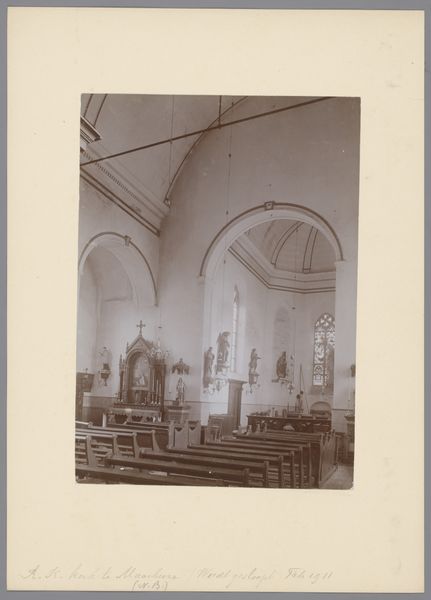
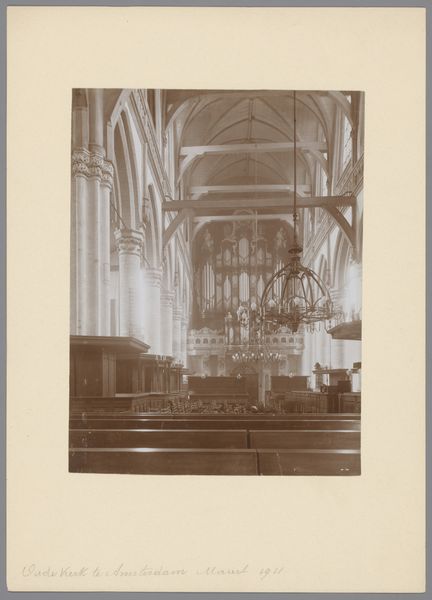
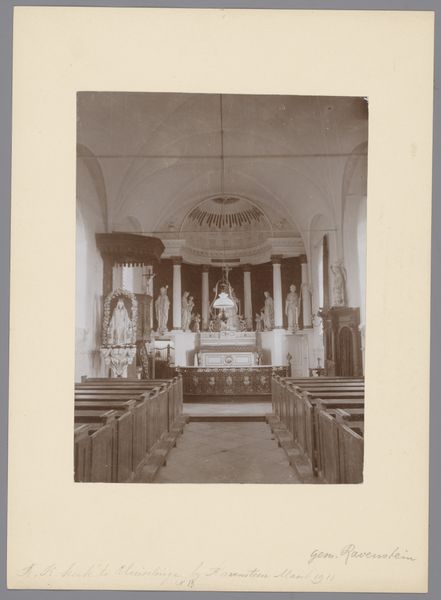
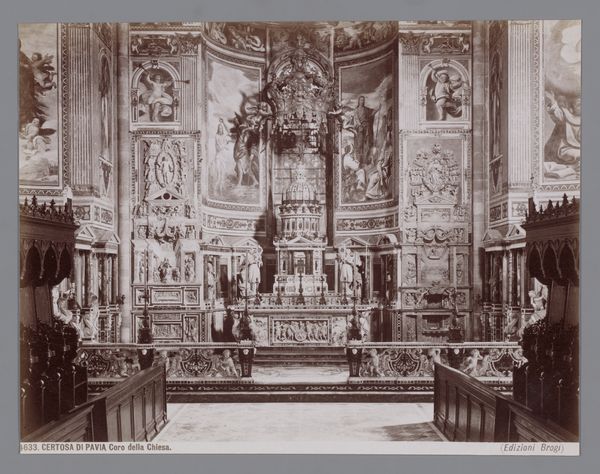
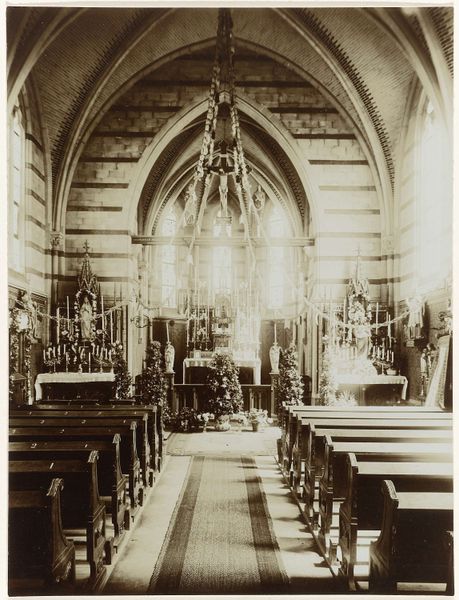
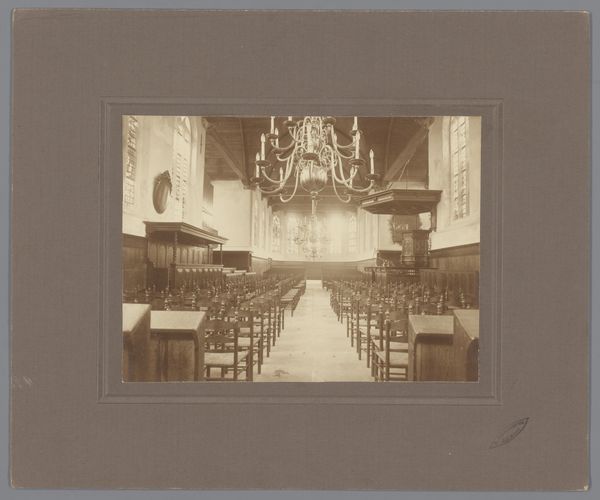
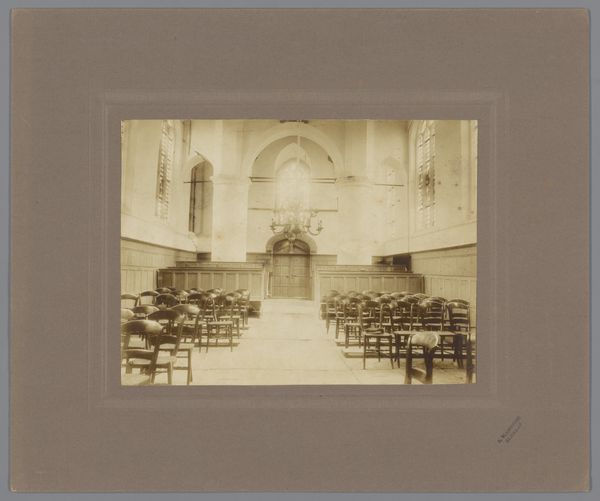
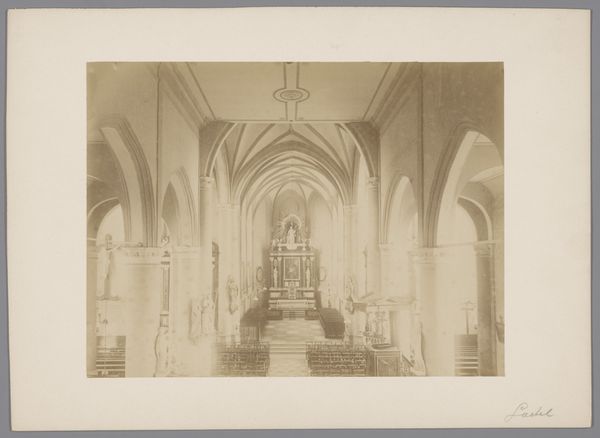
Editor: This photograph, titled "Interieur R.C. Kerk," was taken sometime between 1900 and 1905. It presents the interior of a Roman Catholic Church, and its sepia tone gives it an aged, solemn feel. The composition draws your eye straight down the central aisle. What strikes you about the form and structure here? Curator: The photograph's strength lies in its meticulous depiction of architectural space through the interplay of light and shadow. Note how the photographer uses linear perspective, converging lines of pews and arches to emphasize depth. It also articulates hierarchy within the depicted space. The strong central composition guides your eye through the receding spaces to focus on the altar in the distance. Consider the strategic use of symmetry here, which is prevalent in classical artistic structures, particularly throughout architecture. Editor: It seems almost hyper-real, yet it’s a photograph, not a painting. Curator: Indeed. But is it merely representational? Note how the gradations in the photographic emulsion itself construct tonal variations in light as well as shadows that describe texture. The quality of light from the windows creates halos and patterns across every element, animating them beyond pure realism. Can you see how the high contrast might evoke a spiritual quality or a sense of transcendence, while the detailed resolution lends itself to clarity of rational thought and spatial integrity? Editor: I see what you mean. The photographer captured not just the space, but a very specific feeling and set of ideas. Thanks, I hadn't considered that. Curator: Absolutely. Close attention to photographic values can unveil subtle meaning inherent in the form of this powerful piece. It encourages us to contemplate structure, perspective, and the relationship between form and symbolic significance within a sacred setting.
Comments
No comments
Be the first to comment and join the conversation on the ultimate creative platform.
 Collect
 React
React Comment
More like this