1946
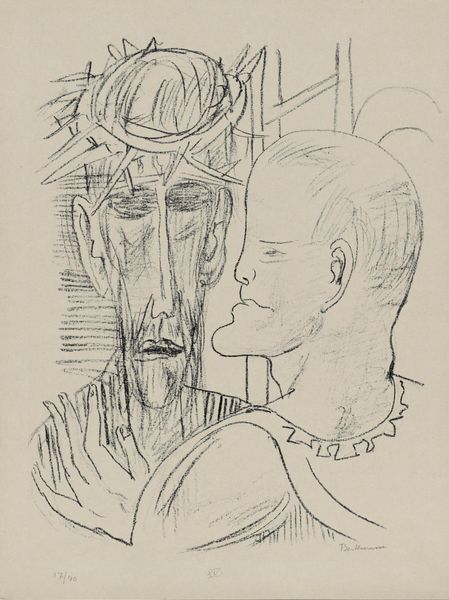
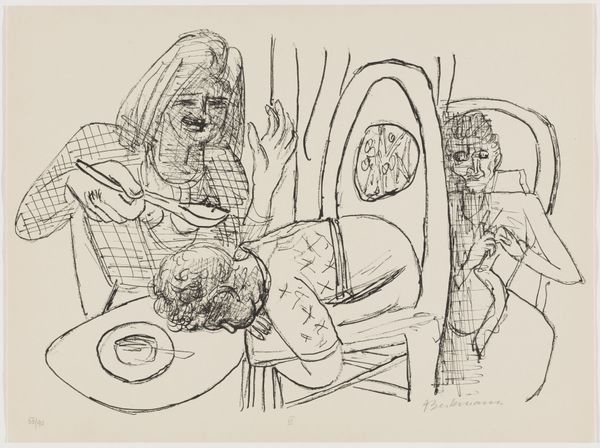
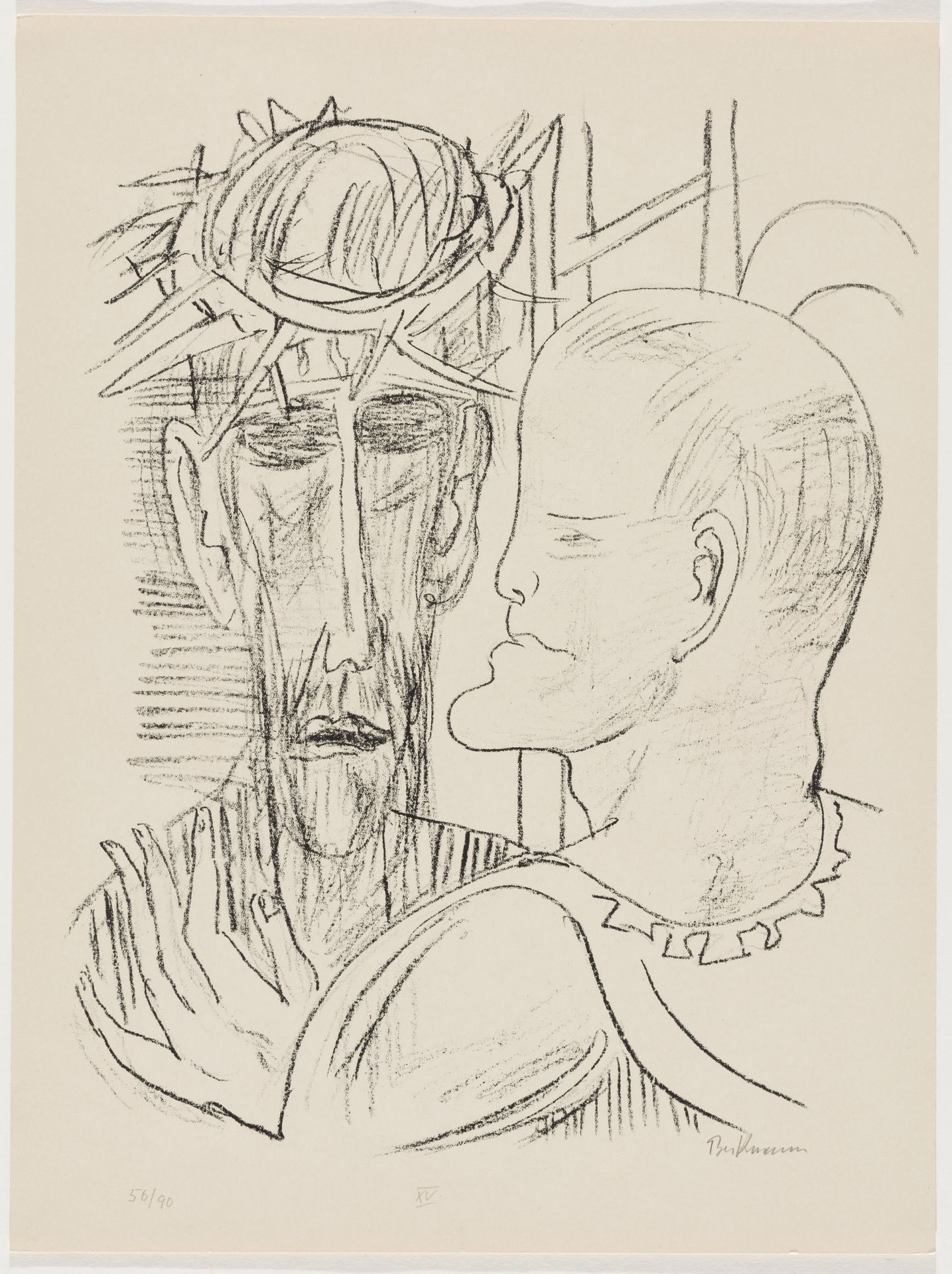
Christ and Pilate (Original Title)Blatt 15 aus der Mappe „Day and Dream“


Listen to curator's interpretation
Curatorial notes
Curator: This lithograph from 1946, created by Max Beckmann, is titled “Christ and Pilate,” and it is currently housed at the Städel Museum. Editor: Immediately, I feel this incredible sense of subdued sorrow and resignation radiating from Christ’s face, contrasted sharply by Pilate's almost detached air. The lines are raw and expressive. Curator: Absolutely. It's interesting to consider the materials themselves. The lithographic process, using a stone or metal plate, allows for that broad tonal range we see, almost mimicking a charcoal drawing. This adds to the somber mood. It bridges a gap between mass production and an original work. Editor: I agree, the medium suits the message so well, giving a quality that’s both stark and ephemeral. It makes me think of the way narratives, especially those with complex power dynamics like this biblical one, are constantly being etched and re-etched into history. Curator: And consider the social context of its creation: 1946, the immediate aftermath of World War II. Beckmann was deeply affected by the war; many view his biblical subjects as allegories for human suffering and the abuse of power. This particular piece captures that postwar disillusionment and questioning. Editor: Exactly! And the lines become imbued with the weight of those anxieties. You know, Pilate’s face, though less overtly pained, also conveys a kind of weariness, an exhaustion from the machinery of decision-making, the weight of ruling. A subtle condemnation. Curator: The tension here, it seems deliberate. By using simple lines in a mechanically reproducible medium, the image democratizes suffering, implying anyone, anytime, anywhere could find themselves either as the powerless or the one inflicting suffering. Editor: Hmm, beautifully stated! This print hits me as both an accusation and a lamentation, doesn’t it? Proof, maybe, that art is where theology and political theory dance a very uneasy tango. Curator: I think it is. An uneasy tango that the viewer is invited to contemplate across time and in our present moment. Editor: Leaving us to ponder, with a frown, our own Pilate-like moments, large and small, huh? Okay, duly pondered.