lithograph, print
#
lithograph
# print
#
caricature
#
figuration
#
cityscape
#
genre-painting
Dimensions: image: 19.2 x 24.2 cm (7 9/16 x 9 1/2 in.) sheet: 26.5 x 34.2 cm (10 7/16 x 13 7/16 in.)
Copyright: National Gallery of Art: CC0 1.0
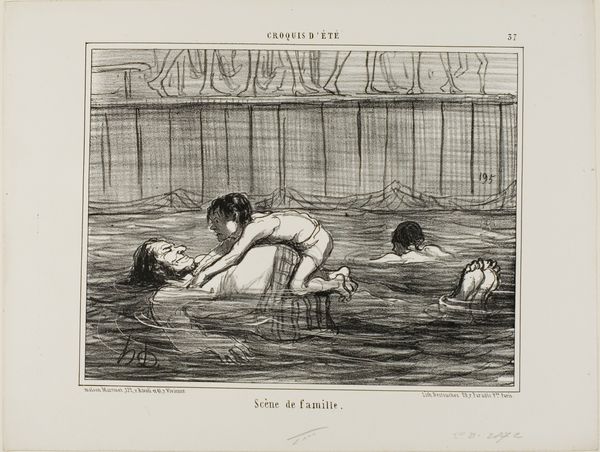
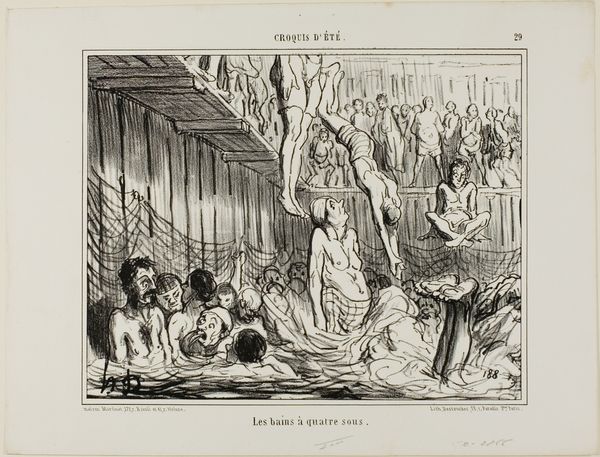
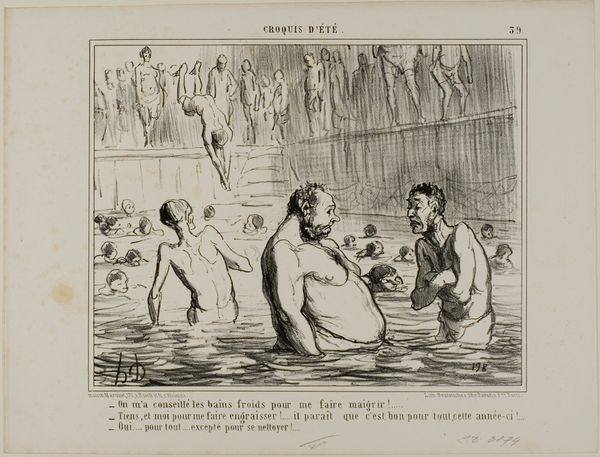
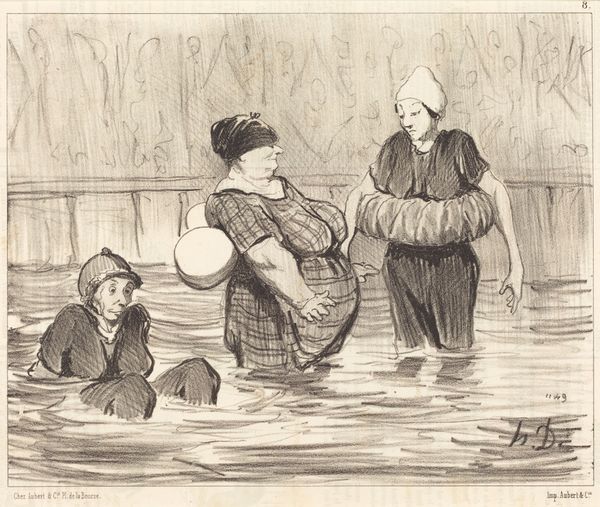
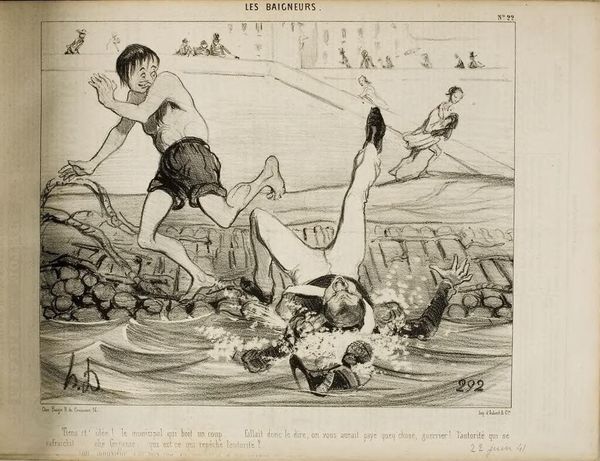
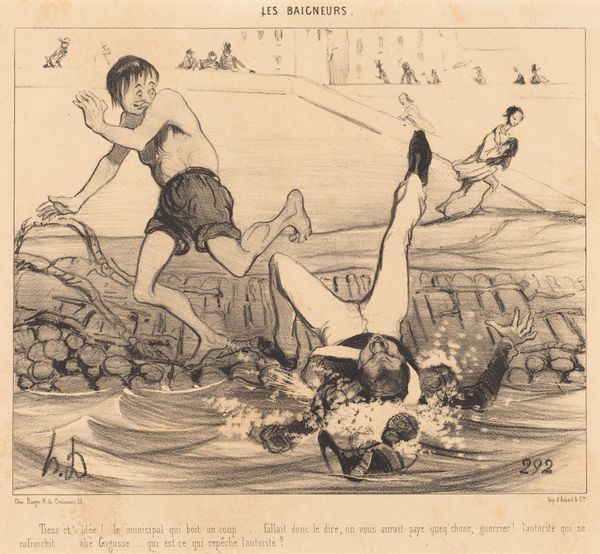
Editor: This lithograph by Honoré Daumier, “Nayades de la Seine (Sea Nymphs of the Seine)," from 1847 presents figures bathing in what I assume is the Seine River. I'm struck by how unflattering it is. It feels like a pointed commentary on Parisian society. What kind of symbolic readings do you find in this image? Curator: Indeed, these "sea nymphs" are hardly idealized! Daumier often used caricature to critique the bourgeoisie. Look at how he renders the bathers - their heavy forms, strained expressions, and the darkness of the print itself. Do these elements call to mind any traditional depictions of nymphs or bathing figures? Editor: Not at all! Traditional depictions are usually quite idealized and elegant, a far cry from this scene. It's almost as if he's intentionally subverting that classical imagery. Curator: Precisely. By contrasting the classical ideal with this unflattering portrayal, Daumier offers a powerful commentary. What feelings are evoked in the viewer of the contrasts within a rapidly industrializing city, with it's new class structures? Consider the gazes of the onlookers on the bridge. Editor: The juxtaposition is uncomfortable. The contrast between leisure and… whatever this is. And I notice now that all the figures, in the water and on the structure, seem to avoid looking at each other directly, which reinforces that awkwardness. Curator: Note that the title "Nayades de la Seine" provides an ironic label when we think about these mythological associations, or what these associations *should* be. Daumier offers a societal critique. This tension heightens the print’s effectiveness as social commentary, inviting viewers to reconsider romantic notions and social realities. What do you think Daumier might be saying about Parisian society? Editor: He seems to be suggesting a stark difference between fantasy and reality. The 'nymphs' aren’t graceful, beautiful creatures but ordinary people engaging in mundane, slightly awkward activities, reflecting a broader commentary on the era’s social dynamics. I hadn't thought about that before, about the distance between mythology and modern life... Curator: These everyday ironies offer a space to analyze continuity, memory, and meaning.
Comments
No comments
Be the first to comment and join the conversation on the ultimate creative platform.
 Collect
 React
React Comment
More like this