About this artwork
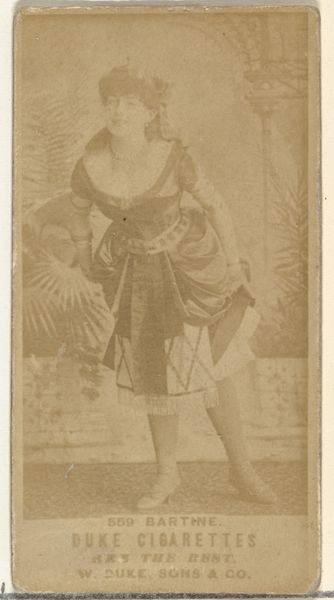
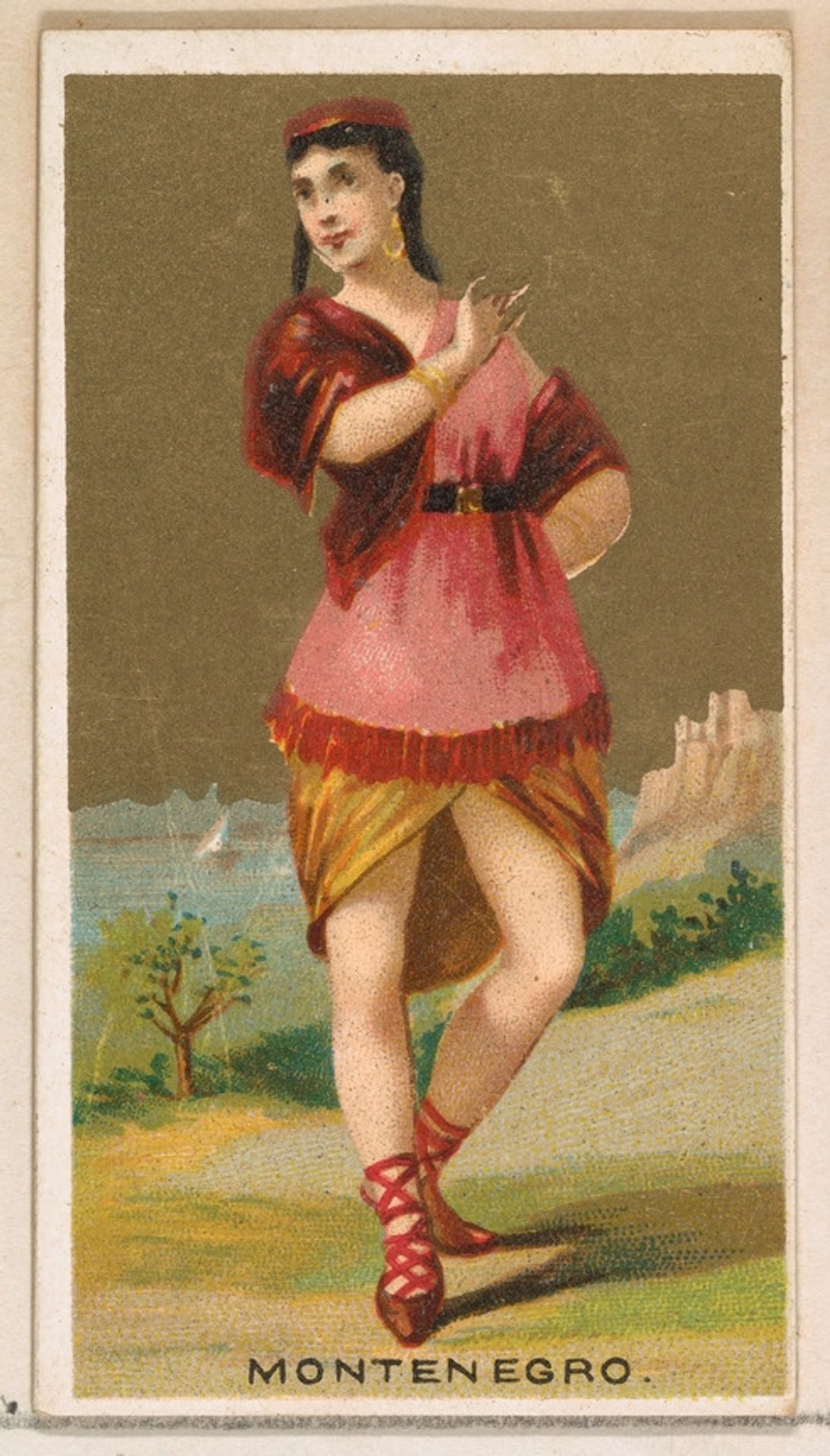
This color lithograph of a Montenegrin dancer comes from the Wm. S. Kimball & Co.’s “Dancing Girls of the World” series. The dancer’s raised hand, wrist bent elegantly, echoes gestures found in ancient Greek vase paintings, where it signified both ritual offering and the anticipation of sacred dance. Consider the echo of this motif through time, reappearing in Renaissance paintings as a symbol of grace and refined movement. It is a gesture we see again and again, a visual echo resonating through centuries, modified by each era, yet retaining its core association with beauty and poise. The motif's persistence reveals a deep-seated human appreciation for rhythmic expression. This simple gesture, laden with historical and cultural weight, evokes a sense of shared humanity and cultural memory. It is a reminder that art transcends temporal boundaries, connecting us to past traditions. The past is never truly gone but subtly reshaped and endlessly re-presented.
Montenegro, from the Dancing Girls of the World series (N185) issued by Wm. S. Kimball & Co.
1889

William S. Kimball & Company
@williamskimballcompany
The Metropolitan Museum of Art
Metropolitan Museum of Art, New York, NYArtwork details
- Medium
- drawing, print
- Dimensions
- Sheet: 2 11/16 × 1 1/2 in. (6.8 × 3.8 cm)
- Location
- Metropolitan Museum of Art, New York, NY
- Copyright
- Public Domain
Tags
Comments
Share your thoughts
About this artwork
This color lithograph of a Montenegrin dancer comes from the Wm. S. Kimball & Co.’s “Dancing Girls of the World” series. The dancer’s raised hand, wrist bent elegantly, echoes gestures found in ancient Greek vase paintings, where it signified both ritual offering and the anticipation of sacred dance. Consider the echo of this motif through time, reappearing in Renaissance paintings as a symbol of grace and refined movement. It is a gesture we see again and again, a visual echo resonating through centuries, modified by each era, yet retaining its core association with beauty and poise. The motif's persistence reveals a deep-seated human appreciation for rhythmic expression. This simple gesture, laden with historical and cultural weight, evokes a sense of shared humanity and cultural memory. It is a reminder that art transcends temporal boundaries, connecting us to past traditions. The past is never truly gone but subtly reshaped and endlessly re-presented.
Comments
Share your thoughts