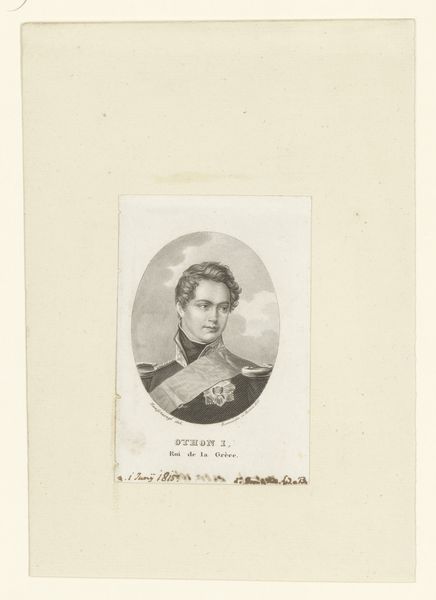
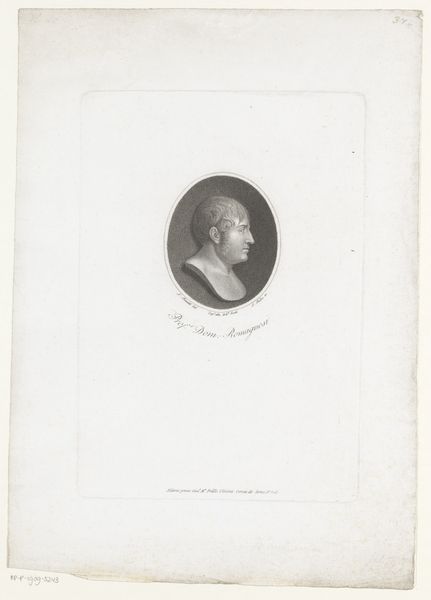
Portret van Adolphus Frederick, 1st Duke of Cambridge 1786 - 1836
0:00
0:00

johannfriedrichbolt
Rijksmuseum
engraving
#
portrait
#
neoclacissism
#
academic-art
#
engraving
Dimensions: height mm, width mm
Copyright: Rijks Museum: Open Domain
Editor: Here we have Johann Friedrich Bolt’s engraving of Adolphus Frederick, 1st Duke of Cambridge, created sometime between 1786 and 1836. It's…stately, certainly. Given the medium, I'm curious: how do you read this portrait through a material lens? Curator: Well, first off, it's crucial to acknowledge the implications of "engraving" here. It signals a reproductive medium, fundamentally about disseminating an image widely, democratizing access to a royal portrait. Consider the labor involved: Bolt meticulously carving the image into a metal plate, each line a testament to skilled craft, a form of controlled mechanical reproduction intended to portray and also solidify social status. Editor: So the medium itself becomes a comment on class and its portrayal? Curator: Precisely! Think about who consumed these prints. Were they adorning aristocratic drawing rooms, or finding their way into the homes of the burgeoning middle class? The availability of the image alters its significance, blurring the lines between the unique aura of a painted portrait and the reproducible nature of the printed image. This isn’t just about capturing likeness; it's about mass-producing and distributing a carefully curated image of power. The relative cheapness of this artwork would have shaped how many individuals could lay claim to being knowledgeable about the Duke. What social impact do you think such dissemination created? Editor: I guess, widespread ownership could give the impression that powerful people such as Adolphus Frederick are close, normal. Making it harder to critique decisions made by a distant leader. Curator: Exactly. Understanding how Bolt manipulated material processes opens up pathways for understanding social aspirations and power dynamics of the time. An artist like Bolt relied on a market keen to have images like these available in relatively large quantities, speaking to that audience and economy can give valuable insight. Editor: I see that now. I was initially focused on the subject, but shifting to the *how* and *why* of its production and dissemination provides a much richer understanding. Thank you! Curator: Absolutely! And in doing so, you resist replicating historical power imbalances. Materiality matters.
Comments
No comments
Be the first to comment and join the conversation on the ultimate creative platform.
 Collect
 React
React Comment
More like this