About this artwork
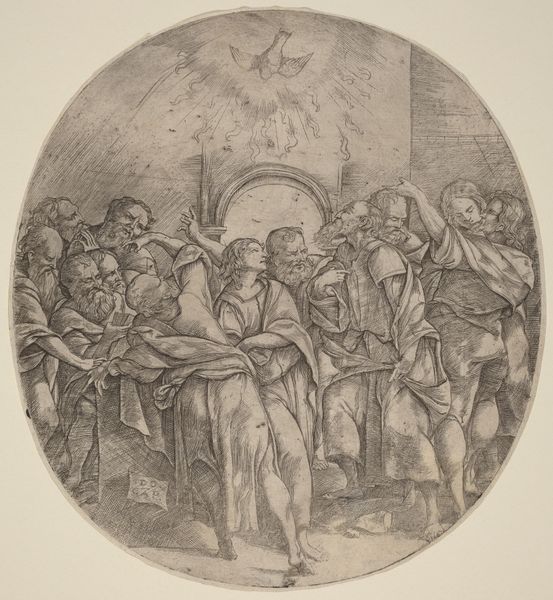
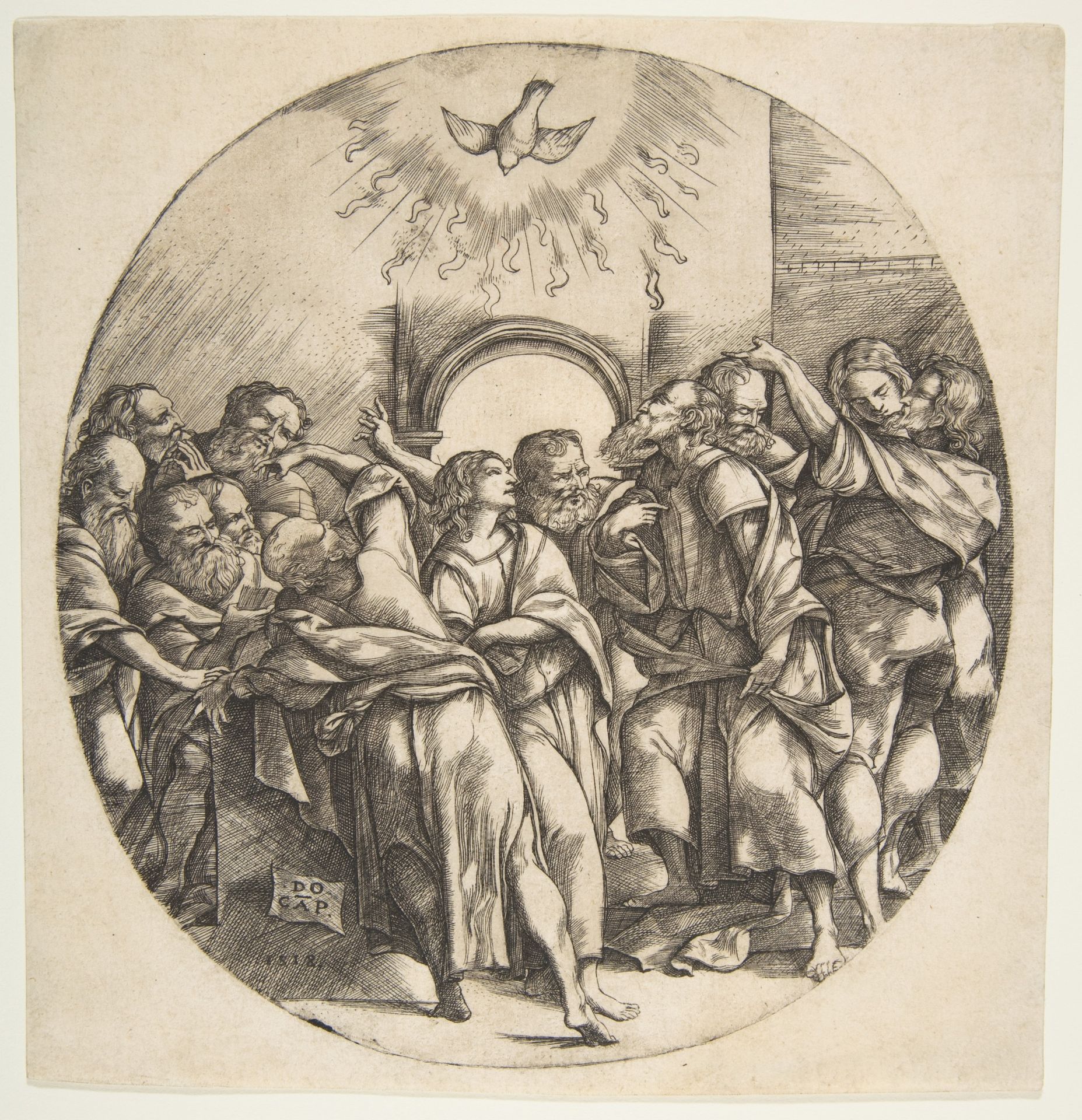
Domenico Campagnola made this print of the Holy Spirit descending upon the Apostles in sixteenth-century Italy. The image captures the biblical moment of Pentecost, a foundational narrative of the Christian church. Campagnola's print offers insight into the religious and social context of its time. In the 1500s the Catholic Church faced growing challenges to its authority. Visual imagery became a battleground. Artists were called upon to reinforce traditional doctrines through art. Here, the dove, a symbol of divine presence, descends amidst rays of light, energizing the apostles. The setting—a classical archway—places this miraculous event within a framework of established authority, merging religious and institutional power. By studying such prints and their histories, we can better understand the complex interplay between art, religion, and society in the early modern world. Through resources, like theological treatises and records of the period, we are able to see how these images promoted and were influenced by religious institutions.
The Holy Spirit as a bird descending with spread wings at top center; the twelve Apostles standing below gesturing to it in front of an archway
1518

Domenico Campagnola
1500 - 1564
The Metropolitan Museum of Art
Metropolitan Museum of Art, New York, NYArtwork details
- Medium
- drawing, print, etching
- Dimensions
- Plate: 7 3/8 x 6 7/8 in. (18.7 x 17.5 cm) Sheet: 7 5/8 × 7 11/16 in. (19.4 × 19.5 cm)
- Location
- Metropolitan Museum of Art, New York, NY
- Copyright
- Public Domain
Tags
Comments
Share your thoughts
About this artwork
Domenico Campagnola made this print of the Holy Spirit descending upon the Apostles in sixteenth-century Italy. The image captures the biblical moment of Pentecost, a foundational narrative of the Christian church. Campagnola's print offers insight into the religious and social context of its time. In the 1500s the Catholic Church faced growing challenges to its authority. Visual imagery became a battleground. Artists were called upon to reinforce traditional doctrines through art. Here, the dove, a symbol of divine presence, descends amidst rays of light, energizing the apostles. The setting—a classical archway—places this miraculous event within a framework of established authority, merging religious and institutional power. By studying such prints and their histories, we can better understand the complex interplay between art, religion, and society in the early modern world. Through resources, like theological treatises and records of the period, we are able to see how these images promoted and were influenced by religious institutions.
Comments
Share your thoughts