1890 - 1895
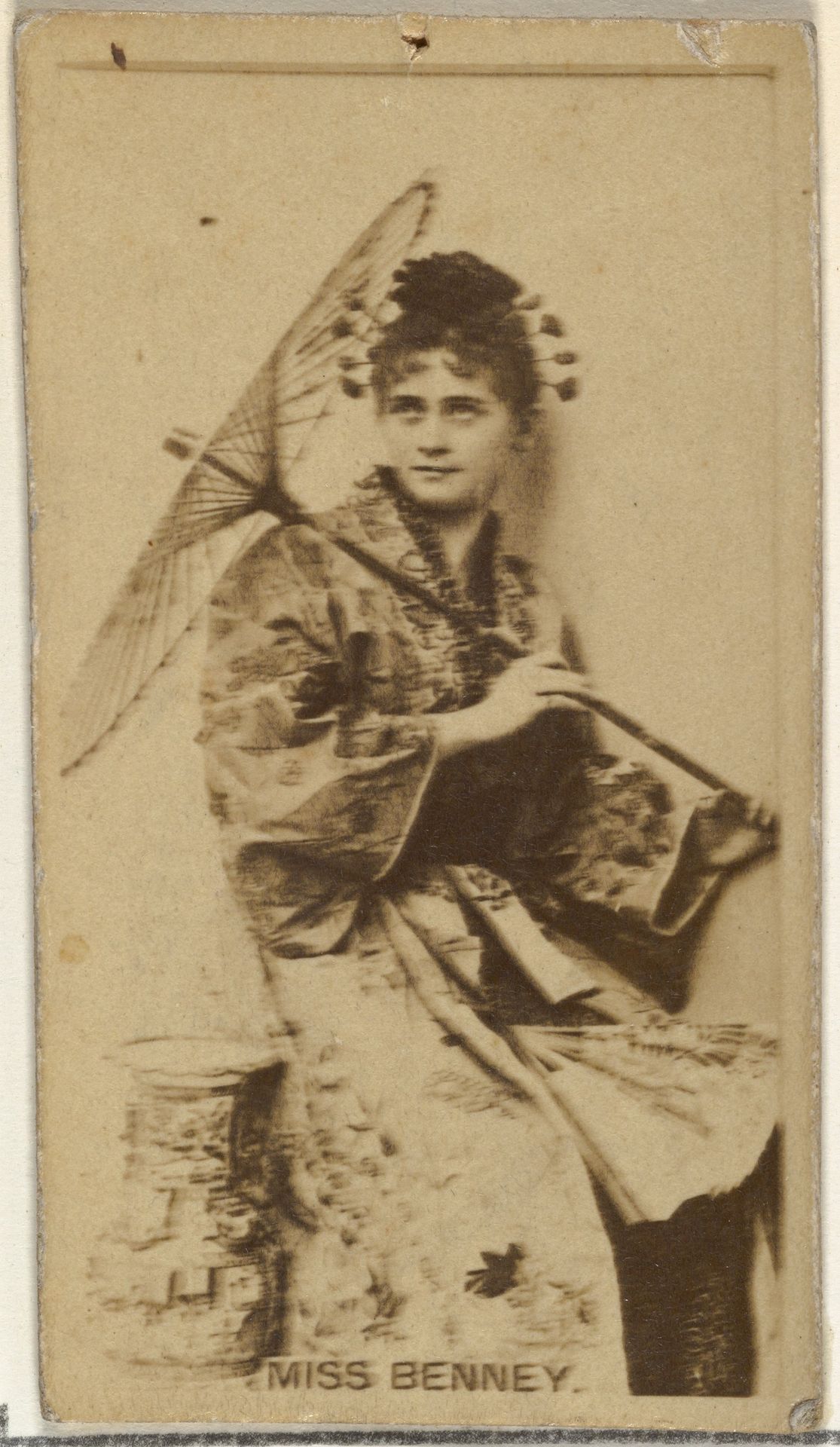
Miss Benney, from the Actors and Actresses series (N145-8) issued by Duke Sons & Co. to promote Duke Cigarettes

W. Duke, Sons & Co.
1870 - 1920
The Metropolitan Museum of Art
Metropolitan Museum of Art, New York, NYListen to curator's interpretation
Curatorial notes
Curator: Looking at "Miss Benney, from the Actors and Actresses series," it’s fascinating to see how Duke Sons & Co. used imagery in their cigarette cards. This one dates from between 1890 and 1895. Editor: Oh, my gosh, it's giving me major geisha vibes! A touch theatrical and dreamy with her flowered kimono, ornate umbrella, the barely-there smile... Curator: The influence of Japonisme is so clear. Notice how the aesthetic embraces Ukiyo-e, the Japanese woodblock print style, and mixes it with modern portraiture, meant to highlight performers like Miss Benney in popular culture. Editor: It feels a little... kitschy? Like someone’s idea of exotic, painted over with Victorian values, all tidied up into a neat little package to sell cigarettes, right? What's that odd little stool thing on the lower left? Curator: Absolutely! These cards reflect not just artistic trends but cultural appropriation. The ‘exotic’ was a commodity, a brand, as much as the cigarettes. Also, consider how an actress playing at being exotic reinforced stereotypes for the intended consumers of Duke Cigarettes. The faux-Japanese aesthetic becomes its own thing: a cultural hybrid that also perpetuated social norms, consumerism, and gendered images. I'm no expert on furniture history, but it almost resembles an eroded classical capital or base. Editor: Well, the poor actress. Talk about being framed! All dolled up for a smoke ad! Now, as to the symbolism... The kimono suggests an orientalised stage identity. I read it like someone playing with the exotic otherness—sort of trapped, isn't she? Even those gorgeous blooms end up functioning as a brand! And do the patterns of the garment somehow allude to a character the actress played? Or something the brand created? It’s interesting to think of that parasol as a defense and projection—of protecting or of showing to others. Curator: What strikes me most is the flattening of global cultures into these cards. Cultural memories condense and simplify into collectible portraits divorced from real narratives—simplified down to exotic tropes. Editor: These kinds of ads tell as much about an industry of performers—as the culture making it. But I want one. This thing is oddly intriguing.