Dimensions: height 86 mm, width 175 mm
Copyright: Rijks Museum: Open Domain
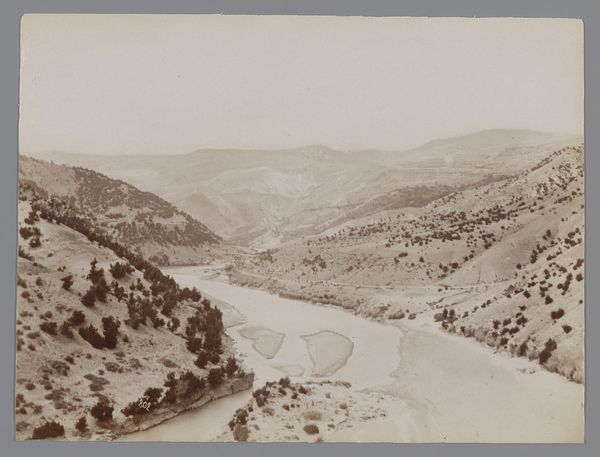
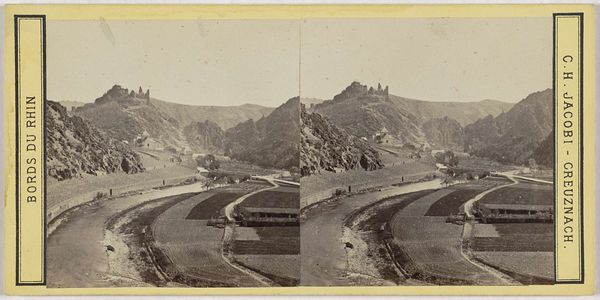
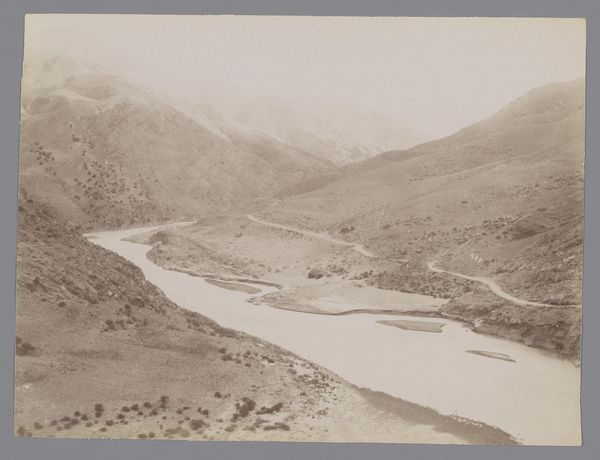
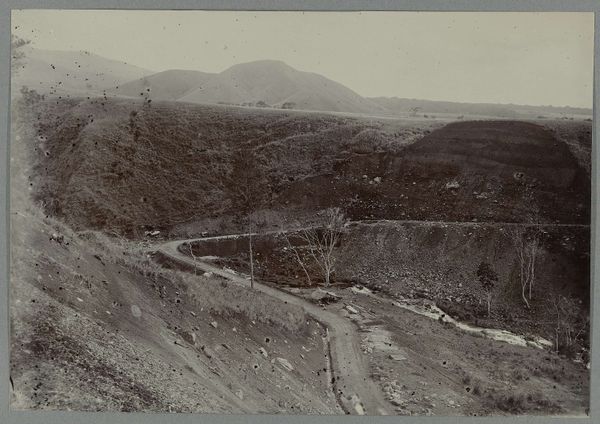
Editor: Here we have "Gezicht op het Ahrdal, Duitsland" – or, "View of the Ahr Valley, Germany" – taken sometime between 1869 and 1872, a photographic print by Johann Friedrich Stiehm. It strikes me as an oddly staged landscape; there's something almost theatrical about the composition with the river snaking through. What do you see in this piece, focusing on its visual elements? Curator: Immediately apparent is the interplay of light and shadow. The photographer utilizes a limited tonal range to accentuate the steep valley walls. The snaking river, you note, acts as a visual guide, leading the eye through the carefully structured composition. Consider the formal contrast between the textured, almost chaotic, rendering of the landscape and the clean, ordered lines of the river. What might this signify? Editor: Perhaps the tension between nature’s raw state and man’s attempts to impose order upon it? Is that reflected also in the perspective and its effect of compressing space? Curator: Indeed. The elevated perspective flattens the landscape, compressing depth and foregrounding the intricate patterns and lines. The photographer isn’t merely recording a scene; he's consciously arranging visual elements to construct a particular aesthetic experience. Notice how the repetition of forms, the echoed curves of the river and the valley, create a sense of visual harmony. Editor: So it’s less about geographical documentation and more about an exercise in form and composition using the landscape as its raw material? I’m beginning to see it differently. Curator: Precisely. By isolating and manipulating the visual elements, Stiehm transcends simple representation and offers us a study in line, texture, and spatial organization. A landscape re-imagined. Editor: That is incredibly insightful! Thanks; I now see the artistry far more clearly.
Comments
No comments
Be the first to comment and join the conversation on the ultimate creative platform.
 Collect
 React
React Comment
More like this