About this artwork
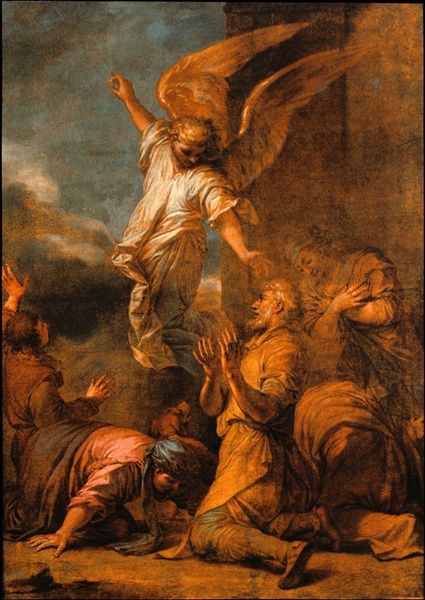
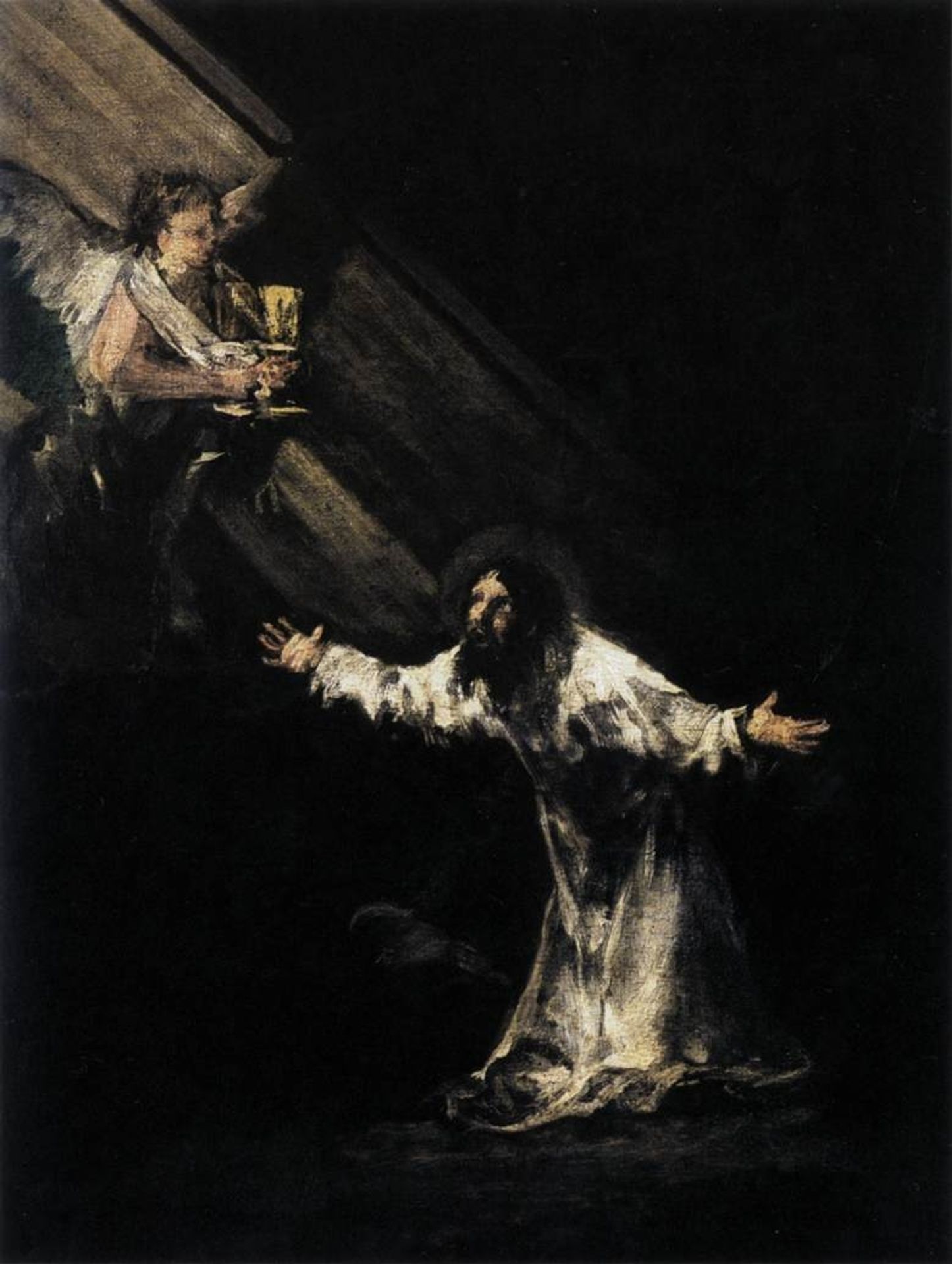
Curator: Goya's charcoal drawing, "Christ on the Mount of Olives," created around 1819, immediately strikes me as an emotionally turbulent scene. The darkness almost swallows everything. Editor: The almost monochromatic charcoal adds to that sense of foreboding, doesn't it? I'm interested in the artistic process itself here, you know. The choice of charcoal feels deliberate, grounding a pivotal spiritual moment in raw materiality. Goya seems to pull transcendence from earthbound carbon. Curator: Absolutely. But think of the loaded imagery at play. The angel, offering the cup, signifies Christ's impending sacrifice – it's heavy with theological meaning, evoking centuries of art historical precedent where the chalice carries associations of blood and covenant. The divine intervention within such an isolated scene carries a weighty burden of faith, wouldn't you say? Editor: Indeed. I see a correspondence between the cup the angel bears, as a vessel, and the charcoal itself as a manufactured tool, or 'technology' – facilitating artistic transmission of Goya’s personal visions to the masses. He created drawings like these as mass-produced lithographs for wider audiences—challenging art's traditionally elite associations. Curator: Yes, lithographs disseminated to a wider audience certainly shifted perceptions. Yet, going back to the original image itself, the looming darkness speaks volumes about Goya's state of mind – a reflection of the sociopolitical anxieties pervading Spain at that time, wouldn't you agree? Editor: I wonder too how charcoal allowed for easier revisions compared to oil paints, revealing aspects of labor typically hidden within art-making. In doing so, did this become a conscious effort to make the art creation experience more visceral for his audience and himself, by using humble tools accessible for reproduction by all? Curator: It's intriguing to consider that aspect. It invites such questions. In terms of our shared viewing experience of it now though, I walk away deeply moved by Goya’s poignant depiction of faith in a time of uncertainty. Editor: And I'm left contemplating how readily accessible materials and multiplying technologies help disseminate creative expression—connecting human labor to timeless themes.
Christ on the Mount of Olives
1819

Francisco de Goya
1746 - 1828Location
Escuelas Pías de San Antón, Madrid, SpainArtwork details
- Medium
- drawing, charcoal
- Dimensions
- 47 x 35 cm
- Location
- Escuelas Pías de San Antón, Madrid, Spain
- Copyright
- Public domain
Tags
Comments
 ❤️
❤️It makes me happy when people make art about Jesus
About this artwork
Curator: Goya's charcoal drawing, "Christ on the Mount of Olives," created around 1819, immediately strikes me as an emotionally turbulent scene. The darkness almost swallows everything. Editor: The almost monochromatic charcoal adds to that sense of foreboding, doesn't it? I'm interested in the artistic process itself here, you know. The choice of charcoal feels deliberate, grounding a pivotal spiritual moment in raw materiality. Goya seems to pull transcendence from earthbound carbon. Curator: Absolutely. But think of the loaded imagery at play. The angel, offering the cup, signifies Christ's impending sacrifice – it's heavy with theological meaning, evoking centuries of art historical precedent where the chalice carries associations of blood and covenant. The divine intervention within such an isolated scene carries a weighty burden of faith, wouldn't you say? Editor: Indeed. I see a correspondence between the cup the angel bears, as a vessel, and the charcoal itself as a manufactured tool, or 'technology' – facilitating artistic transmission of Goya’s personal visions to the masses. He created drawings like these as mass-produced lithographs for wider audiences—challenging art's traditionally elite associations. Curator: Yes, lithographs disseminated to a wider audience certainly shifted perceptions. Yet, going back to the original image itself, the looming darkness speaks volumes about Goya's state of mind – a reflection of the sociopolitical anxieties pervading Spain at that time, wouldn't you agree? Editor: I wonder too how charcoal allowed for easier revisions compared to oil paints, revealing aspects of labor typically hidden within art-making. In doing so, did this become a conscious effort to make the art creation experience more visceral for his audience and himself, by using humble tools accessible for reproduction by all? Curator: It's intriguing to consider that aspect. It invites such questions. In terms of our shared viewing experience of it now though, I walk away deeply moved by Goya’s poignant depiction of faith in a time of uncertainty. Editor: And I'm left contemplating how readily accessible materials and multiplying technologies help disseminate creative expression—connecting human labor to timeless themes.
Comments
❤️It makes me happy when people make art about Jesus