
Curatorial notes
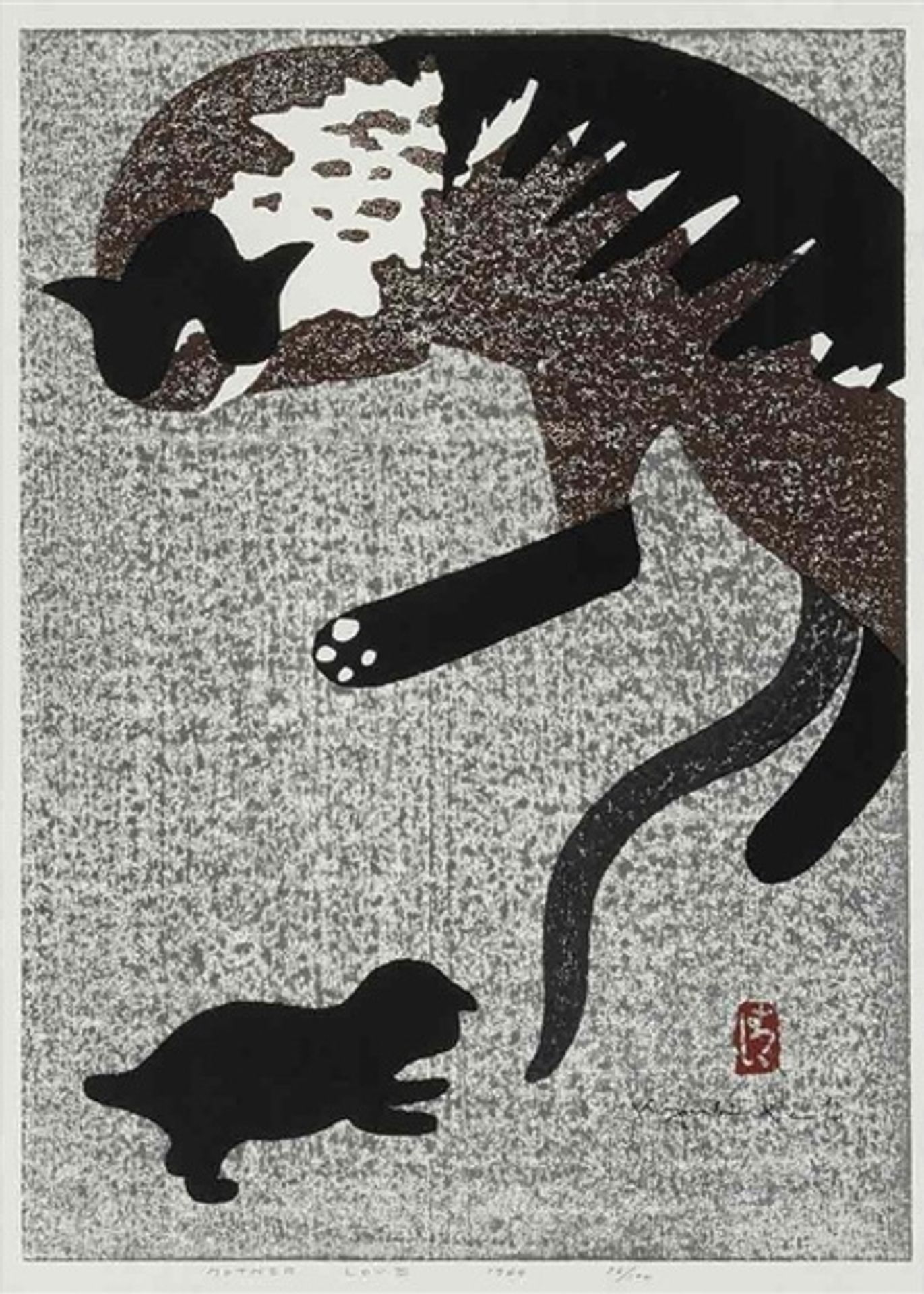
Editor: This is Kiyoshi Saito’s “Mother Love,” created in 1964. It’s a woodblock print showing a cat and kitten. I find the use of simplified shapes really charming, almost like a child’s drawing. What stands out to you? Curator: The reduction of form to geometric shapes is quite compelling. Notice how Saito utilizes a limited palette of blacks, whites, and grays. The textural variation achieved within these constraints—the speckled background, the solid blocks of color—creates a surprising visual depth. Editor: Yes, it’s flat, but not flat at all! The lines also give a sense of movement and energy. The dangling limb of the mother is visually captivating. It seems almost playful. How does the composition play into the emotional content? Curator: Precisely. The implied lines, especially the gaze and implied downward motion, create a strong sense of connection between the two cats. Semiotically, we could interpret the strong vertical orientation of the mother as a protective presence over her dependent, rendered much smaller and in a solid, unwavering stance. There's a structural interplay of scale and direction. The mother almost disappears into a geometric landscape, emphasizing a natural phenomenon. Editor: So it's more than just a simple image of a cat and kitten. Curator: Indeed. Through a deliberate arrangement of form, color, and line, Saito constructs a visual discourse on maternal protection within the visual vocabulary that flirts with semi-abstraction while evoking Japanese woodblock-print aesthetics. It allows the image to exist somewhere between pure form and pure subject, which amplifies, rather than reduces, the viewing experience. Editor: I never thought about the vertical and horizontal emphasis. Thanks, I'll definitely look at woodblock prints differently now.