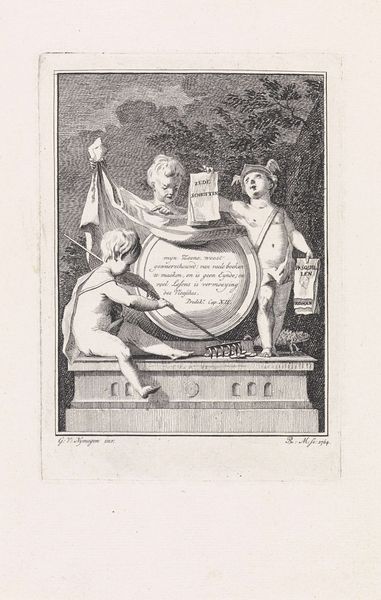
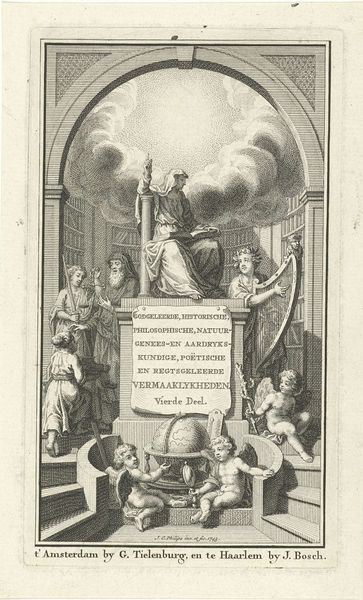
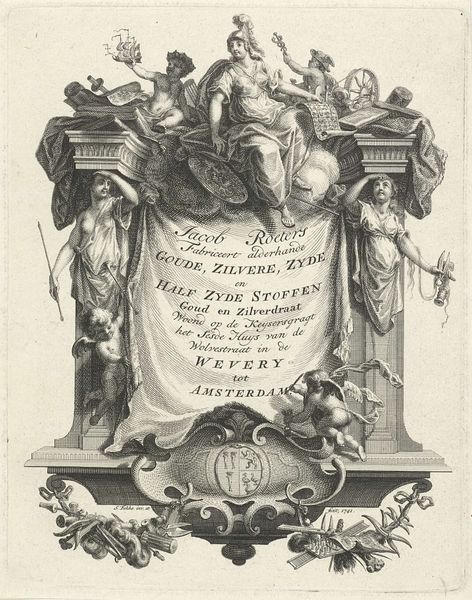
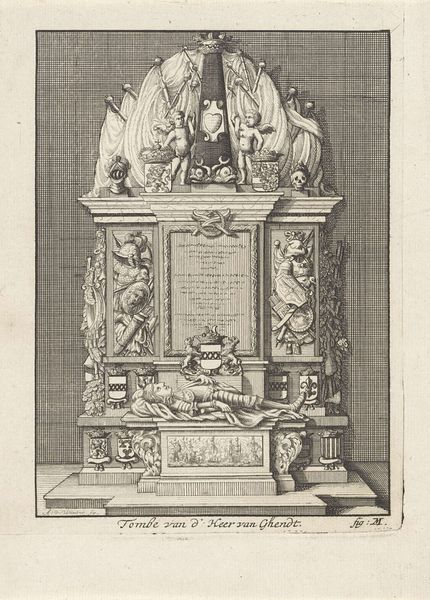
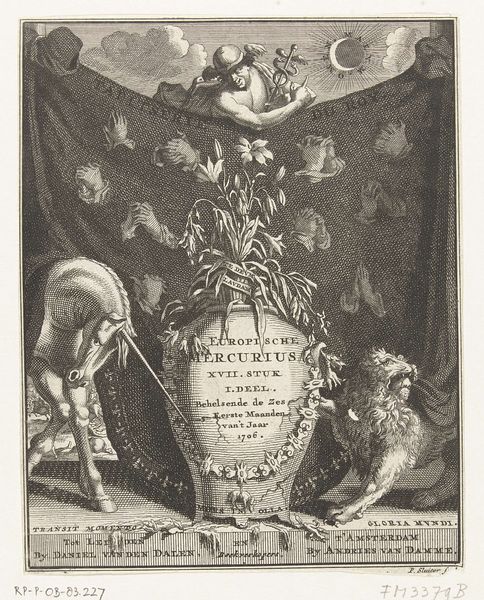
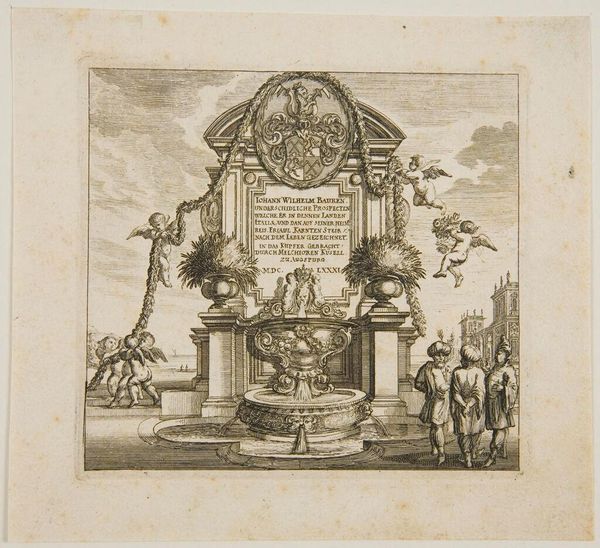
Titelpagina voor: Nederland in verbond met Frankrijk. 10 november 1785 1786
0:00
0:00

reiniervinkeles
Rijksmuseum
drawing, print, ink, engraving
#
drawing
#
allegory
#
dutch-golden-age
#
neoclassicism
# print
#
ink
#
history-painting
#
engraving
Dimensions: height 191 mm, width 112 mm
Copyright: Rijks Museum: Open Domain
Editor: This is "Titelpagina voor: Nederland in verbond met Frankrijk. 10 november 1785," made in 1786 by Reinier Vinkeles. It's an engraving in ink. The composition is quite symmetrical, and it feels celebratory, but there’s a formality to it as well. How do you interpret this work? Curator: Well, let's consider the historical context. This piece commemorates an alliance, a political maneuver. But who benefits from this alliance, and who is potentially marginalized or exploited by it? Look at the figures of the putti—are they truly celebratory figures, or do they represent the manipulated public, blindly supporting a treaty they may not fully understand the implications of? What's visually presented as national pride can obscure underlying power dynamics, don't you think? Editor: That's a good point! I was just seeing cherubic figures, but now I'm considering their potential as symbols of something more complex, more conflicted. The title is literally 'The Netherlands in alliance with France.' Could the artist be subtly questioning that alliance? Curator: Exactly! And consider the symbolism employed here – are they symbols of true partnership, or tools used to manufacture consent? We need to be critically aware of how visual language functions within specific socio-political environments, particularly when dealing with representations of power. Do the symbols and figures challenge the established notions, or merely reinforce existing structures? Editor: This makes me think differently about how prints can be deployed for very specific reasons related to a time period's cultural values, not just decorative ones. I now realize how limited my reading of the artwork was to its aesthetic surface. Curator: It is about thinking how art participates and responds to broader political struggles and ideological frameworks, shaping or resisting social change. Looking beneath the surface is the crucial first step!
Comments
No comments
Be the first to comment and join the conversation on the ultimate creative platform.
 Collect
 React
React Comment
More like this