Dimensions: image: 42.2 x 51.5 cm (16 5/8 x 20 1/4 in.) sheet: 31.2 x 43.1 cm (12 5/16 x 16 15/16 in.)
Copyright: National Gallery of Art: CC0 1.0
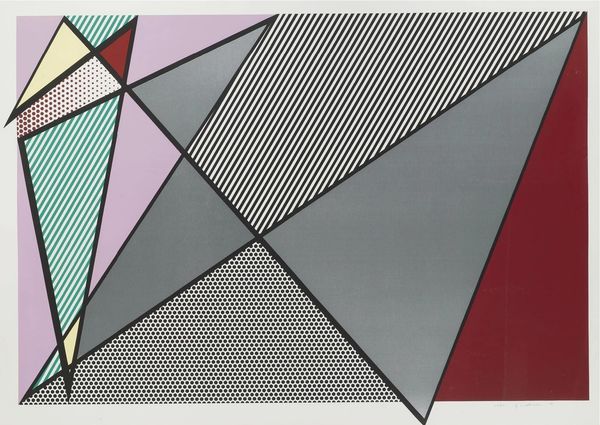
Curator: What strikes me immediately about this collage is its playful, almost chaotic energy. The juxtaposition of geometric forms with organic imagery is rather disarming. Editor: It does feel a bit unsettling, doesn’t it? Well, this print, created in 1986, is titled Velké století techniky, or "Great Century of Technology." It’s the work of Jaroslav Kaiser and combines elements of Cubism and Pop Art, typical of the period. Curator: Given that title, and the hard lines mixed with swirling ones, one wonders what visual stories they attempt to elicit as we advance further into the digital age. Perhaps it represents technological disruption. It could very well reference the optimism surrounding technological advancement but filtered through a distinctly socialist lens, don’t you think? Editor: Indeed. The geometric abstractions evoke a sense of both rigid structure and dynamic transformation, resonating, I think, with how technology was perceived in the Eastern Bloc at the time. A dialectical tool, if you will, that cuts in a double-edged way. Even something like that orchid hovering overhead--in what sense do technology and nature cohere? The inclusion of natural elements like the butterfly and the flower softens the overall composition. This isn't just cold, hard technology but also speaks to the environment. Curator: Absolutely. The orchid introduces this contrasting theme of vulnerability and ephemeral beauty to all that bold abstraction, offering some respite. Editor: The piece also makes use of varied optical illusions that render our perception unstable. When we look to understand our moment now, how do we reckon with images that reflect back what may be troubling about our era? I imagine some might call this aesthetic disquieting, even. Curator: The patterns and colliding geometries could also be read as the layered systems—both visible and invisible—that make technology possible and, maybe more importantly, increasingly unavoidable. I can also read this artwork in conversation with architectural rendering that attempts to show how natural environments mesh with built spaces. In some ways, they speak to our aspirations for technology's positive contribution to society, which makes it all the more disquieting to ponder about today. Editor: It offers a fascinating meditation on progress, beauty, and our relationship with a world reshaped by technological innovation. There is some comfort to be found here, yes?
Comments
No comments
Be the first to comment and join the conversation on the ultimate creative platform.
 Collect
 React
React Comment
More like this