About this artwork
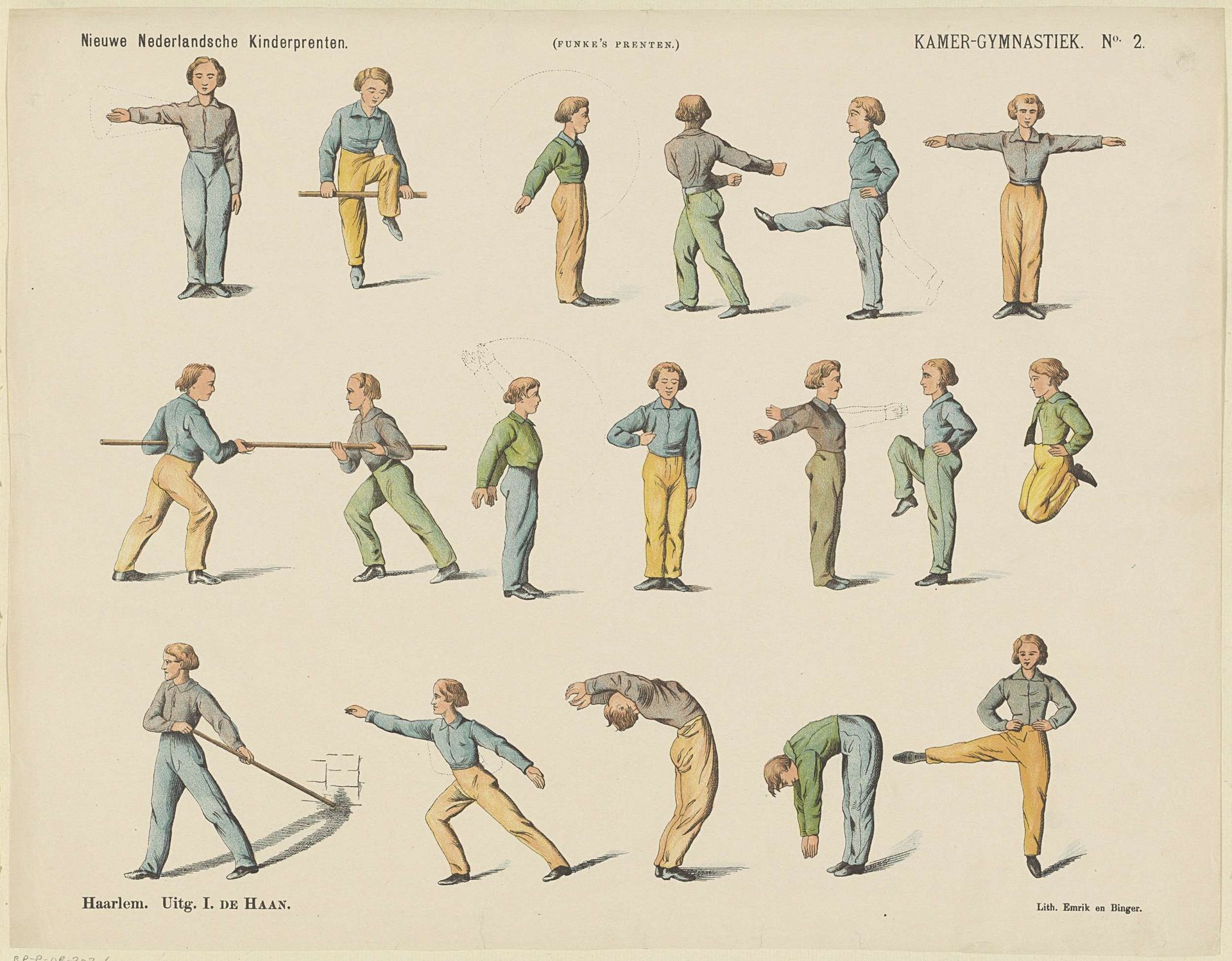
This print, "Kamer-gymnastiek No. 2" by Jan de Haan, presents a series of gymnastic poses. The most striking motif is the human body itself, engaged in various stretches and exercises, often aided by a rod. These poses, seemingly simple, echo ancient gestures of ritual and physical training. Consider the outstretched arms: we see it here as an exercise, but its roots lie in expressions of supplication or invocation found in religious art across cultures, from ancient Egyptian depictions of worship to Christian iconography of prayer. The act of stretching, bending, and balancing, when seen through the lens of cultural memory, becomes more than mere physical exercise. These movements resonate with the universal human need to understand and control our bodies, yet they also carry echoes of ritualistic and symbolic gestures passed down through generations. It's a testament to how physical acts can transcend their immediate purpose, engaging viewers on a deep, subconscious level. The body, after all, is a stage for our internal dramas.

Artwork details
- Medium
- lithograph, print
- Dimensions
- height 339 mm, width 439 mm
- Copyright
- Rijks Museum: Open Domain
Tags
Comments
Share your thoughts
About this artwork
This print, "Kamer-gymnastiek No. 2" by Jan de Haan, presents a series of gymnastic poses. The most striking motif is the human body itself, engaged in various stretches and exercises, often aided by a rod. These poses, seemingly simple, echo ancient gestures of ritual and physical training. Consider the outstretched arms: we see it here as an exercise, but its roots lie in expressions of supplication or invocation found in religious art across cultures, from ancient Egyptian depictions of worship to Christian iconography of prayer. The act of stretching, bending, and balancing, when seen through the lens of cultural memory, becomes more than mere physical exercise. These movements resonate with the universal human need to understand and control our bodies, yet they also carry echoes of ritualistic and symbolic gestures passed down through generations. It's a testament to how physical acts can transcend their immediate purpose, engaging viewers on a deep, subconscious level. The body, after all, is a stage for our internal dramas.
Comments
Share your thoughts