drawing, engraving
#
portrait
#
drawing
#
quirky sketch
#
allegory
#
baroque
#
pen drawing
#
pen illustration
#
pen sketch
#
figuration
#
ink line art
#
ink drawing experimentation
#
pen-ink sketch
#
line
#
pen work
#
sketchbook drawing
#
history-painting
#
engraving
#
fantasy sketch
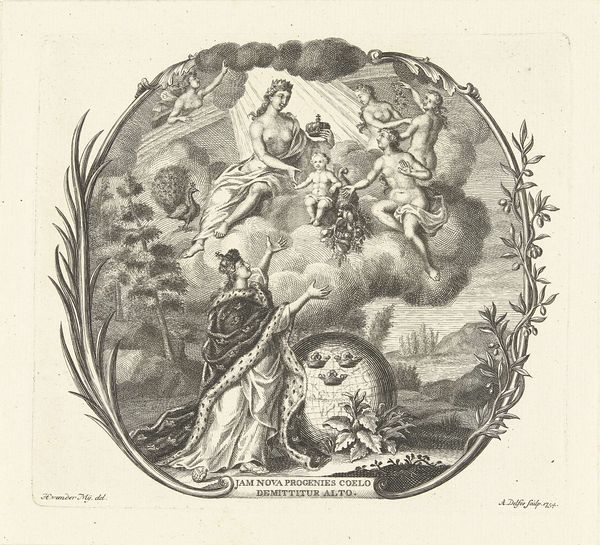
Dimensions: height 77 mm, width 78 mm
Copyright: Rijks Museum: Open Domain
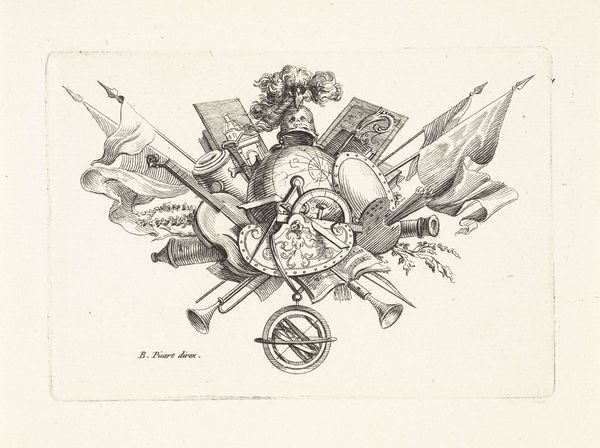
Editor: So, this is "Victoria Crowns a Field Commander," an engraving by Bernard Picart from 1720, currently at the Rijksmuseum. It’s a very elaborate drawing. What's striking to me is the dynamism – this commander on horseback with angels swirling above him. What do you see in this piece? Curator: What jumps out is how Picart represents power through the material elements. Consider the tools of warfare – the cannons, shields, spears scattered at the bottom. These are rendered almost carelessly, discarded in favor of celebrating the commander. We should ask, how does this representation mask the brutal labor required to produce these implements of war? Editor: That's an interesting angle. I was just seeing a triumphant image. You’re suggesting it glosses over something darker? Curator: Exactly! The material reality of war – the mining of metals, the forging of weapons, the sheer human cost – is absent. The glory is foregrounded, abstracting the brutal realities and turning the focus to a single figure and a romanticised process. Where’s the dirt? The sweat? Instead we have line, ink and paper. Consider the political machine *behind* the pen. Editor: So it’s a carefully constructed image promoting a specific, perhaps skewed, idea of victory? Curator: Precisely. It invites us to reflect on the construction of heroism. The material simplicity of the artwork belies the complex networks of power and production it obscures. Editor: That makes me look at it in a totally different light! Thanks, I now perceive so much more. Curator: My pleasure. I think, approaching art from a material perspective grants a much greater understanding of history, and labor.
Comments
No comments
Be the first to comment and join the conversation on the ultimate creative platform.
 Collect
 React
React Comment
More like this