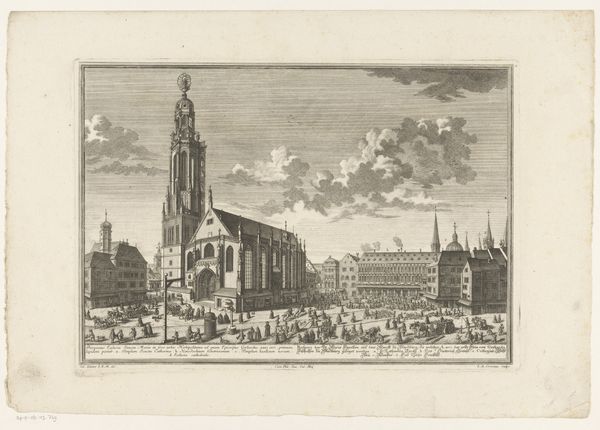
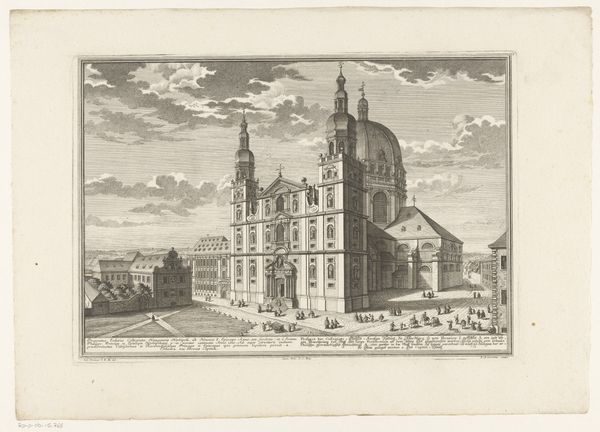
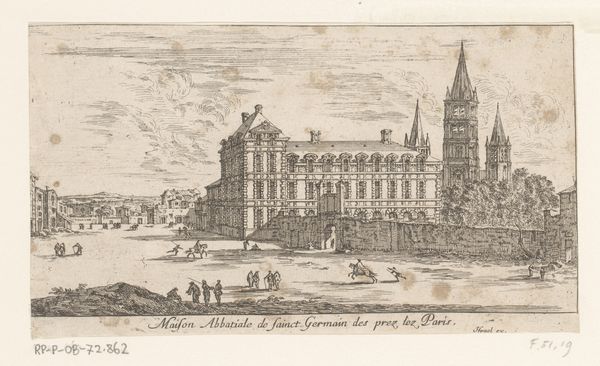
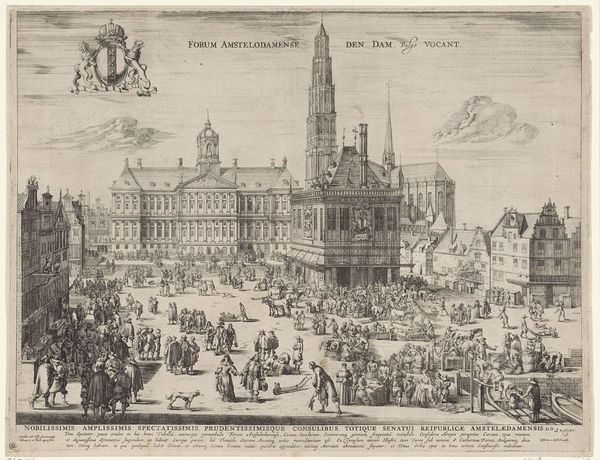
Gezicht op de stiftskerk in Würzburg, tegenwoordig bekend als de Neumünster 1740
0:00
0:00

johannaugustcorvinus
Rijksmuseum
print, engraving, architecture
#
baroque
# print
#
cityscape
#
engraving
#
architecture
Dimensions: height 285 mm, width 409 mm
Copyright: Rijks Museum: Open Domain
Editor: This is “View of the Collegiate Church in Würzburg, now known as the Neumünster,” an engraving by Johann August Corvinus, from around 1740. I’m really struck by the sheer amount of detail and how it captures the energy of the cityscape. What do you see in this piece? Curator: I see a careful articulation of power and faith, manifested in architectural form and urban space. Consider how the Baroque style – with its curves and embellishments – suggests dynamism, growth, earthly triumph and aspiration towards the divine. The church itself becomes a vessel, charged with symbolism. Editor: That’s interesting. The way it looms so large in the frame makes the figures in the foreground seem almost insignificant. Curator: Precisely. The figures, reduced in scale, animate the church, and also subtly represent human striving within a divinely ordained structure. Do you notice how the towers draw the eye upward? Think about their shape and symbolism; they act as a kind of cultural tuning fork to something greater. What emotions do they evoke? Editor: A sort of… hopeful aspiration, I suppose? Like a collective desire to reach beyond the everyday. Curator: That’s a keen observation. This engraving allows us a glimpse into the symbols of the 18th-century mindset and Baroque art: to inspire awe and ultimately direct people towards faith and understanding. It's also the historical memory. Editor: I hadn't really considered how loaded the image was with all that. It’s more than just a pretty picture of a building, it seems. Curator: Exactly. It’s a record, an idealization, and a powerful statement all at once. Editor: Well, I've definitely learned to look a bit deeper into the engravings now. Curator: Indeed, images speak volumes, don't they?
Comments
No comments
Be the first to comment and join the conversation on the ultimate creative platform.
 Collect
 React
React Comment
More like this